Tipos de Reacciones Químicas
Introducido| English | Significado |
|---|---|
| synthesis/ˈsɪnθəsɪs/ | síntesis |
| decomposition/ˌdiːkɒmpəˈzɪʃn/ | descomposición |
| combustion/kəmˈbʌstʃn/ | combustión |
Sorting reactions into families
- Countless reactions exist, but they fall into a few patterns.
- Two things join; one thing splits; partners swap.
- Spotting the pattern helps classify products; predicting whether a reaction occurs also needs chemical evidence such as solubility or reactivity.
- A handful of families covers most of what you will see.
Joining and splitting
- Synthesis 化合反应 combines two things into one ($A + B \to AB$).
- Decomposition 分解反应 breaks one thing into parts ($AB \to A + B$).
- They are exact opposites.
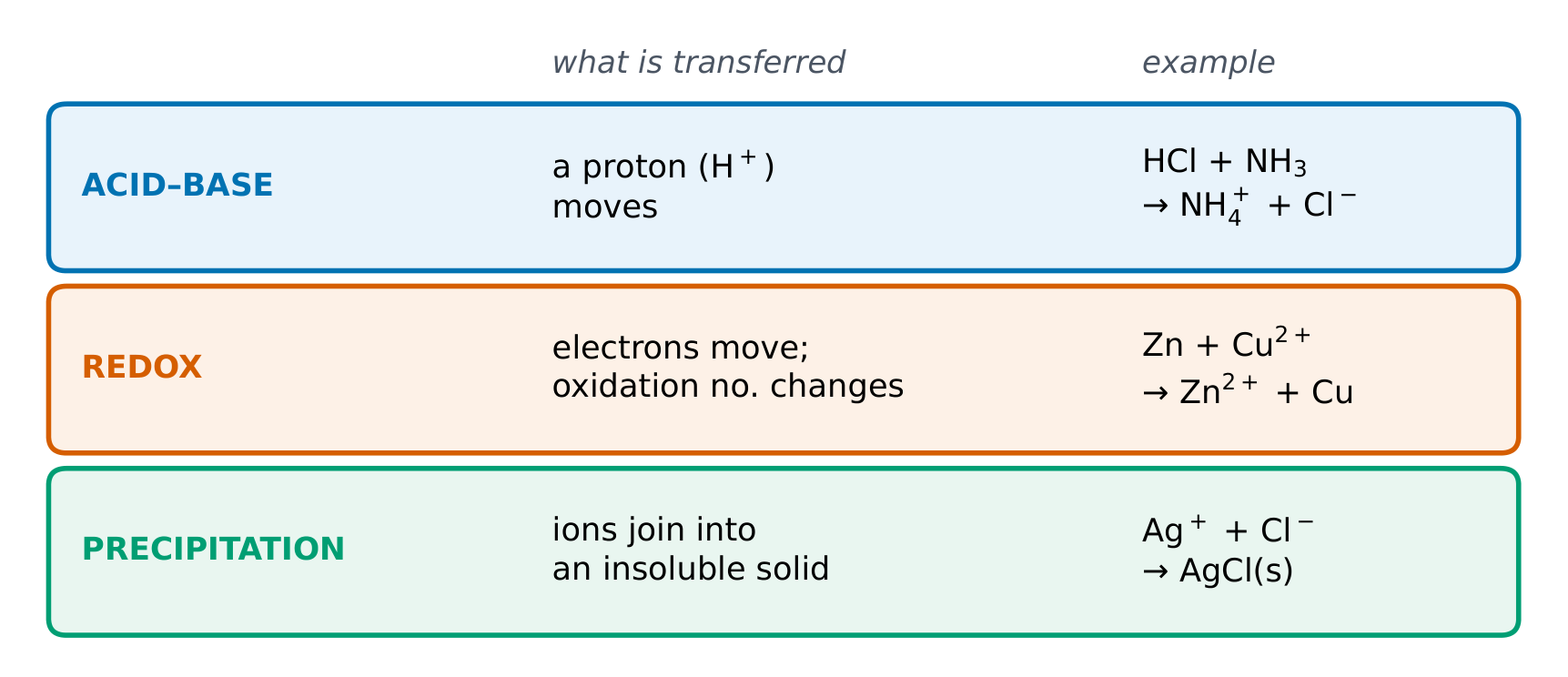
Acid-base reactions move protons; redox moves electrons; precipitation forms a solid
$A + B \to AB$ ¿es qué tipo de reacción?
Dificultad 1/5 · 100 monedas + un pequeño bono en el primer intento de hoy
Dos cosas combinándose en una es una síntesis.
$AB \to A + B$ ¿es qué tipo?
Dificultad 1/5 · 100 monedas + un pequeño bono en el primer intento de hoy
Un compuesto que se divide en partes es una descomposición.
Swapping partners
- Single replacement: one element kicks out another ($A + BC \to AC + B$).
- Double replacement: two compounds swap partners ($AB + CD \to AD + CB$).
- Many precipitation and acid–hydroxide neutralization equations fit double replacement; acid–base reactions can also transfer a proton without this pattern.
Emparejar cada patrón con su tipo de reacción.
Dificultad 2/5 · 140 monedas + un pequeño bono en el primer intento de hoy
Unir, dividir e intercambiar son síntesis, descomposición y doble sustitución.
Una reacción de precipitación, donde dos compuestos cambian socios, es una sustitución ____.
Dificultad 1/5 · 100 monedas + un pequeño bono en el primer intento de hoy
Dos compuestos intercambiando iones es una doble sustitución.
Burning in oxygen
- Combustion 燃烧反应 is a fuel reacting with oxygen and releasing energy.
- Complete hydrocarbon combustion in sufficient oxygen gives $\text{CO}_2$ and $\text{H}_2\text{O}$; limited oxygen can produce CO or carbon.
- It always needs $\text{O}_2$ and gives off heat.
Clasificar la reacción
Ordenar cada ecuación según su patrón de reacción.
Toda reacción de combustión requiere...
Dificultad 1/5 · 100 monedas + un pequeño bono en el primer intento de hoy
La combustión es un combustible reaccionando con oxígeno.
Classify $2\text{H}_2 + \text{O}_2 \to 2\text{H}_2\text{O}$.
- Two substances combine into one product, so it is a synthesis.
- It is also a combustion, since a fuel reacts with oxygen.
Una sola reacción puede pertenecer a más de un tipo.
Dificultad 1/5 · 100 monedas + un pequeño bono en el primer intento de hoy
La quema de hidrógeno es tanto síntesis como combustión.
Some reactions fit more than one family — hydrogen burning is both synthesis and combustion, and that is fine. Look at the pattern of reactants and products, not just the names. And combustion always involves oxygen; with no $\text{O}_2$, it is not combustion.
Most reactions fall into families: synthesis (join into one), decomposition (split apart), single and double replacement (swap partners), and combustion (fuel plus oxygen). Recognize the pattern to predict products, and remember a reaction can belong to more than one family.