Espectroscopía y el espectro electromagnético
Introducido| English | Significado |
|---|---|
| electromagnetic spectrum/ɪˌlektrəʊməɡˈnetɪk ˈspektrəm/ | espectro electromagnético |
Light as a ruler for matter
- Light is more than what our eyes can see.
- Radio waves, microwaves, and X-rays are all the same family.
- Shine the right kind on a substance and it responds.
- That response is a fingerprint of what is inside.
A family ordered by energy
- The electromagnetic spectrum 电磁波谱 runs from radio waves to gamma rays.
- As frequency rises, wavelength shrinks and energy grows.
- Visible light is only a thin slice in the middle.
¿Cuál tiene mayor energía?
Dificultad 1/5 · 100 monedas + un pequeño bono en el primer intento de hoy
La energía aumenta con la frecuencia; los rayos gamma tienen la frecuencia más alta.
La región visible es solo una pequeña ____ de todo el espectro.
Dificultad 1/5 · 100 monedas + un pequeño bono en el primer intento de hoy
La luz visible es una banda estrecha dentro de un espectro mucho más amplio.
Wavelength and frequency
- In a vacuum, all light travels at the same speed, $c = 3.0\times10^8\ \text{m/s}$.
- Wavelength and frequency are linked by $c = \lambda\nu$.
- A longer wavelength means a lower frequency.
La longitud de onda y la frecuencia son directamente proporcionales.
Dificultad 1/5 · 100 monedas + un pequeño bono en el primer intento de hoy
Falso. $c = \lambda\nu$ es constante, por lo que están relacionadas inversamente: una longitud de onda más larga significa una frecuencia más baja.
En el vacío, todas las ondas electromagnéticas viajan a...
Dificultad 1/5 · 100 monedas + un pequeño bono en el primer intento de hoy
Toda la luz comparte la velocidad $c = 3.0\times10^8\ \text{m/s}$ en el vacío.
Each region probes something
- Microwave photons can excite rotational transitions in suitable gas molecules; infrared photons can excite vibrational transitions.
- Ultraviolet and visible light move electrons between levels.
- Matching the light to the change is the heart of spectroscopy.
A través del espectro electromagnético
Desplácese desde las ondas de radio hasta los rayos gamma y vea cómo se relacionan la longitud de onda, la frecuencia y la energía.
Empareje cada tipo de luz con el cambio que provoca.
Dificultad 2/5 · 140 monedas + un pequeño bono en el primer intento de hoy
El IR vibra enlaces, la UV mueve electrones, las microondas rotan moléculas.
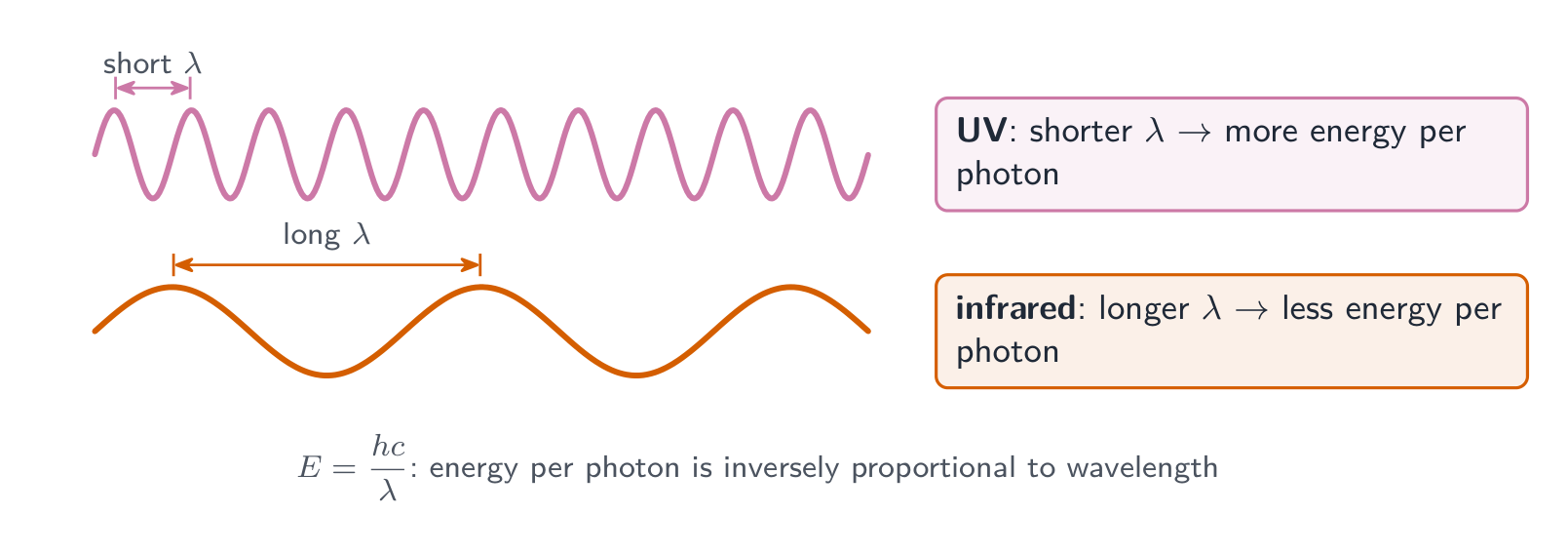
Which has more energy, a UV photon or an infrared photon?
- UV has a higher frequency (shorter wavelength) than infrared.
- Higher frequency means more energy, so UV wins.
En comparación con el infrarrojo, la luz ultravioleta tiene...
Dificultad 1/5 · 100 monedas + un pequeño bono en el primer intento de hoy
La UV tiene una longitud de onda más corta, por lo que mayor frecuencia y energía.
Frequency and wavelength are inversely related ($c = \lambda\nu$) — as one rises, the other falls. Higher frequency means shorter wavelength and higher energy, all together. Do not mix up the order: radio is low-energy, gamma is high-energy.
The electromagnetic spectrum orders light by energy, from radio to gamma, with $c = \lambda\nu$ tying wavelength and frequency together. Different regions probe different changes — microwaves can probe molecular rotation, infrared probes vibration, and UV-visible probes electronic transitions. Microwave heating of liquid water involves its response to the changing electric field, rather than isolated gas-phase rotational lines. That is how spectroscopy reads matter.