Separation of Solutions and Mixtures
Introducido| English | Significado |
|---|---|
| filtration/fɪlˈtreɪʃn/ | filtración |
| evaporation/ɪˌvæpəˈreɪʃn/ | evaporación |
| chromatography/krəʊməˈtɒɡrəfi/ | cromatografía |
| distillation/dɪstɪˈleɪʃn/ | destilación |
Pulling a blend apart
- A muddy river can be made clear again.
- Salt can be recovered from the sea by the sun.
- Ink can be split into its hidden colours.
- Each trick exploits one way the parts differ.
Filtration and evaporation
- Filtration 过滤 separates by particle size: solids are caught, liquid passes.
- Evaporation 蒸发 leaves a dissolved solid behind as solvent escapes from the surface; boiling is not required.
- Use filtration for undissolved solids, evaporation for dissolved ones.
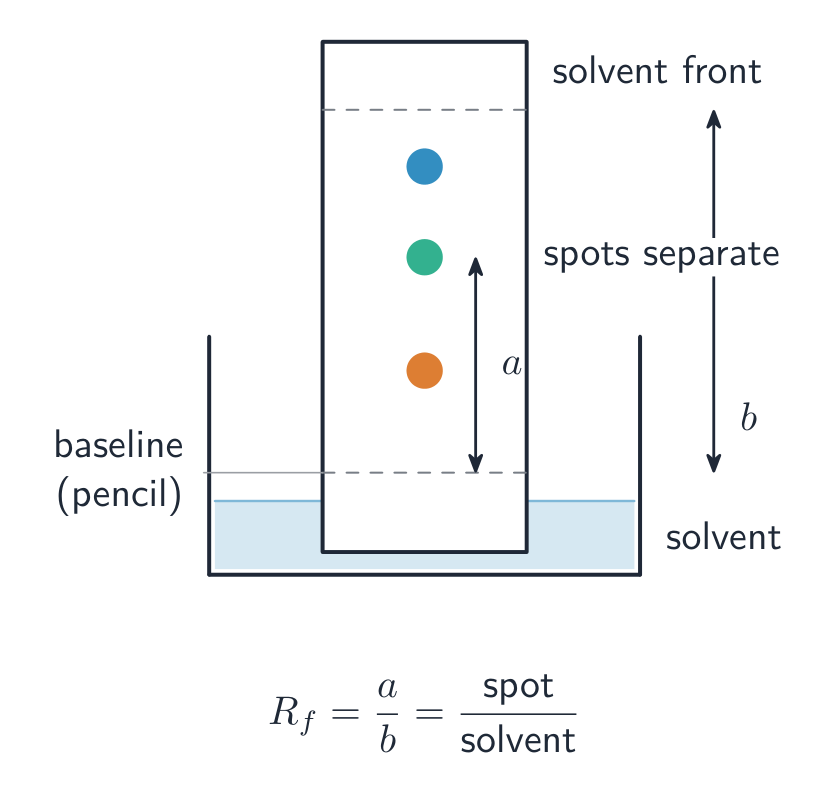
Paper chromatography 色谱法 separates a mixture as the solvent rises up the paper
Filtration separates a mixture based on differences in...
Dificultad 1/5 · 100 monedas + un pequeño bono en el primer intento de hoy
Large solids are trapped while liquid passes through the filter.
To recover dissolved salt from salt water while discarding the water, use...
Dificultad 1/5 · 100 monedas + un pequeño bono en el primer intento de hoy
Boiling off the water leaves the solid salt behind.
Distillation
- Distillation 蒸馏 separates liquids by their boiling points.
- For many mixtures, vapour is richer in the more volatile component; condensation collects an enriched distillate, not necessarily a pure liquid.
- Fractional distillation improves separation through repeated vaporization and condensation; an azeotrope limits ethanol–water separation by ordinary distillation.
To separate pure water from salt water, you would use...
Dificultad 1/5 · 100 monedas + un pequeño bono en el primer intento de hoy
Distillation boils off the water and re-condenses it, leaving salt behind.
Chromatography
- Chromatography separates by the relative attractions of each component to the stationary and mobile phases.
- The components travel at different speeds and spread out.
- Ink's dyes separate into a rainbow of bands.
Pick the separation method
Match each mixture to the technique that separates it, and the property it exploits.
Match each method to the property it uses.
Dificultad 2/5 · 140 monedas + un pequeño bono en el primer intento de hoy
Distillation = boiling point, filtration = size, chromatography = affinity.
Chromatography separates ink dyes because each travels at a different ____.
Dificultad 1/5 · 100 monedas + un pequeño bono en el primer intento de hoy
A component that interacts more strongly with the stationary phase relative to the mobile phase travels more slowly, so the dyes separate.
How would you get pure water from salt water?
- Distil it: boil the water off and re-condense the vapour.
- The salt stays behind, and the collected liquid is pure water.
Filtration can separate a dissolved solute from its solvent.
Dificultad 1/5 · 100 monedas + un pequeño bono en el primer intento de hoy
Dissolved particles pass through the filter; use evaporation or distillation.
Each method exploits one specific difference — size for filtration, boiling point for distillation, surface affinity for chromatography. Filtration cannot separate a dissolved solute (it passes through the filter); use evaporation or distillation for that. Match the method to the property that differs.
Separation methods each exploit a property difference: filtration by particle size, evaporation to recover a dissolved solid, distillation by boiling point, and chromatography by surface affinity. A dissolved solute passes through a filter, so recover it by evaporation or distillation instead.