Structure of Ionic Solids
Introducido| English | Significado |
|---|---|
| crystal lattice/ˈkrɪstl ˈlætɪs/ | red cristalina |
| lattice energy/ˈlætɪs ˈenədʒi/ | energía reticular |
A perfect repeating grid
- Magnesium oxide melts at 2852 °C, so it lines furnaces; sodium chloride melts at 801 °C. Both are ionic solids, so why are they so different?
- An ionic solid is a repeating crystal lattice 晶格 of ions. How strongly the ions attract sets its melting point and hardness.
The lattice
- An ionic solid is a crystal lattice 晶格 of alternating positive and negative ions.
- Each ion is surrounded by neighbours of the opposite charge.
- Strong electrostatic attraction locks the whole grid together.
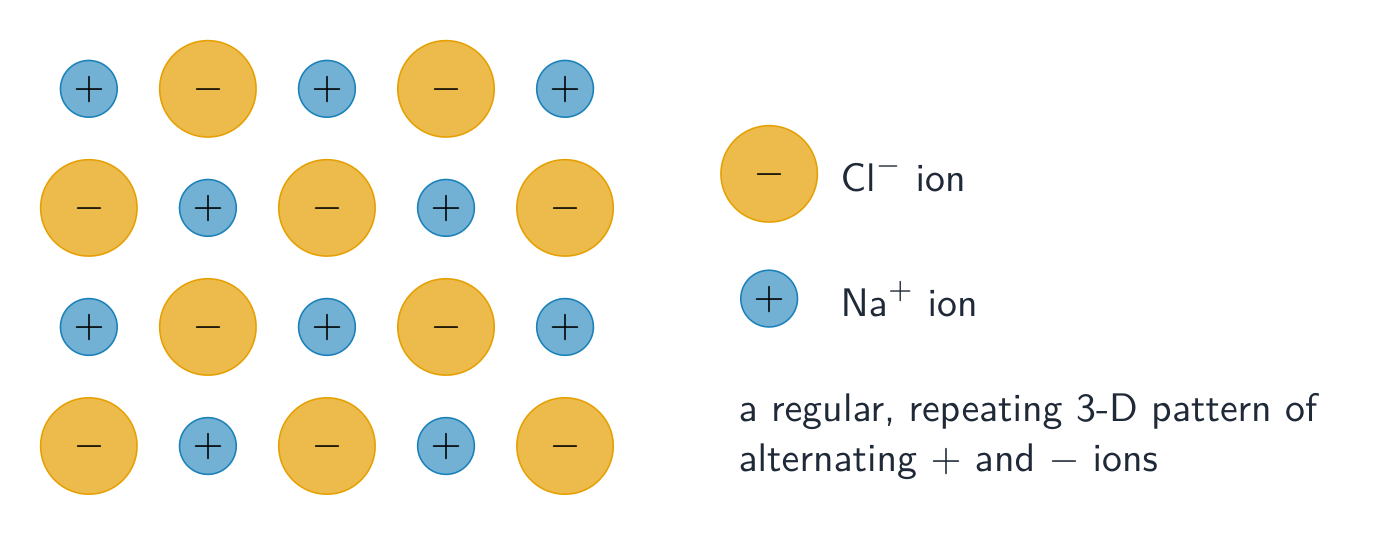
Ions pack into a giant lattice of alternating positive and negative ions
In an ionic lattice, each ion is surrounded by ions of the opposite charge.
Dificultad 1/5 · 100 monedas + un pequeño bono en el primer intento de hoy
Alternating opposite charges maximise attraction and stability.
Lattice energy
- Here lattice energy 晶格能 means the positive energy needed to separate one mole of an ionic solid into gaseous ions; formation uses the opposite sign.
- Higher charges and smaller ions give stronger attraction and higher lattice energy.
- Stronger attraction generally raises melting point; melting disrupts the lattice but does not separate every ion into the gas phase.
Which ionic compound has the higher lattice energy?
Dificultad 1/5 · 100 monedas + un pequeño bono en el primer intento de hoy
Larger charges attract far more strongly, so MgO has the higher lattice energy.
A higher lattice energy generally means a lower melting point.
Dificultad 1/5 · 100 monedas + un pequeño bono en el primer intento de hoy
False. More lattice energy holds the ions together more strongly, so more heat is needed to break the lattice: a higher melting point.
Lattice energy increases when the ion charges get ____.
Dificultad 1/5 · 100 monedas + un pequeño bono en el primer intento de hoy
Stronger charges attract more, raising the lattice energy.
Why ionic solids behave as they do
- High melting points: the strong grid is hard to break apart.
- Brittle: shift a layer and like charges meet and repel, cracking it.
- They conduct only when molten or dissolved, when the ions can move.
Dentro de un sólido iónico
Oppositely charged ions pack into a giant repeating lattice held by electrostatic forces.
An ionic solid conducts electricity...
Dificultad 1/5 · 100 monedas + un pequeño bono en el primer intento de hoy
Ions must be free to move -- that happens when melted or dissolved.
Why are ionic solids brittle?
Dificultad 1/5 · 100 monedas + un pequeño bono en el primer intento de hoy
A small shift brings like charges together; their repulsion cracks the crystal.
Which has the higher lattice energy, $\text{NaCl}$ or $\text{MgO}$?
- MgO has $2+$ and $2-$ ions; NaCl has $1+$ and $1-$.
- Bigger charges mean much stronger attraction, so MgO wins and melts far hotter.
Charge and size in real data
| Compound | Ion charges | Melting point / °C |
|---|---|---|
| NaF | +1, −1 | 993 |
| NaCl | +1, −1 | 801 |
| NaBr | +1, −1 | 747 |
| CaO | +2, −2 | 2613 |
| MgO | +2, −2 | 2852 |
- Coulomb's law: attraction $\propto \dfrac{|q_+q_-|}{r}$. Charge has the bigger effect; with equal charges, the smaller ions win.
Which compound has the highest melting point?
Dificultad 1/5 · 100 monedas + un pequeño bono en el primer intento de hoy
MgO has 2+ and 2− ions, so |q₊q₋| is four times larger, and the ions are small.
Same charges, different size. Explain why NaF melts higher than NaCl.
- Both have +1 and −1 ions, so $|q_+q_-|$ is the same. F⁻ (133 pm) is smaller than Cl⁻ (181 pm), so the ions in NaF are closer together.
- A smaller $r$ gives stronger Coulombic attraction, so NaF has the larger lattice energy and the higher melting point (993 °C against 801 °C).
Why does MgO have a larger lattice energy than CaO?
Dificultad 1/5 · 100 monedas + un pequeño bono en el primer intento de hoy
The charges are equal (+2, −2), so ion size decides: smaller r gives stronger Coulombic attraction.
- Ionic solids do not conduct as solids: the ions are fixed. They conduct when molten or dissolved.
- Compare charge first, then ion size: $|q_+q_-|/r$ decides, not charge alone.
- In an explanation, name Coulomb's law and say which ions are smaller or more highly charged.
An ionic solid is a crystal lattice of alternating ions held by strong electrostatic attraction. Its lattice energy — larger for higher charges and smaller ions — gives it a high melting point. It is brittle and conducts only when molten or dissolved, once the ions are free to move.