Intramolecular Force and Potential Energy
Introducido| English | Significado |
|---|---|
| potential energy/pəˈtenʃl ˈenədʒi/ | energía potencial |
| bond length/bɒnd leŋθ/ | longitud de enlace |
| bond energy/bɒnd ˈenədʒi/ | energía de enlace |
The perfect distance apart
- Push two bonded atoms too close and their nuclei repel. Pull them apart and the shared electrons pull them back. In between is a resting distance where the energy is lowest.
- One curve, potential energy against distance, shows all of this. AP asks you to read it, draw it and compare two of them.
The bond's energy curve
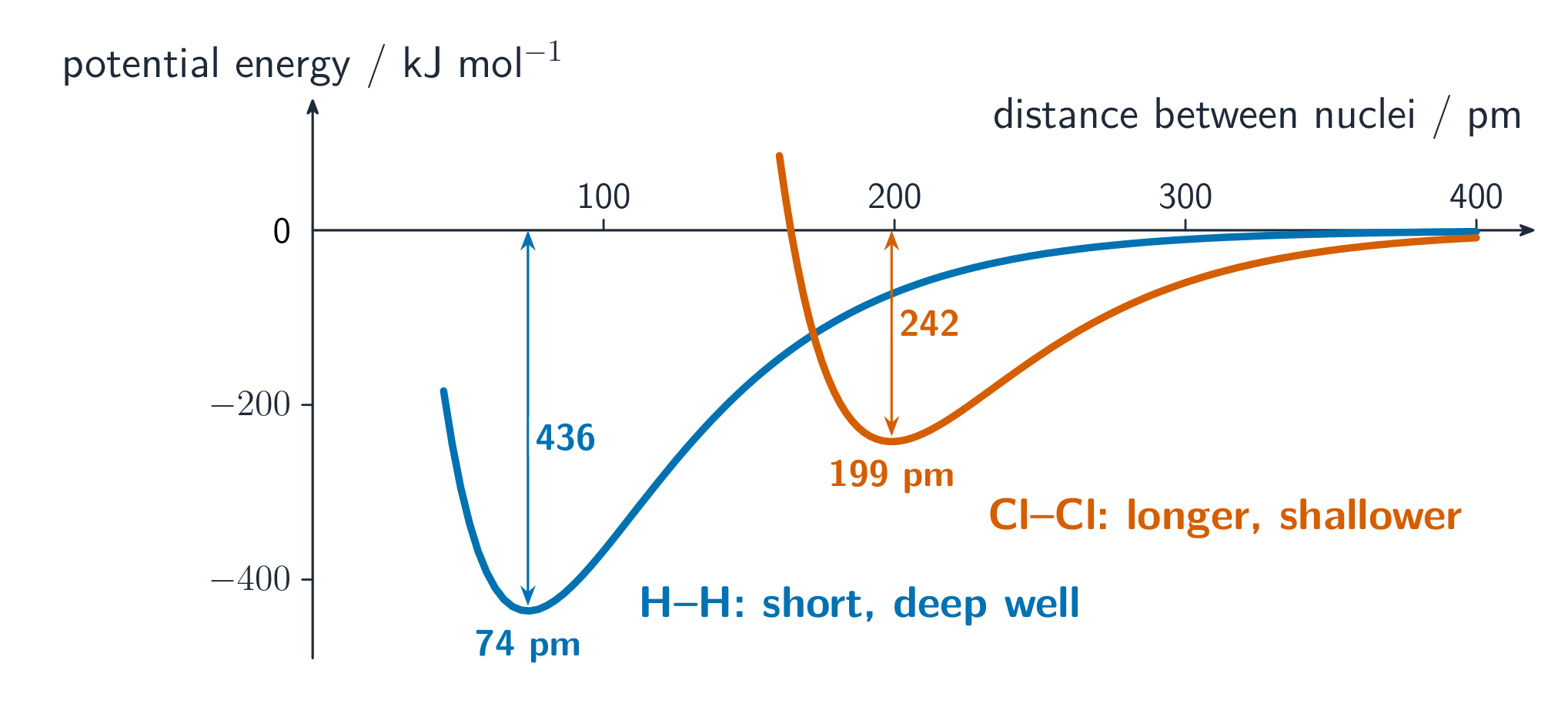
- Plot the potential energy 势能 against the distance between the two nuclei. Far apart, the energy is zero; too close, it shoots up from nucleus–nucleus repulsion.
- The lowest point is the bond length 键长: attraction and repulsion balance there.

On a potential-energy versus distance curve, the bond length is at the...
Dificultad 1/5 · 100 monedas + un pequeño bono en el primer intento de hoy
The minimum is the stable separation -- the bond length.
Depth means strength
- The depth of the well below zero is the bond energy 键能: the energy needed to separate the atoms completely. A deeper well means a stronger bond.
- Breaking a bond always costs energy; forming one always releases it.
A deeper potential-energy well means a weaker bond.
Dificultad 1/5 · 100 monedas + un pequeño bono en el primer intento de hoy
False. The well depth equals the energy needed to break the bond, so a deeper well means a stronger bond.
Breaking a chemical bond...
Dificultad 1/5 · 100 monedas + un pequeño bono en el primer intento de hoy
You must supply energy to pull bonded atoms apart.
Forming a bond releases energy.
Dificultad 1/5 · 100 monedas + un pequeño bono en el primer intento de hoy
Bond formation is exothermic -- the reverse of breaking.
Comparing two curves
- Bigger atoms sit further apart, so the minimum is further right and usually shallower: H–H is 74 pm and 436 kJ mol⁻¹; Cl–Cl is 199 pm and 242 kJ mol⁻¹.
- More shared pairs (higher bond order) pull the atoms closer and hold them more tightly: C≡C is shorter and stronger than C=C, which is shorter and stronger than C–C.
Compared with a single bond, a double bond between the same atoms is...
Dificultad 1/5 · 100 monedas + un pequeño bono en el primer intento de hoy
More shared pairs pull the atoms closer and hold them more tightly.
As bond order rises, bond length gets shorter and bond strength gets ____.
Dificultad 1/5 · 100 monedas + un pequeño bono en el primer intento de hoy
For the same pair of elements in comparable environments, increasing bond order generally shortens and strengthens the bond. Well depth measures strength; the position of its minimum measures length.
Compared with the H–Cl curve, the H–I curve has its minimum:
Dificultad 1/5 · 100 monedas + un pequeño bono en el primer intento de hoy
I is larger than Cl, so H–I is longer (further right) and weaker (shallower well).
From the H–H curve above, how much energy (in kJ mol⁻¹) is needed to break one mole of H–H bonds?
Dificultad 2/5 · 140 monedas + un pequeño bono en el primer intento de hoy
The bond energy is the depth of the well below zero: 436 kJ mol⁻¹.
Bond order. Rank C–C, C=C and C≡C by length and strength.
- Length: C≡C (120 pm) < C=C (134 pm) < C–C (154 pm).
- Strength: C≡C (839 kJ mol⁻¹) > C=C (614) > C–C (348). More shared electrons give a shorter, stronger bond.
Reading the potential-energy curve
As two atoms approach, their potential energy changes. Match each region of the curve to what the atoms are doing.
Ionic attraction (Coulomb's law). Which has the stronger attraction between its ions, NaF or MgO?
- Coulomb's law: force $\propto\dfrac{q_1q_2}{r^2}$. Mg²⁺ and O²⁻ have charges ±2; Na⁺ and F⁻ have ±1. The ion sizes are similar.
- So the product of charges is 4 times larger in MgO: much stronger attraction, a deeper energy well, and a much higher melting point (2852 °C vs 993 °C).
Which compound has the strongest attraction between its ions?
Dificultad 1/5 · 100 monedas + un pequeño bono en el primer intento de hoy
Ca²⁺ and O²⁻ carry ±2 charges, so $q_1q_2$ is four times larger than for the ±1 compounds.
- The minimum is not where the energy is zero. Zero is where the atoms are far apart.
- Read the bond length from the horizontal position of the minimum, and the bond energy from the depth. Don't swap them.
- When you sketch a second curve for bigger atoms, move the minimum to the right and make it shallower.
A bond's potential energy curve dips to a minimum at the bond length, where attraction and repulsion balance. The depth of the well is the bond energy. Bigger atoms give a longer, usually weaker bond; more shared pairs give a shorter, stronger bond; for ions, larger charges and smaller ions give stronger attraction.