Finding the Area Between Curves Expressed as Functions of x
Introducido| English | Significado |
|---|---|
| area between two curves/ˈeərɪə bɪˈtwiːn tuː kɜːvz/ | área entre dos curvas |
The area trapped between two curves
- A single integral gives the area between a curve and the $x$-axis. What about the area between two curves?
- Slice the region into thin vertical strips; each strip's height is the gap between the curves.
- Add up (integrate) those heights across the interval — that's the area between two curves 曲线间面积.
- The recipe is "top minus bottom, integrated."
Top minus bottom
- If $f$ is the upper curve and $g$ the lower on $[a,b]$:
-
$$A=\int_a^b \big(f(x)-g(x)\big)\,dx$$
- Each vertical strip has height $f(x)-g(x)$ and width $dx$.
- Always subtract upper minus lower, so the height (and the area) stays positive.
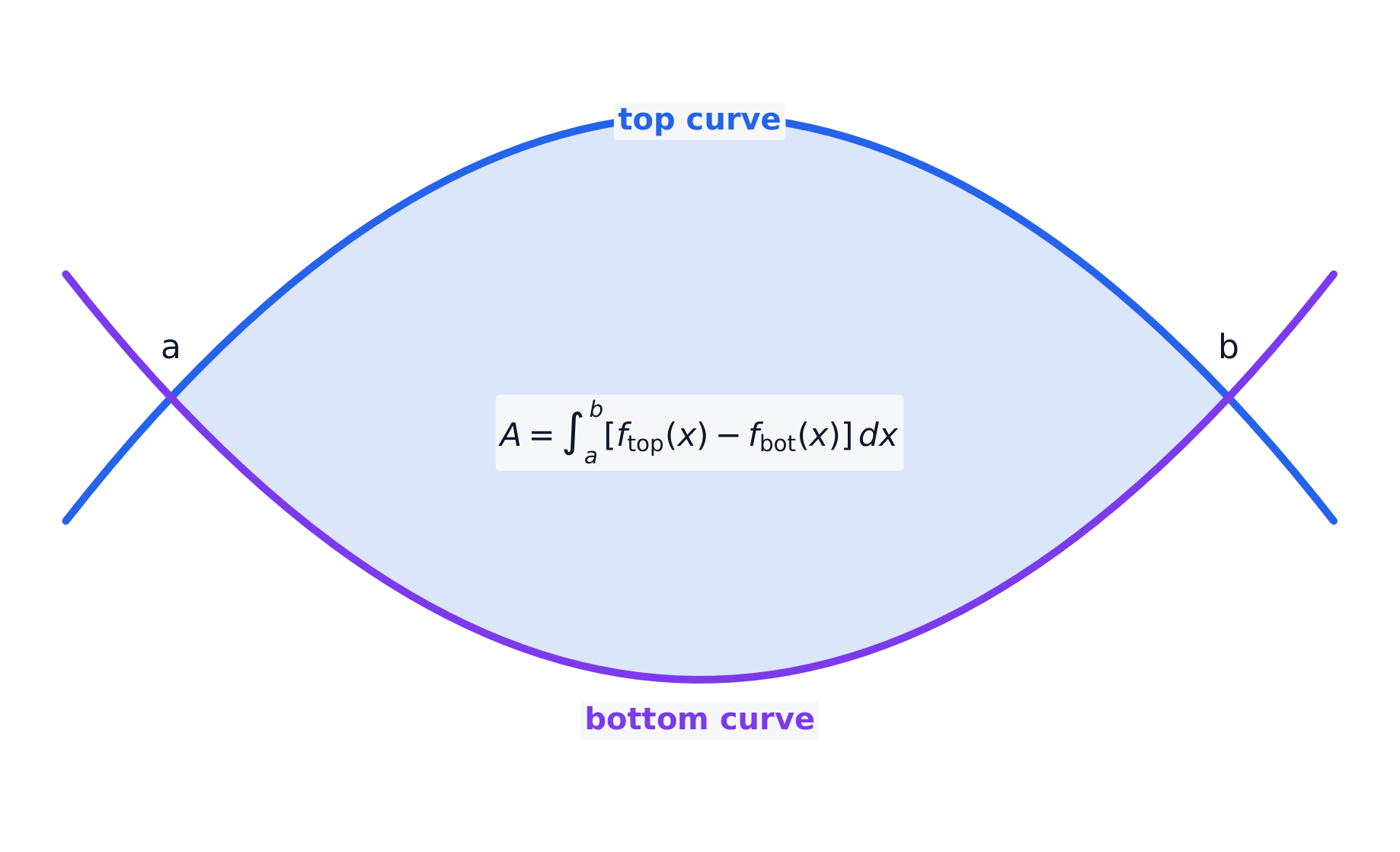
Area between curves: integrate top curve minus bottom curve from a to b
A line above a parabola
y = ax² + bx + c
Between the intersection points the line sits above the parabola — the vertical gap, integrated, is the enclosed area.
The area between an upper curve $f$ and lower curve $g$ on $[a,b]$ is...
Dificultad 1/5 · 100 monedas + un pequeño bono en el primer intento de hoy
Upper minus lower, integrated.
Find the limits from intersections
- The bounds $a$ and $b$ are usually where the curves cross — set $f(x)=g(x)$ and solve.
- Those intersection $x$-values are the left and right edges of the enclosed region.
- Between them, decide which curve is on top (test a point).
- Then integrate the top-minus-bottom difference over $[a,b]$.
Where do $y=x+2$ y $y=x^2$ intersect?
Dificultad 2/5 · 140 monedas + un pequeño bono en el primer intento de hoy
$x^2-x-2=0\Rightarrow x=-1,2$.
To decide which curve is on top between intersections, you...
Dificultad 1/5 · 100 monedas + un pequeño bono en el primer intento de hoy
Plug in a test point to see which is higher.
The limits of integration come from setting the two curves ____.
Dificultad 1/5 · 100 monedas + un pequeño bono en el primer intento de hoy
Solve $f(x)=g(x)$ for the intersection $x$-values.
It works even below the axis
- Because you take upper minus lower, the formula handles regions below the $x$-axis automatically.
- The $-g(x)$ term lifts everything, so no separate "signed area" bookkeeping is needed.
- A region entirely under the axis still gives a positive area with top-minus-bottom.
- That's the advantage of the gap-height approach.
The area between $y=x+2$ y $y=x^2$ es $\int_{-1}^2 (x+2-x^2)\,dx$. Compute it (a decimal).
Dificultad 2/5 · 140 monedas + un pequeño bono en el primer intento de hoy
The integral evaluates to $\tfrac92=4.5$.
Integrating lower minus upper gives the negative of the true area.
Dificultad 1/5 · 100 monedas + un pequeño bono en el primer intento de hoy
Reversing the order flips the sign.
Always subtract upper minus lower — if you reverse it, you get a negative of the true area. Check which curve is on top by testing an $x$-value between the intersections (they can swap, which is the next lesson). And the limits come from setting the curves equal, not from the $x$-axis.
Find the area between $y=x+2$ and $y=x^2$.
- Intersections: $x^2=x+2\Rightarrow x^2-x-2=0\Rightarrow x=-1,2$.
- On $(-1,2)$ the line is on top (test $x=0$: line $=2>0=$ parabola).
- $A=\displaystyle\int_{-1}^{2}\big((x+2)-x^2\big)\,dx=\Big[\tfrac{x^2}{2}+2x-\tfrac{x^3}{3}\Big]_{-1}^{2}=\tfrac{9}{2}$.
When the curves cross. Find the total area between $y=x^3$ and $y=x$ on $[-1,1]$.
- They meet at $x=-1,0,1$. On $(-1,0)$, $x^3$ is on top (test $x=-\tfrac12$: $-\tfrac18>-\tfrac12$); on $(0,1)$, $x$ is on top.
- $A=\displaystyle\int_{-1}^{0}(x^3-x)\,dx+\int_0^1(x-x^3)\,dx=\tfrac14+\tfrac14=\tfrac12$.
- One integral of $(x-x^3)$ over $[-1,1]$ gives $0$: the two pieces cancel. Split at every crossing, or integrate $|f-g|$ on a calculator.
Find the total area between y = x² and y = x³ on [0, 1]. Give a decimal to 4 places.
Dificultad 2/5 · 140 monedas + un pequeño bono en el primer intento de hoy
x² ≥ x³ on [0, 1]: ∫(x² − x³) dx = 1/3 − 1/4 = 1/12 ≈ 0.0833.
∫ from −1 to 1 of (x − x³) dx gives the total area between y = x and y = x³ on [−1, 1].
Dificultad 1/5 · 100 monedas + un pequeño bono en el primer intento de hoy
False. It gives 0, because the two pieces cancel. Split at x = 0 to get 1/2.
Find the area between $y=4$ y $y=x$ from $x=0$ hasta $x=4$.
The triangle has base 4 and height 4, so area 8.
What is the area between $y=4$ y $y=x$ from $x=0$ hasta $x=4$?
Dificultad 1/5 · 100 monedas + un pequeño bono en el primer intento de hoy
Upper minus lower integrates to 8.
The area between two curves (functions of $x$) is $A=\int_a^b\big(f(x)-g(x)\big)\,dx$, integrating upper minus lower over vertical strips. Find $a,b$ where the curves intersect, decide which is on top, and integrate the gap. Top-minus-bottom keeps the area positive automatically.