Sketching Graphs of Functions and Their Derivatives
IntroducidoDraw the whole shape from its derivatives
- The derivatives are a recipe for a graph: $f'$ gives the slopes, $f''$ gives the bends.
- Combine the two sign charts and you can sketch a curve you were never handed.
- Extrema come from $f'$; concavity and inflection come from $f''$.
- This is where all of Unit 5 comes together into one picture.
The information you assemble
- From $f'$: intervals of increase/decrease and the extrema (where $f'$ changes sign).
- From $f''$: intervals of concavity and the points of inflection (where $f''$ changes sign).
- Plus a few plotted points and any intercepts to anchor the height.
- Layer these together and the shape is forced.
For a differentiable function, the First Derivative Test detects a local extremum at a sign-changing ____ of $f'$.
Dificultad 1/5 · 100 monedas + un pequeño bono en el primer intento de hoy
A sign-changing zero of $f'$ marks an extremum of $f$.
Which features come from $f''$ (the second derivative)?
Dificultad 2/5 · 140 monedas + un pequeño bono en el primer intento de hoy
Concavity + inflection from $f''$; increase/decrease + extrema from $f'$.
Sketching $f'$ from $f$, and back
- Given the graph of $f$: where $f$ has a horizontal tangent, $f'=0$ (a zero of $f'$).
- Where $f'>0$, $f$ rises; where $f'<0$, $f$ falls. A rising curve can have an isolated horizontal tangent.
- Where $f$ changes concavity and $f'$ exists nearby, $f'$ changes from increasing to decreasing or vice versa, giving a local extremum of $f'$.
- Reverse the reading to sketch $f$ from a given $f'$.
Where the graph of $f$ has a horizontal tangent, the graph of $f'$...
Dificultad 1/5 · 100 monedas + un pequeño bono en el primer intento de hoy
Horizontal tangent ⇒ slope $0$ ⇒ $f'=0$.
If $f'(x)>0$ throughout an interval, then $f$ is increasing there.
Dificultad 1/5 · 100 monedas + un pequeño bono en el primer intento de hoy
Positive derivative throughout an interval guarantees increase; an increasing function can still have isolated zero derivatives.
Put the marks on the sketch
- Mark each extremum (peak/valley), each inflection point (bend flip), and label the intervals.
- Match increasing+concave-up (curving up steeply) vs. increasing+concave-down (leveling off), and so on — four combinations.
- Check consistency: a positive-to-negative sign change of $f'$ gives a local max when $f$ is continuous there. Concavity is a separate check.
- A clean sketch shows all four features agreeing.
La forma final
y = ax³ + cx
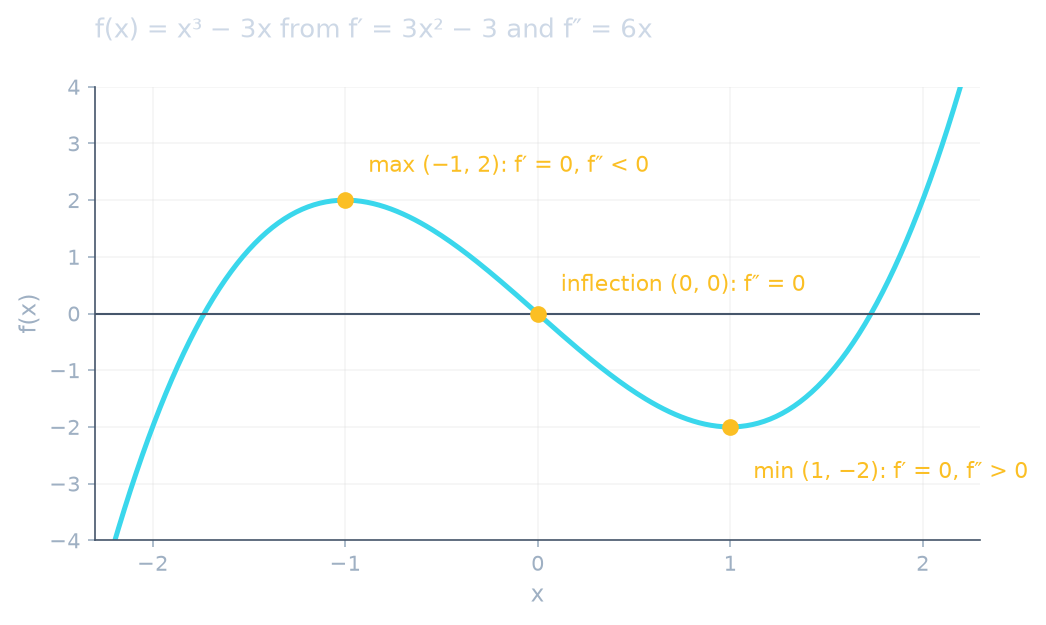
Peak at $(-1,2)$, inflection at $(0,0)$, valley at $(1,-2)$ — exactly what the $f'$ y $f''$ charts predict.
At a point where $f$ is high but flat, the value of $f'$ is...
Dificultad 1/5 · 100 monedas + un pequeño bono en el primer intento de hoy
Read the slope, not the height: flat ⇒ $f'=0$.
If $f'(c)=0$ y $f''(c)<0$, the Second Derivative Test classifies a local maximum. The curve is bending...
Dificultad 1/5 · 100 monedas + un pequeño bono en el primer intento de hoy
At a stationary point, a negative second derivative guarantees a local maximum. A local maximum alone does not guarantee concavity throughout a neighborhood.
Don't read $f'$ off the height of $f$ — read it off the slope. Where $f$ is high but flat, $f'=0$, not "large." And a zero of $f'$ marks a possible extremum of $f$; a zero of $f''$ marks a possible inflection of $f$ — keep the two levels straight.
Sketch clues for $f(x)=x^3-3x$.
- $f'=3(x-1)(x+1)$: increasing on $(-\infty,-1)$ and $(1,\infty)$, decreasing on $(-1,1)$; max at $(-1,2)$, min at $(1,-2)$.
- $f''=6x$: concave down for $x<0$, concave up for $x>0$; inflection at $(0,0)$.
- The sketch: rises to a peak at $(-1,2)$, falls through $(0,0)$, dips to $(1,-2)$, then rises.
To sketch a graph, combine what $f'$ says (increase/decrease and extrema) with what $f''$ says (concavity and inflection points), plus a few anchor points. Read $f'$ from the slope of $f$ (not its height); a zero of $f'$ is a possible extremum, a zero of $f''$ a possible inflection.
Write from this case
- A graph of f is rising, then flat, then falling.
- f itself stays positive the whole time.
Where is a possible extremum, and what does the positive height not tell you?
Read the derivative from the slope.
At a positive-height point where the tangent slopes downward, what is the derivative?
Dificultad 1/5 · 100 monedas + un pequeño bono en el primer intento de hoy
Direction comes from slope, not height.