Integration (Pure 2) · Integración (Puro 2)
| English | Español |
|---|---|
| integral/ˈɪntɪɡrəl/ | integral |
| exponential function/ˌekspəˈnenʃl ˈfʌŋkʃn/ | función exponencial |
| differential equation/ˌdɪfəˈrenʃl ɪˈkweɪʒn/ | ecuación diferencial |
| trapezium rule/trəˈpiːzɪəm ruːl/ | regla del trapecio |
| strip/strɪp/ | tira |
| estimate/ˈestɪmət/ | estimación |
| identity/aɪˈdentɪti/ | identidad |
The area that eˣ can't escape
- The integral 积分 of $e^x$ is $e^x$ — the same function. This self-referential property makes exponential functions 指数函数 central to differential equations 微分方程.
- Integration techniques let you find areas, volumes, and solutions to real-world problems.
El área que eˣ no puede escapar
- La integral de $e^x$ es $e^x$ — la misma función. Esta propiedad autorreferencial hace que las funciones exponenciales sean centrales en las ecuaciones diferenciales.
- Las técnicas de integración permiten encontrar áreas, volúmenes y soluciones a problemas del mundo real.
Standard integrals
Worked example. $\int e^{3x}\,dx = \dfrac{1}{3}e^{3x} + C$. The $\dfrac{1}{3}$ comes from the chain rule in reverse.
Don't forget the $\dfrac{1}{a}$. When integrating $e^{ax+b}$, you must divide by $a$. The integral of $e^{2x}$ is $\dfrac{1}{2}e^{2x}$, not $e^{2x}$.
The trapezium rule 梯形法则 adds straight-topped strips 条带 of width h to estimate 估计 the area
Integrales estándar
Ejemplo resuelto. $\int e^{3x}\,dx = \dfrac{1}{3}e^{3x} + C$. El $\dfrac{1}{3}$ proviene de la regla de la cadena en sentido inverso.
No olvides el $\dfrac{1}{a}$. Al integrar $e^{ax+b}$, debes dividir por $a$. La integral de $e^{2x}$ es $\dfrac{1}{2}e^{2x}$, no $e^{2x}$.
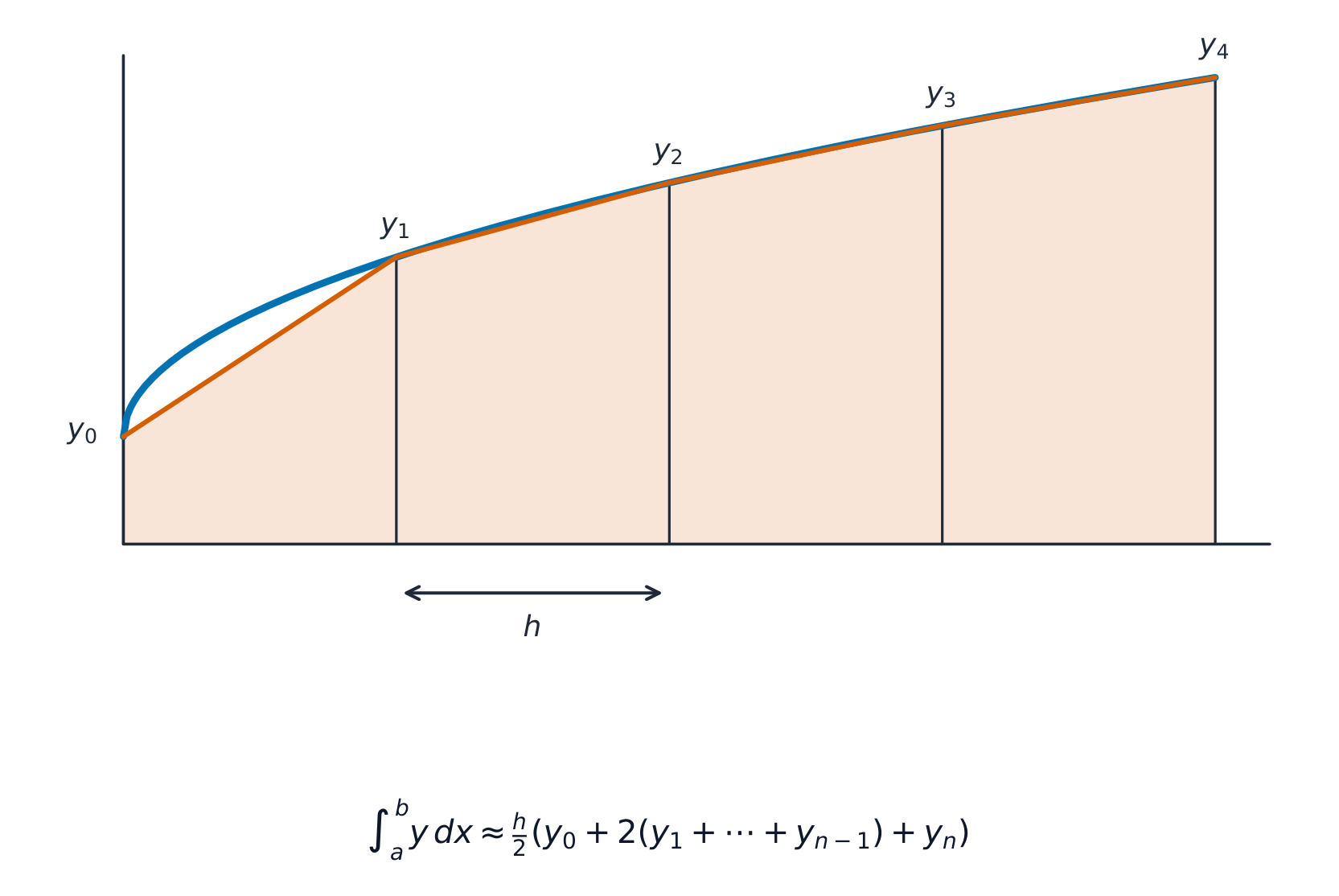
La regla del trapecio 梯形法则 añade tiras de parte superior recta 条带 de ancho h para estimar 估计 el área
The area under the curve · El área bajo la curva
area = ∫ f(x) dx · área = ∫ f(x) dx
The integral still measures area · área — drag a and b to total the strip under the curve. · La integral todavía mide el área — arrastra a y b para sumar la franja bajo la curva.
What is ∫ eˣ dx? · ¿Qué es ∫ eˣ dx?
eˣ is its own integral (and derivative): ∫eˣ dx = eˣ + C. · eˣ es su propia integral (y derivada): ∫eˣ dx = eˣ + C.
What is ∫ (1/x) dx? · ¿Qué es ∫ (1/x) dx?
∫(1/x) dx = ln|x| + C (the power rule fails for n = −1). · ∫(1/x) dx = ln|x| + C (la regla de la potencia falla para n = −1).
∫ e^(2x) dx = (1/a)e^(2x) + C. What is a? · ∫ e^(2x) dx = (1/a)e^(2x) + C. ¿Cuál es a?
The chain rule in reverse: divide by the coefficient of x inside the exponential. · La regla de la cadena inversa: divide por el coeficiente de x dentro del exponencial.
∫ cos(3x) dx = (1/3)sin(3x) + C. Evaluate from 0 to π/6 (2 dp). · ∫ cos(3x) dx = (1/3)sin(3x) + C. Evalúa desde 0 hasta π/6 (2 dp).
[(1/3)sin(3x)]₀^(π/6) = (1/3)sin(π/2) − 0 = 1/3 ≈ 0.33. · [(1/3)sin(3x)]₀^(π/6) = (1/3)sin(π/2) − 0 = 1/3 ≈ 0,33.
Integrating powers of trig functions
- To integrate a power of $\sin$/$\cos$, use an identity 恒等式 to remove the power first.
- Example: $\sin^2 x = \dfrac{1}{2}(1 - \cos 2x)$, so $\int \sin^2 x\,dx = \dfrac{x}{2} - \dfrac{\sin 2x}{4} + C$.
Integración de potencias de funciones trigonométricas
- Para integrar una potencia de $\sin$/$\cos$, utiliza una identidad 恒等式 para eliminar la potencia primero.
- Ejemplo: $\sin^2 x = \dfrac{1}{2}(1 - \cos 2x)$, por lo tanto $\int \sin^2 x\,dx = \dfrac{x}{2} - \dfrac{\sin 2x}{4} + C$.
The trapezium rule
- When you can't integrate exactly, estimate:
- Each strip of width $h$ is a trapezium; add their areas.
The trapezium rule: divide the area into strips, approximate each as a trapezium, and sum their areas.
La regla del trapecio
- Cuando no se puede integrar exactamente, estima:
- Cada franja de anchura $h$ es un trapecio; suma sus áreas.
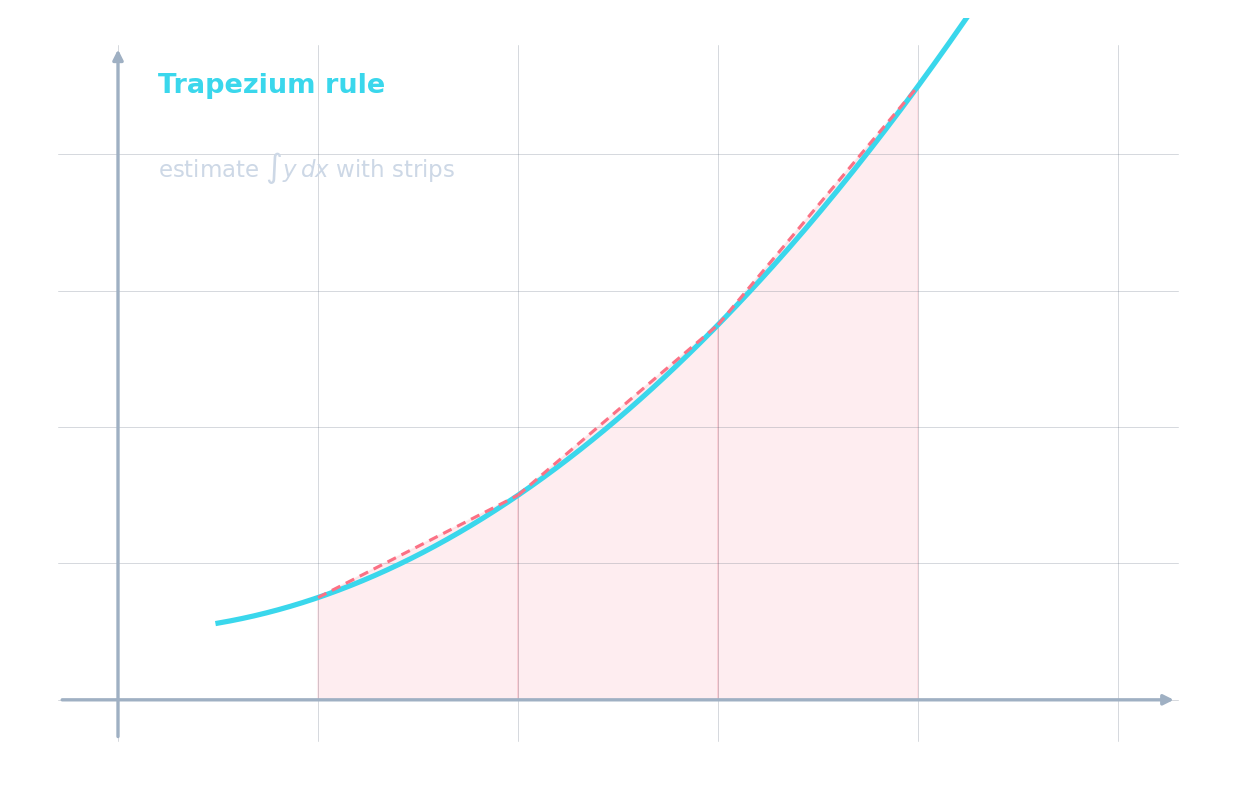
La regla del trapecio: divide el área en franjas, aproxima cada una como un trapecio y suma sus áreas.
The trapezium rule estimates a definite integral when it cannot be found exactly. · La regla del trapecio estima una integral definida cuando no se puede encontrar exactamente.
It approximates the area as a sum of trapezium strips of width h. · Aproxima el área como una suma de franjas trapezoidales de anchura h.
Using the trapezium rule with h = 1, estimate ∫₁³ x² dx with y-values 1, 4, 9. · Usando la regla del trapecio con h = 1, estima ∫₁³ x² dx con valores y de 1, 4, 9.
(1/2)[1 + 9 + 2(4)] = (1/2)[10 + 8] = 9. (Exact: 26/3 ≈ 8.67.) · (1/2)[1 + 9 + 2(4)] = (1/2)[10 + 8] = 9. (Exacto: 26/3 ≈ 8,67.)
Worked example — trapezium rule
- Estimate $\int_1^4 x^2\,dx$ using 3 strips ($h = 1$).
- $y$-values: $y_0 = 1$, $y_1 = 4$, $y_2 = 9$, $y_3 = 16$.
- $\int \approx \dfrac{1}{2}[1 + 16 + 2(4 + 9)] = \dfrac{1}{2}[17 + 26] = 21.5$.
- Exact value: $\left[\dfrac{x^3}{3}\right]_1^4 = \dfrac{64}{3} - \dfrac{1}{3} = 21$. The estimate is close.
- Integration is reverse differentiation; harder integrals use integration by substitution.
Ejemplo resuelto — regla del trapecio
- Estima $\int_1^4 x^2\,dx$ usando 3 franjas ($h = 1$).
- $y$valores: $y_0 = 1$, $y_1 = 4$, $y_2 = 9$, $y_3 = 16$.
- $\int \approx \dfrac{1}{2}[1 + 16 + 2(4 + 9)] = \dfrac{1}{2}[17 + 26] = 21.5$.
- Valor exacto: $\left[\dfrac{x^3}{3}\right]_1^4 = \dfrac{64}{3} - \dfrac{1}{3} = 21$. La estimación es cercana.
- La integración es derivación inversa; las integrales más difíciles utilizan integración por sustitución.
You've got it
- $\int e^{ax+b}dx = \tfrac1a e^{ax+b} + C$; $\int \tfrac{1}{ax+b}dx = \tfrac1a\ln|ax+b| + C$
- remove powers of $\sin$/$\cos$ with an identity before integrating
- the trapezium rule estimates an integral as a sum of trapezium strips
Lo has entendido
- $\int e^{ax+b}dx = \tfrac1a e^{ax+b} + C$; $\int \tfrac{1}{ax+b}dx = \tfrac1a\ln|ax+b| + C$
- eliminar potencias de $\sin$/$\cos$ con una identidad antes de integrar
- la regla del trapecio estima una integral como una suma de franjas trapezoidales