Numerical solution of equations · Solución numérica de ecuaciones
| English | Español |
|---|---|
| root/ruːt/ | root |
| numerical method/njuːˈmerɪkl ˈmeθəd/ | método numérico |
| accuracy/ˈækjʊrəsi/ | exactitud |
| sign change/saɪn tʃeɪndʒ/ | cambio de signo |
| iteration/ˌɪtəˈreɪʃn/ | iteración |
| converge/kənˈvɜːdʒ/ | converger |
| iterative formula/ˈɪtərətɪv ˈfɔːmjʊlə/ | fórmula iterativa |
| rearrangement/ˌriːəˈreɪndʒmənt/ | reordenamiento |
| diverge/daɪˈvɜːdʒ/ | divergir |
The root 根 you can't see
- Some equations have no neat algebraic solution. $x^3 + x - 1 = 0$ can't be factorised.
- But you know a root exists between $0$ and $1$ because the function changes sign. Numerical methods 数值方法 let you find it to any accuracy 精度.
La raíz 根 que no se puede ver
- Algunas ecuaciones no tienen una solución algebraica exacta. $x^3 + x - 1 = 0$ no se puede factorizar.
- Pero sabes que existe una raíz entre $0$ y $1$ porque la función cambia de signo. Los métodos numéricos 数值方法 te permiten encontrarla con cualquier precisión 精度 deseada.
Locating a root
- Many equations can't be solved exactly. A root is a solution.
- Sign change 变号: if $f(a)$ and $f(b)$ have opposite signs (and no break between them), a root lies between $a$ and $b$.
Worked example. $f(x) = x^3 + x - 1$. $f(0) = -1$ (negative), $f(1) = 1$ (positive). Sign change → root between $0$ and $1$.
Sign change doesn't guarantee exactly one root. There could be 3 roots (or any odd number) between $a$ and $b$. The sign change only tells you there's at least one.
Iteration 迭代: step up to the curve and across to y = x; the steps converge 收敛 to a root
Localización de una raíz
- Muchas ecuaciones no se pueden resolver exactamente. Una raíz es una solución.
- Cambio de signo 变号: si $f(a)$ y $f(b)$ tienen signos opuestos (y no hay discontinuidad entre ellos), hay una raíz entre $a$ y $b$.
Ejemplo resuelto. $f(x) = x^3 + x - 1$. $f(0) = -1$ (negativo), $f(1) = 1$ (positivo). Cambio de signo → raíz entre $0$ y $1$.
El cambio de signo no garantiza exactamente una sola raíz. Pueden haber 3 raíces (o cualquier número impar) entre $a$ y $b$. El cambio de signo solo indica que hay al menos una.
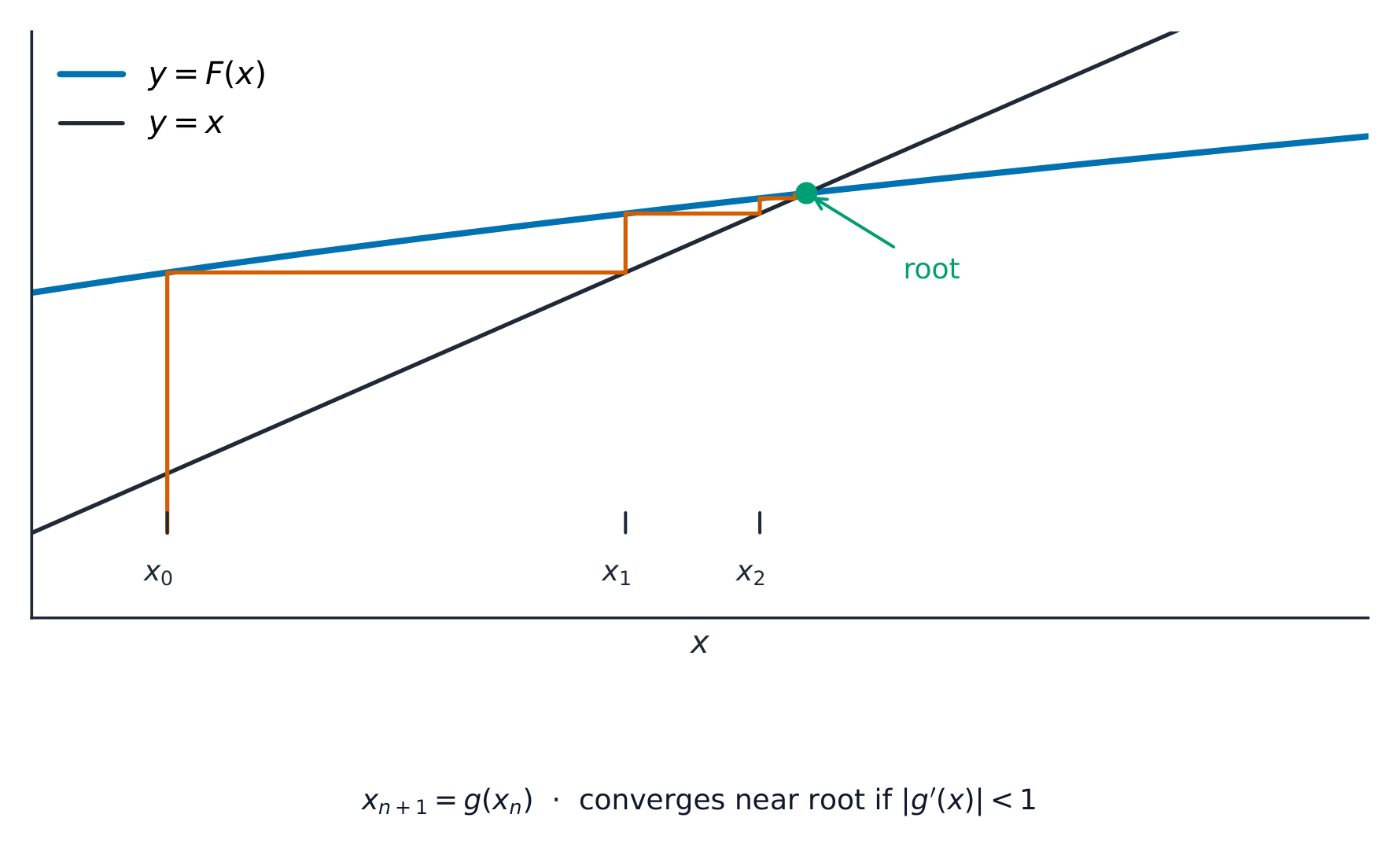
Iteración 迭代: sube hasta la curva y cruza hacia y = x; los pasos convergen 收敛 a una raíz
Where is the root? · ¿Dónde está la raíz?
y = ax³ + bx² + cx + d
A root is where the curve crosses zero. A sign change in f(x) traps a root between two x-values. · Una raíz es donde la curva cruza el cero. Un cambio de signo en f(x) encierra una raíz entre dos valores de x.
If f(a) and f(b) have opposite signs (and f is continuous between them), then between a and b there is: · Si f(a) y f(b) tienen signos opuestos (y f es continua entre ellos), entonces entre a y b hay:
A sign change of a continuous function guarantees a root between a and b. · Un cambio de signo en una función continua garantiza una raíz entre a y b.
f(x) = x³ + x − 1. f(0) = −1 and f(1) = 1. Between which two integers is the root? · f(x) = x³ + x − 1. f(0) = −1 y f(1) = 1. ¿Entre qué dos enteros está la raíz?
Sign change between 0 and 1 (f(0) < 0, f(1) > 0), so root is between 0 and 1. · Cambio de signo entre 0 y 1 (f(0) < 0, f(1) > 0), por lo tanto la raíz está entre 0 y 1.
Iteration
- Rearrange the equation into the form $x = F(x)$.
- Use the iterative formula 迭代公式 $x_{n+1} = F(x_n)$ from a first guess $x_0$.
- If the values settle, they converge to a root. Keep going until steady to the asked accuracy.
Iteration: starting from $x_0$, each step applies $F$ and reflects in $y = x$. The cobweb spirals into the fixed point — the root.
Iteración
- Reordena la ecuación en la forma $x = F(x)$.
- Usa la fórmula iterativa 迭代公式 $x_{n+1} = F(x_n)$ partiendo de una estimación inicial $x_0$.
- Si los valores se estabilizan, convergen a una raíz. Continúa hasta alcanzar la precisión solicitada.
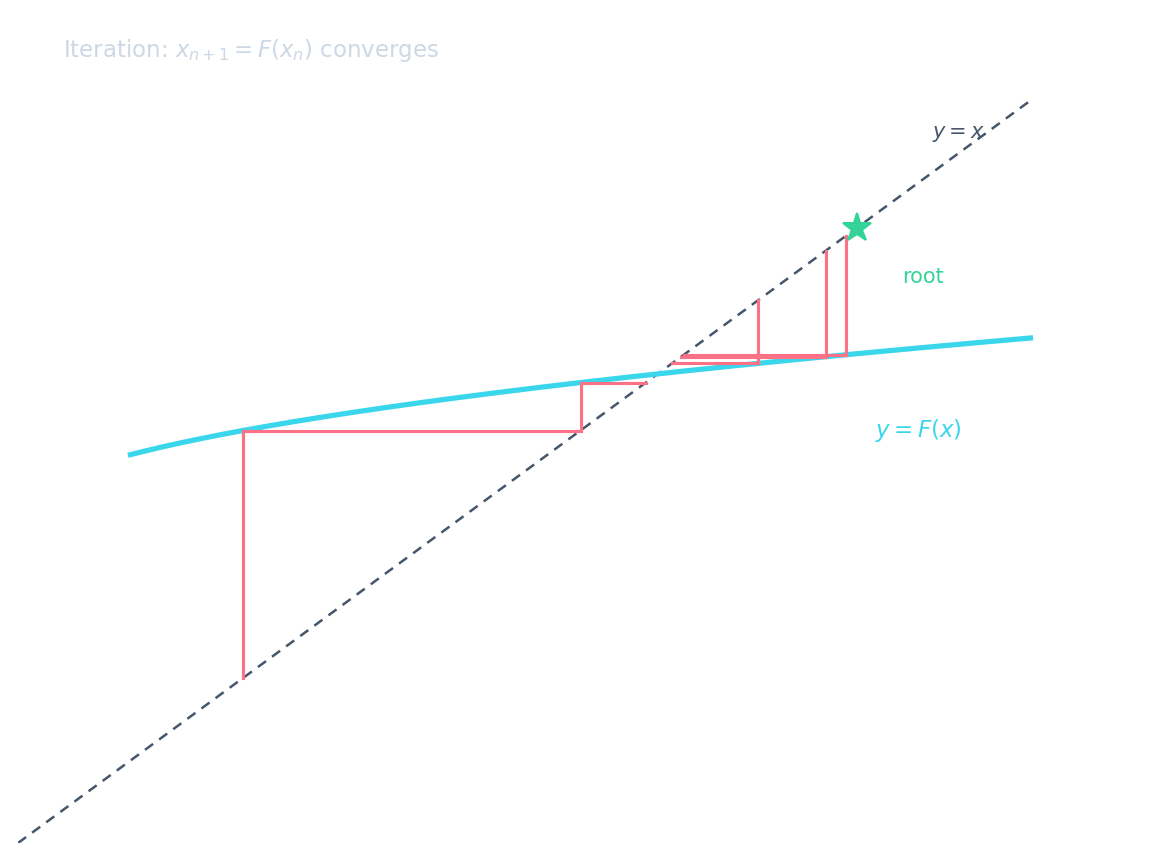
Iteración: partiendo de $x_0$, cada paso aplica $F$ y se refleja en $y = x$. La telaraña gira hacia el punto fijo —la raíz.
An iterative formula has the form: · Una fórmula iterativa tiene la forma:
Iteration repeatedly applies x_{n+1} = F(x_n) from a first guess. · La iteración aplica repetidamente x_{n+1} = F(x_n) desde una primera estimación.
If the iteration values settle down to a steady number, they have converged to a root. · Si los valores de iteración se estabilizan en un número constante, han convergido a una raíz.
Convergence means the sequence approaches a fixed value — a root of the equation. · La convergencia significa que la secuencia se acerca a un valor fijo — una raíz de la ecuación.
Using x_{n+1} = ∛(1 − x_n) with x₀ = 0, what is x₁ (2 dp)? · Usando x_{n+1} = ∛(1 − x_n) con x₀ = 0, ¿cuál es x₁ (2 decimales)?
x₁ = ∛(1 − 0) = ∛1 = 1.
Worked example — iteration
- Solve $x^3 + x - 1 = 0$ using $x_{n+1} = \sqrt[3]{1 - x_n}$, starting from $x_0 = 0.5$.
- $x_1 = \sqrt[3]{0.5} = 0.794$, $x_2 = \sqrt[3]{0.206} = 0.591$, $x_3 = \sqrt[3]{0.409} = 0.742$, ...
- The values converge to $x \approx 0.682$.
Ejemplo resuelto — iteración
- Resuelve $x^3 + x - 1 = 0$ usando $x_{n+1} = \sqrt[3]{1 - x_n}$, partiendo de $x_0 = 0.5$.
- $x_1 = \sqrt[3]{0.5} = 0.794$, $x_2 = \sqrt[3]{0.206} = 0.591$, $x_3 = \sqrt[3]{0.409} = 0.742$, ...
- Los valores convergen a $x \approx 0.682$.
An iteration x_{n+1} = F(x_n) always converges regardless of the starting value. · Una iteración x_{n+1} = F(x_n) siempre converge sin importar el valor inicial.
Convergence requires |F′(x)| < 1 near the root. Poor rearrangements or starting values can diverge. · La convergencia requiere |F′(x)| < 1 cerca de la raíz. Malas reordenaciones o valores iniciales pueden divergir.
Choosing a rearrangement 重新排列
- Not all rearrangements converge. The iteration $x_{n+1} = F(x_n)$ converges when $|F'(x)| < 1$ near the root.
- If it diverges 发散 (values move away), try a different rearrangement.
Elección de un reordenamiento 重新排列
- No todos los reordenamientos convergen. La iteración $x_{n+1} = F(x_n)$ converge cuando $|F'(x)| < 1$ está cerca de la raíz.
- Si diverge (los valores se alejan), intente un reordenamiento diferente.
You've got it
- a sign change of $f$ between $a$ and $b$ traps a root in between
- iteration: $x_{n+1} = F(x_n)$ from a starting guess
- if the values converge (settle), they approach a root
- convergence requires $|F'(x)| < 1$ near the root
Lo has entendido
- un cambio de signo de $f$ entre $a$ y $b$ encierra una raíz en medio
- iteración: $x_{n+1} = F(x_n)$ a partir de una estimación inicial
- si los valores convergen (se estabilizan), se acercan a una raíz
- la convergencia requiere $|F'(x)| < 1$ cerca de la raíz