Matrices (Further Pure 2)
Introducido| English | Significado |
|---|---|
| matrix equation/ˈmeɪtrɪks ɪˈkweɪʒn/ | ecuación matricial |
| non-singular/ˌnɒnˈsɪŋɡjʊlə/ | no singular |
| singular/ˈsɪŋɡjʊlə/ | singular |
| consistent/kənˈsɪstənt/ | consistente |
| inconsistent/ˌɪnkənˈsɪstənt/ | inconsistente |
| eigenvector/ˈaɪɡənvektə/ | vector propio |
| eigenvalue/ˈaɪɡənvæljuː/ | valor propio |
| scalar/ˈskeɪlə/ | escalar |
| stretch/stretʃ/ | estiramiento |
| characteristic equation/ˌkærɪktəˈrɪstɪk ɪˈkweɪʒn/ | ecuación característica |
| diagonalisation/daɪˌæɡənəlaɪˈzeɪʃn/ | diagonalización |
| diagonal matrix/daɪˈæɡənl ˈmeɪtrɪks/ | matriz diagonal |
| linearly independent/ˈlɪnɪəli ˌɪndɪˈpendənt/ | linealmente independiente |
| Cayley–Hamilton theorem/ˈkeɪli ˈhæmɪltən ˈθɪərəm/ | teorema de Cayley–Hamilton |
One map, many repeated moves
- A matrix can describe one change in a model. Repeating the change needs a power such as $A^{20}$; multiplying twenty times hides the structure.
- This lesson joins three tools: solve a matrix equation 矩阵方程, find special vectors, then simplify powers and inverses. Keep track of when a solution or inverse exists.
Put three equations into one matrix
- Put the coefficients of $x,y,z$ in that order in every row. The right-hand side is a column, not another row of the coefficient matrix.
- To read the matrix equation back, multiply each row by the unknown column. A missing variable has coefficient zero.
Escribe x+2y−z=4, 3x−z=2 y y+z=5 como una ecuación matricial. Luego lee su segunda fila hacia atrás.
Escribe el método y verifica las condiciones enunciadas antes de comparar con el modelo.
Find and check the unique point
- Here $\det C=1\ne0$, so $C$ is non-singular 非奇异: there is exactly one solution. Inverse multiplication is valid, but elimination is shorter here.
- Subtract the first equation from the second to get $y=2$. The first then gives $x+z=4$, and the third gives $2x+3z=11$; hence $(x,y,z)=(1,2,3)$.
Check all three original equations: $1+2+3=6$, $1+4+3=8$ and $2+2+9=13$. Geometrically, the three planes meet at one point. Checking only two planes is not enough.
Resuelve x+y+z=7, x+2y+z=10, 2x+y+3z=13. Verifica cada ecuación y describe la intersección.
Escribe el método y verifica las condiciones enunciadas antes de comparar con el modelo.
A zero determinant needs another check
- A singular 奇异 coefficient matrix has determinant zero. The equations may be consistent 相容 (at least one solution) or inconsistent 不相容 (no solution); singular does not mean no solution.
- For $x+y+z=3$ and $x+2y+z=4$, subtraction gives $y=1$, $x+z=2$. A third equation $2x+3y+2z=7$ adds no condition: the common line is $(x,y,z)=(2-t,1,t)$, $t\in\mathbb R$.
Change only the third right-hand side to $8$. Subtracting the first two equations from the third gives $0=1$, so no point lies on all three planes. Pairwise intersections do not prove a common intersection. Coincident planes can also occur; three identical equations leave a whole plane of solutions.
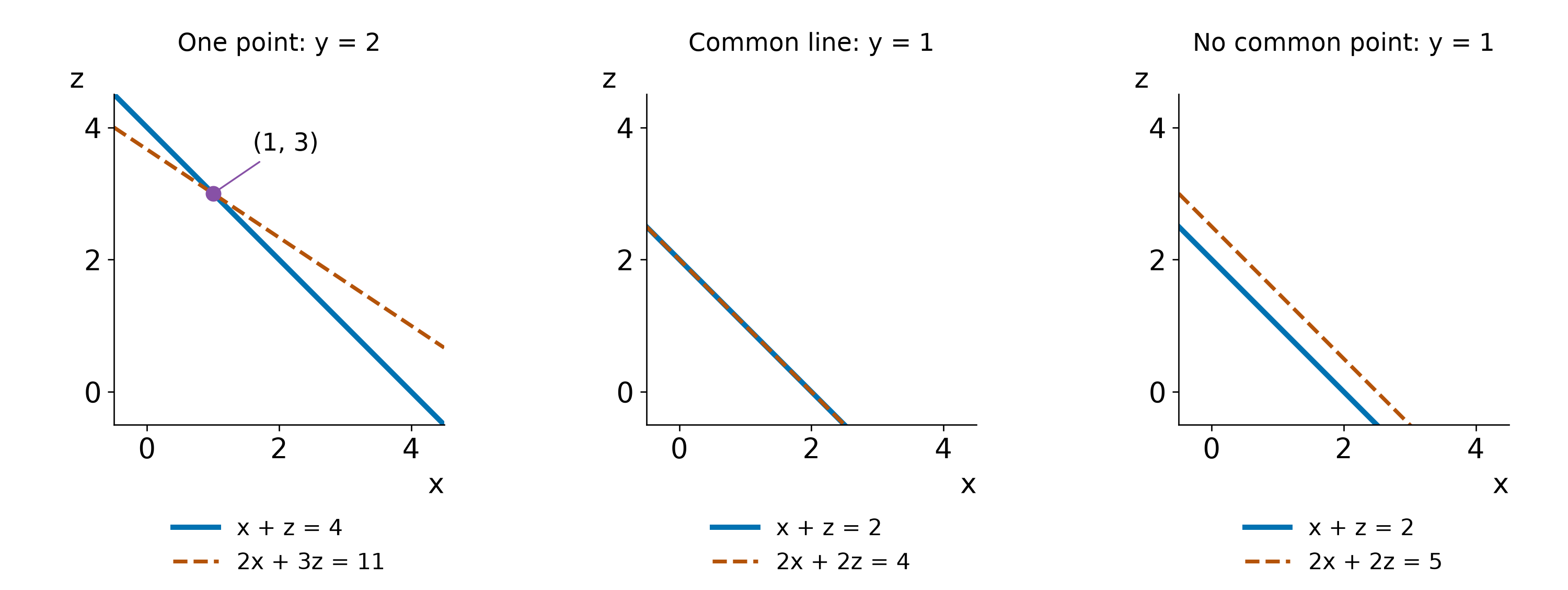
Each panel uses the value of y forced by the first two equations. The remaining lines represent the conditions on x and z.
Resuelve x+y+z=5, x+2y+z=7, 2x+3y+2z=12. Da todas las soluciones y explica la geometría.
Escribe el método y verifica las condiciones enunciadas antes de comparar con el modelo.
Mantén las dos primeras ecuaciones del ejercicio anterior, pero cambia el lado derecho de la tercera a 13. ¿Da un determinante nulo ahora una recta de soluciones?
Escribe el método y verifica las condiciones enunciadas antes de comparar con el modelo.
Separate exceptional parameter values
- For the system below, subtract row 1 from rows 2 and 3. The determinant is $(a-1)(a+1)$, so only $a=1,-1$ need a separate consistency check.
- If $a\ne\pm1$, then $y=1/(a-1)$, $z=0$ and $x=3-1/(a-1)$. Never divide by $a-1$ or $a+1$ before separating the zero cases.
At $a=1$, $0=1$ is impossible. At $a=-1$, $y=-1/2$ but $z=t$ is free, giving the common line $(x,y,z)=(7/2-t,-1/2,t)$. Both coefficient matrices are singular; only the second system is consistent.
Clasifica cada real a para x+y+z=5, x+ay+z=7, x+y+(a+2)z=5. Da todas las soluciones cuando existen.
Escribe el método y verifica las condiciones enunciadas antes de comparar con el modelo.
A special vector stays on its line
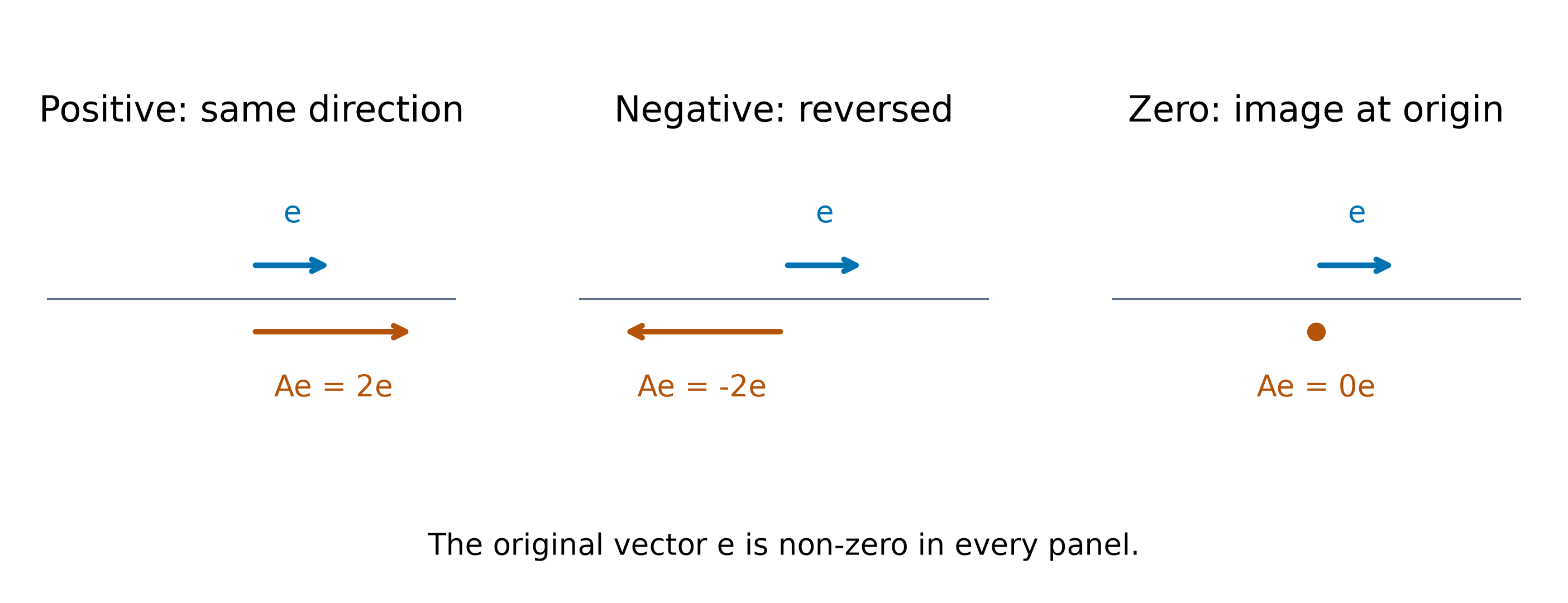
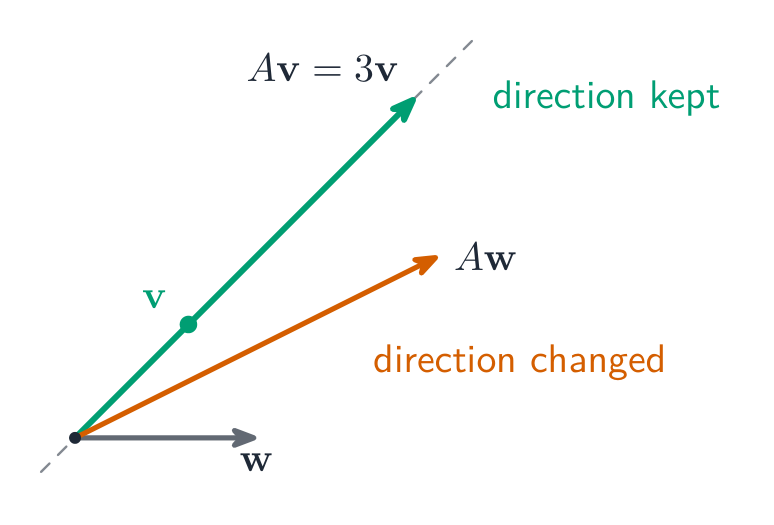
- An eigenvector 特征向量 is a non-zero vector $\mathbf e$ with $A\mathbf e=\lambda\mathbf e$. Its eigenvalue 特征值 is the scalar 标量 $\lambda$. Every non-zero multiple of $\mathbf e$ is another eigenvector for the same value.
- A positive eigenvalue can stretch 拉伸 or shorten a vector. A negative value also reverses it; zero sends it to the origin, where direction is undefined. The zero vector is never an eigenvector, although it solves the equation.
Multiplicar un vector propio por A siempre lo rota 90°.
Dificultad 1/5 · 100 monedas + un pequeño bono en el primer intento de hoy
Falso. Un vector propio mantiene su dirección: Av = λv, por lo que A solo lo escala por el valor propio λ (lo invierte si λ < 0).
Si v es un autovector de A, entonces 2v también es un autovector de A.
Dificultad 1/5 · 100 monedas + un pequeño bono en el primer intento de hoy
Los autovectores no son únicos — cualquier múltiplo escalar distinto de cero de un autovector también es un autovector.
Para T=diag(−2,0), describe las imágenes de e₁=(1,0)ᵀ y e₂=(0,1)ᵀ. ¿Es el vector cero un autovector?
Escribe el método y verifica las condiciones enunciadas antes de comparar con el modelo.
Find two eigenvalues and their vectors
- A non-zero solution of $(A-\lambda I)\mathbf e=\mathbf0$ exists when $\det(A-\lambda I)=0$. This is the characteristic equation 特征方程; using $\det(\lambda I-A)=0$ gives the same roots.
- For the matrix below, $\lambda=1$ gives $u+v=0$, so choose $(1,-1)^T$. For $\lambda=3$, $u-v=0$, so choose $(1,1)^T$. Check each by multiplying by $A$.
Matrices (Further Pure 2)
(x', y') = M(x, y)
Compara las imágenes de (1,1) y (1,−1): los valores propios son 3 y 1. Los vectores generales no necesitan permanecer en su línea original.
La matriz [[2,1],[1,2]] tiene ecuación característica (2−λ)² − 1 = 0, lo que da λ = 1 o λ = 3. ¿Cuál es el autovalor mayor?
Dificultad 2/5 · 140 monedas + un pequeño bono en el primer intento de hoy
(2−λ)² = 1 → 2−λ = ±1 → λ = 1 o 3; el mayor es 3.
Los autovalores de una matriz A se encuentran resolviendo:
Dificultad 1/5 · 100 monedas + un pequeño bono en el primer intento de hoy
La ecuación característica det(A − λI) = 0 da los autovalores.
Encuentra los autovectores y un autovector para cada uno de R con filas (3,1),(1,3). Muestra la ecuación característica.
Escribe el método y verifica las condiciones enunciadas antes de comparar con el modelo.
Extend the method to three dimensions
- A triangular matrix has the diagonal entries as eigenvalues: its characteristic determinant is the product of the diagonal factors. Do not row-reduce the original matrix to find its eigenvalues; ordinary row operations need not preserve them.
- For each root below, solve $(B-\lambda I)\mathbf e=0$. At $\lambda=3$, the first row gives $-u+v=0$ and the third gives $w=0$, hence $(1,1,0)^T$.
Para T con filas (1,2,0),(0,3,0),(0,0,−2), encuentra todos los autovectores y un vector no cero correspondiente para cada uno.
Escribe el método y verifica las condiciones enunciadas antes de comparar con el modelo.
Prove what happens under powers
- Start with $A\mathbf e=\lambda\mathbf e$, not with an inverse of the vector. Then $A^2\mathbf e=A(\lambda\mathbf e)=\lambda^2\mathbf e$; repeating gives $A^n\mathbf e=\lambda^n\mathbf e$ for positive integers $n$.
- Also $(A+cI)\mathbf e=(\lambda+c)\mathbf e$. If $A$ is invertible, $\lambda\ne0$ and multiplication by $A^{-1}$ gives $A^{-1}\mathbf e=\lambda^{-1}\mathbf e$. Positive powers do not require invertibility.
For $B$, the vector $(0,0,1)^T$ has eigenvalue $-1$. Under $B^2$ its eigenvalue is $1$, under $B^3$ it is $-1$, and under $B^{-1}$ it is $-1$. The vector remains non-zero in all these cases.
Dado Ae=λe con e≠0, demuestra A³e=λ³e. Si A es invertible, demuestra también el resultado inverso. ¿Qué argumento requiere invertibilidad?
Escribe el método y verifica las condiciones enunciadas antes de comparar con el modelo.
Match each column to its eigenvalue
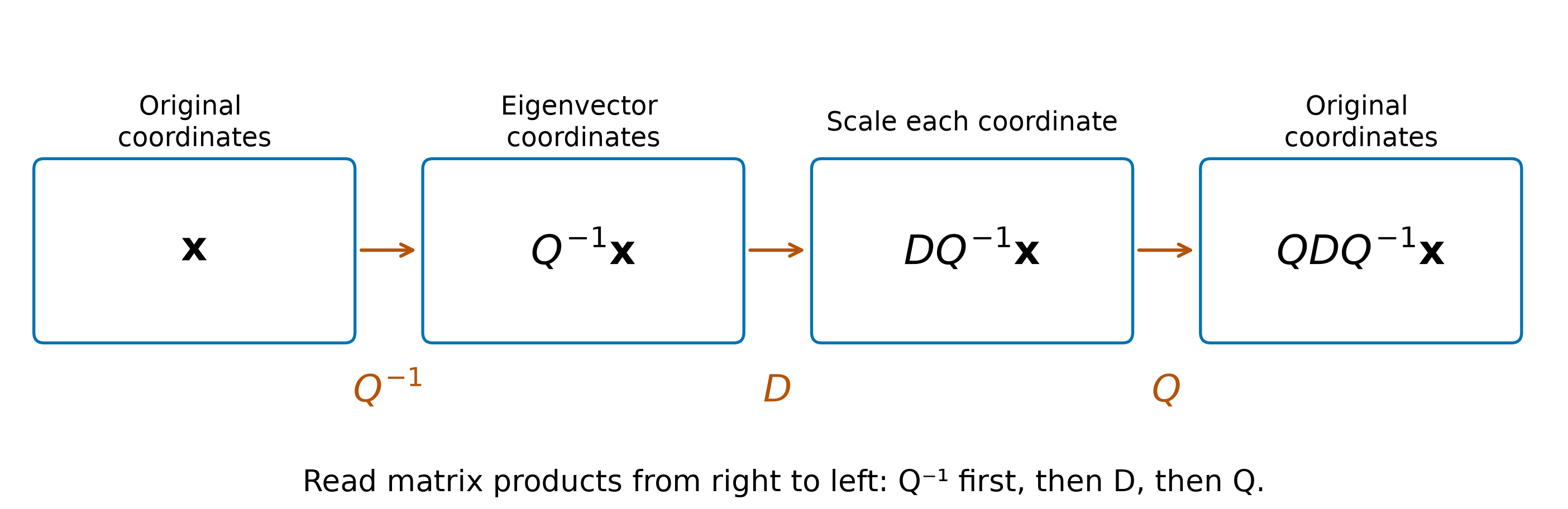
- Diagonalisation 对角化 writes $B=QDQ^{-1}$, where $D$ is a diagonal matrix 对角矩阵. Put eigenvectors in the columns of $Q$, and put their eigenvalues in the same order down $D$.
- $BQ=QD$ checks all three eigenvector equations at once. The columns must be linearly independent 线性无关 so that $Q^{-1}$ exists. Real, distinct eigenvalues guarantee this in the syllabus cases; do not assume every matrix is diagonalisable.
En la diagonalización A = QDQ⁻¹, la matriz D contiene:
Dificultad 1/5 · 100 monedas + un pequeño bono en el primer intento de hoy
D es una matriz diagonal con los autovalores de A en su diagonal principal.
Para la lección matriz B, un estudiante toma Q columnas (1,1,0)ᵀ,(1,0,0)ᵀ,(0,0,1)ᵀ pero D=diag(2,3,−1). Corrija la afirmación B=QDQ⁻¹.
Escribe el método y verifica las condiciones enunciadas antes de comparar con el modelo.
Compute powers without repeated multiplication
- In $(QDQ^{-1})(QDQ^{-1})$, the middle $Q^{-1}Q$ cancels. Thus $B^n=QD^nQ^{-1}$: raise only the diagonal entries of $D$ to the power.
- For $n=0$ this gives $I$; because $B$ is invertible, the same formula holds for negative integers too. Its upper-right block shows why powers of individual entries of $B$ would be wrong.
For the earlier $2\times2$ matrix $A$, choose $Q_A=\begin{pmatrix}1&1\\-1&1\end{pmatrix}$ and $D_A=\operatorname{diag}(1,3)$. Then
Si A = QDQ⁻¹, entonces A³ = QD³Q⁻¹. Si D tiene entradas diagonales 1 y 3, D³ tiene entradas diagonales 1 y ?
Dificultad 2/5 · 140 monedas + un pequeño bono en el primer intento de hoy
D³ tiene entradas diagonales 1³ = 1 y 3³ = 27.
Para A con filas (2,1),(1,2), use la diagonalización para calcular A⁴. No eleve cada entrada a su cuarta potencia.
Escribe el método y verifica las condiciones enunciadas antes de comparar con el modelo.
Para la lección B, encuentre B⁵ y B⁻¹ usando su forma diagonal. Explique por qué la potencia inversa está permitida.
Escribe el método y verifica las condiciones enunciadas antes de comparar con el modelo.
Reuse the vectors for a changed matrix
- A polynomial $f(B)$ has the same eigenvectors with eigenvalues $f(\lambda)$. Therefore $f(B)=Qf(D)Q^{-1}$; do not change $Q$ merely because the question asks about a shifted or squared matrix.
- For $(B+I)^2$, use $D'=\operatorname{diag}(9,16,0)$ with the same $Q$. It is singular but still diagonalisable. Repeated transformed eigenvalues also do not invalidate an already invertible $Q$.
For $(B-2I)^3$, the diagonal becomes $\operatorname{diag}(0,1,-27)$. For $B^{-1}$ it becomes $\operatorname{diag}(1/2,1/3,-1)$. In every case, keep the order $2,3,-1$ used to build $Q$.
Use la lección B y su Q para diagonalizar (B−I)². Dos autovalores de la matriz transformada coinciden: ¿esto impide su método?
Escribe el método y verifica las condiciones enunciadas antes de comparar con el modelo.
Reconstruct a matrix from its eigenvectors
- Given the eigenvectors first, form $Q$ and $D$, then calculate $QDQ^{-1}$. The columns may be scaled separately by non-zero numbers without changing the resulting matrix.
- If $(1,1)^T$ has eigenvalue $4$ and $(1,-1)^T$ has eigenvalue $2$, the calculation below gives $R$. Check $R(1,1)^T=4(1,1)^T$ and $R(1,-1)^T=2(1,-1)^T$.
La matriz tiene filas (4, 1) y (1, 4). ¿Cuál es su mayor valor propio y por qué un vector propio no es un único vector?
Los valores propios resuelven (4 menos lambda) al cuadrado menos 1 = 0. Escalar un vector propio no cambia la ecuación del valor propio.
Una matriz T tiene autovalores 1,4, −2 con respectivos autovectores (1,0,0)ᵀ, (1,1,0)ᵀ, (0,0,1)ᵀ. Reconstruye T y verifica las tres ecuaciones.
Escribe el método y verifica las condiciones enunciadas antes de comparar con el modelo.
Para a≠0, tome Q con columnas (a,0,0)ᵀ,(1,a,0)ᵀ,(0,0,1)ᵀ y D=diag(1,3,−2). Encuentre T=QDQ⁻¹ en términos de a.
Escribe el método y verifica las condiciones enunciadas antes de comparar con el modelo.
A matrix satisfies its own equation
- The Cayley–Hamilton theorem 凯莱–哈密顿定理 states that a square matrix satisfies its characteristic equation. Replace the variable by the matrix and each scalar constant by that constant times $I$.
- For $B$, expanding the three factors gives $\lambda^3-4\lambda^2+\lambda+6=0$. Therefore $B^3-4B^2+B+6I=0$, or $B^3=4B^2-B-6I$.
Use the characteristic equation of the matrix named in the question. Writing $B^3-4B^2+B+6=0$ omits the identity matrix and adds a scalar to a matrix. The theorem does not say that the whole matrix is an eigenvalue.
Para R con filas (3,1), (1,3), encuentra la ecuación característica y expresa Cayley–Hamilton con todos los términos de identidad.
Escribe el método y verifica las condiciones enunciadas antes de comparar con el modelo.
Reduce higher powers to lower ones
- Multiply the identity for $B^3$ by $B$, then replace $B^3$ again. The answer becomes a combination of $B^2,B,I$, without diagonalising again.
- A shifted cube can be expanded because $B$ and $I$ commute. After expanding, reduce every power of degree three or more using Cayley–Hamilton.
Usando R²−6R+8I=0 para R con filas (3,1), (1,3), expresa R³ en términos de R e I, y da sus entradas.
Escribe el método y verifica las condiciones enunciadas antes de comparar con el modelo.
Usa B³−4B²+B+6I=0 para reducir (B+I)³ a pB²+qB+rI. Da p, q, r.
Escribe el método y verifica las condiciones enunciadas antes de comparar con el modelo.
Obtain an inverse from Cayley–Hamilton
- $\det B=-6\ne0$, so multiply the characteristic identity by $B^{-1}$ and collect it. This gives an inverse as a polynomial in $B$; do not multiply by an inverse before checking it exists.
- For the $2\times2$ matrix $A$, $A^2-4A+3I=0$ gives $A^{-1}=(4I-A)/3$. Cayley–Hamilton works for both matrix sizes.
An inverse square can simplify further. Multiply the identity for $B^3$ by $B^{-2}$: $B-4I+B^{-1}+6B^{-2}=0$. Substitute the expression for $B^{-1}$ to obtain $B^{-2}=(B^2-10B+25I)/36$.
Use R²−6R+8I=0 para encontrar R⁻¹ para R con filas (3,1),(1,3). Verifique el resultado.
Escribe el método y verifica las condiciones enunciadas antes de comparar con el modelo.
Para la lección B, use Cayley–Hamilton para escribir B⁻² como un polinomio de grado a lo sumo 2 en B.
Escribe el método y verifica las condiciones enunciadas antes de comparar con el modelo.
Choose and justify the method
- For three equations: form the coefficient matrix, separate singular parameter values, then solve or prove inconsistency and describe the geometry. For eigenvectors: state non-zero, solve the characteristic equation and match each vector to its root.
- For powers or inverses: choose diagonalisation or Cayley–Hamilton, show the intermediate identity, and check the result. A determinant, a list of roots or a final matrix alone may leave most of the method unexplained.
$C\mathbf x=\mathbf b$ describes simultaneous equations. $A\mathbf e=\lambda\mathbf e$, $\mathbf e\ne0$, describes a special direction. $A=QDQ^{-1}$ requires an invertible eigenvector matrix. Cayley–Hamilton reduces matrix powers and, when the matrix is non-singular, gives its inverse.
¿Cuál es el mayor valor propio?
Dificultad 1/5 · 100 monedas + un pequeño bono en el primer intento de hoy
Los valores propios son 3 y 5, por lo que el mayor es 5. Otras opciones — 3 (el menor valor propio, y también el mayor valor propio de la lección); 125 (el cubo del mayor valor propio).
Para T con filas (1,2,0),(0,3,0),(0,0,−2), dé Q, D, encuentre T⁴ y use su ecuación característica para obtener T⁻¹. Verifique al menos una entrada fuera de la diagonal.
Escribe el método y verifica las condiciones enunciadas antes de comparar con el modelo.