Roots of polynomial equations · Raíces de ecuaciones polinómicas
| English | Español |
|---|---|
| quadratic/kwɒˈdrætɪk/ | cuadrática |
| root/ruːt/ | root |
| coefficient/ˌkəʊɪˈfɪʃənt/ | coeficiente |
| cubic/ˈkjuːbɪk/ | cúbico |
| substitution/ˌsʌbstɪˈtjuːʃn/ | sustitución |
The secret hidden in every equation
- Every quadratic 二次 equation hides two numbers — its roots 根. You can find their sum and product without solving the equation at all.
- These relationships between roots and coefficients 系数 unlock problems that would otherwise require messy algebra.
El secreto oculto en cada ecuación
- Cada ecuación cuadrática 二次 esconde dos números — sus raíces 根. Puedes hallar su suma y producto sin resolver la ecuación en absoluto.
- Estas relaciones entre raíces y coeficientes 系数 resuelven problemas que de otro modo requerirían un álgebra compleja.
Roots of a quadratic
- For $ax^2 + bx + c = 0$ with roots $\alpha, \beta$:
Worked example. $2x^2 - 7x + 3 = 0$. Sum of roots $= \dfrac{7}{2}$, product $= \dfrac{3}{2}$. Check: roots are $3$ and $\dfrac{1}{2}$: sum $= 3.5$ ✓, product $= 1.5$ ✓.
The roots of a quadratic and how they relate to its coefficients
Raíces de una ecuación cuadrática
- Para $ax^2 + bx + c = 0$ con raíces $\alpha, \beta$:
Ejemplo resuelto. $2x^2 - 7x + 3 = 0$. Suma de raíces $= \dfrac{7}{2}$, producto $= \dfrac{3}{2}$. Comprobación: las raíces son $3$ y $\dfrac{1}{2}$; suma $= 3.5$ ✓, producto $= 1.5$ ✓.
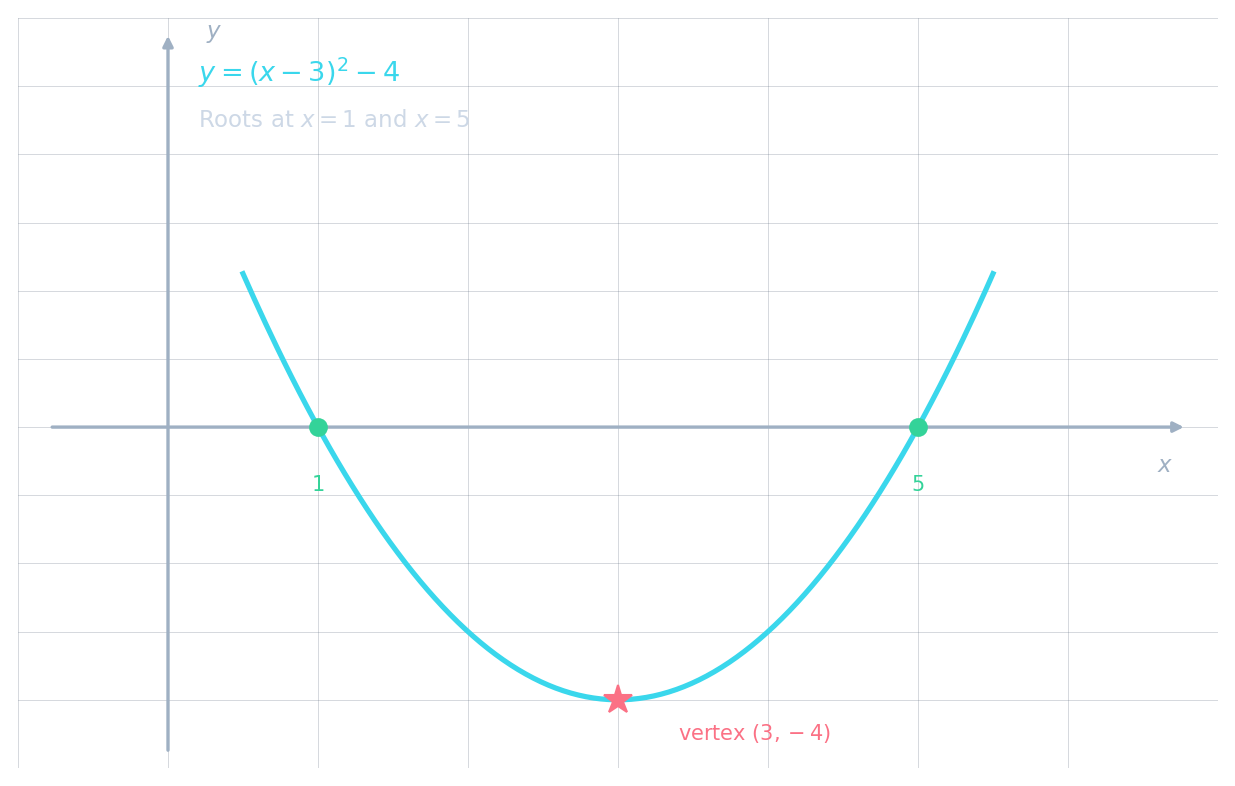
Las raíces de una ecuación cuadrática y cómo se relacionan con sus coeficientes
Roots of a polynomial · Raíces de un polinomio
y = ax³ + bx² + cx + d
The · El roots · raíces are where the curve meets the x-axis — their sum and product link to the coefficients. · Las raíces son los puntos donde la curva intersecta el eje x — su suma y producto se relacionan con los coeficientes.
For x² − 5x + 6 = 0, what is the sum of the roots α + β = −b/a? · Para x² − 5x + 6 = 0, ¿cuál es la suma de las raíces α + β = −b/a?
α + β = −b/a = −(−5)/1 = 5.
For x² − 5x + 6 = 0, what is the product αβ = c/a? · Para x² − 5x + 6 = 0, ¿cuál es el producto αβ = c/a?
αβ = c/a = 6/1 = 6.
Roots of a cubic 三次
- For a cubic $ax^3 + bx^2 + cx + d = 0$ with roots $\alpha, \beta, \gamma$:
- $\sum\alpha = -\dfrac{b}{a}$, $\sum\alpha\beta = \dfrac{c}{a}$, $\alpha\beta\gamma = -\dfrac{d}{a}$.
Watch the signs. The sum of roots is $-\dfrac{b}{a}$ (negative), and the product of three roots is $-\dfrac{d}{a}$ (also negative). Getting the signs wrong is the most common error.
Raíces de una ecuación cúbica 三次
- Para una ecuación cúbica $ax^3 + bx^2 + cx + d = 0$ con raíces $\alpha, \beta, \gamma$:
- $\sum\alpha = -\dfrac{b}{a}$, $\sum\alpha\beta = \dfrac{c}{a}$, $\alpha\beta\gamma = -\dfrac{d}{a}$.
Atención a los signos. La suma de raíces es $-\dfrac{b}{a}$ (negativo), y el producto de tres raíces es $-\dfrac{d}{a}$ (también negativo). Equivocarse en los signos es el error más común.
For x³ − 6x² + 11x − 6 = 0, the sum of roots Σα = −b/a. Find it. · Para x³ − 6x² + 11x − 6 = 0, la suma de raíces Σα = −b/a. Encuéntrela.
Σα = −(−6)/1 = 6. (Roots are 1, 2, 3: sum = 6.) · Σα = −(−6)/1 = 6. (Las raíces son 1, 2, 3: suma = 6.)
For ax³ + bx² + cx + d = 0, the product of roots αβγ = d/a. · Para ax³ + bx² + cx + d = 0, el producto de raíces αβγ = d/a.
The product of three roots is αβγ = −d/a (negative), not d/a. · El producto de tres raíces es αβγ = −d/a (negativo), no d/a.
Match each root relationship to its formula (leading coefficient a). · Asocie cada relación de raíces con su fórmula (coeficiente líder a).
Quadratic: α+β = −b/a, αβ = c/a. Cubic: Σα = −b/a, αβγ = −d/a (sign alternates with degree). · Cuadrática: α+β = −b/a, αβ = c/a. Cúbica: Σα = −b/a, αβγ = −d/a (el signo alterna con el grado).
Transforming roots
- To find an equation whose roots are changed simply, use a substitution 代换 (e.g. $w = \alpha + 1$).
- Example: $x^2 - 5x + 6 = 0$ ($\alpha+\beta=5$, $\alpha\beta=6$) → roots $\alpha+1,\beta+1$ give sum $7$, product $12$, so $x^2 - 7x + 12 = 0$.
Transformación de raíces
- Para encontrar una ecuación cuyas raíces cambian de forma sencilla, utiliza una sustitución 代换 (p. ej., $w = \alpha + 1$).
- Ejemplo: $x^2 - 5x + 6 = 0$ ($\alpha+\beta=5$, $\alpha\beta=6$) → las nuevas raíces $\alpha+1,\beta+1$ tienen suma $7$ y producto $12$, por lo tanto $x^2 - 7x + 12 = 0$.
With α + β = 5 and αβ = 6, what is the product (α+1)(β+1)? · Con α + β = 5 y αβ = 6, ¿cuál es el producto (α+1)(β+1)?
(α+1)(β+1) = αβ + α + β + 1 = 6 + 5 + 1 = 12.
Worked example — finding $\alpha^2 + \beta^2$
- Given $x^2 - 5x + 6 = 0$: $\alpha + \beta = 5$, $\alpha\beta = 6$.
- $\alpha^2 + \beta^2 = (\alpha + \beta)^2 - 2\alpha\beta = 25 - 12 = 13$.
- Sums like $\sum\alpha$ are symmetric functions of the roots.
Ejemplo resuelto — Hallar $\alpha^2 + \beta^2$
- Dada $x^2 - 5x + 6 = 0$: $\alpha + \beta = 5$, $\alpha\beta = 6$.
- $\alpha^2 + \beta^2 = (\alpha + \beta)^2 - 2\alpha\beta = 25 - 12 = 13$.
- Las sumas como $\sum\alpha$ son funciones simétricas de las raíces.
For x² − 5x + 6 = 0, α² + β² = (α+β)² − 2αβ. Find it. · Para x² − 5x + 6 = 0, α² + β² = (α+β)² − 2αβ. Encuéntrelo.
(α+β)² − 2αβ = 25 − 12 = 13.
You've got it
- quadratic: $\alpha+\beta = -\dfrac{b}{a}$, $\alpha\beta = \dfrac{c}{a}$
- cubic: $\sum\alpha = -\dfrac{b}{a}$, $\sum\alpha\beta = \dfrac{c}{a}$, $\alpha\beta\gamma = -\dfrac{d}{a}$
- transform roots with a substitution
¡Ya lo dominas!
- Cuadrática: $\alpha+\beta = -\dfrac{b}{a}$, $\alpha\beta = \dfrac{c}{a}$
- Cúbica: $\sum\alpha = -\dfrac{b}{a}$, $\sum\alpha\beta = \dfrac{c}{a}$, $\alpha\beta\gamma = -\dfrac{d}{a}$
- Transforma las raíces mediante una sustitución