Rational functions and graphs · Funciones racionales y gráficas
| English | Español |
|---|---|
| polynomial/ˌpɒlɪˈnəʊmɪəl/ | polinómica |
| vertical asymptote/ˈvɜːtɪkl ˈæsɪmptəʊt/ | asíntota vertical |
| oblique asymptote/əˈbliːk ˈæsɪmptəʊt/ | asíntota oblicua |
| denominator/dɪˈnɒmɪneɪtə/ | denominador |
| rational function/ˈræʃənl ˈfʌŋkʃn/ | función racional |
| remainder/rɪˈmeɪndə/ | resto |
| quotient/ˈkwəʊʃənt/ | cociente |
The graph that breaks the rules
- Most functions you've met are polynomials 多项式 — smooth, continuous, defined everywhere. But divide one polynomial by another and you get something wilder: vertical asymptotes 垂直渐近线, oblique asymptotes 斜渐近线, and behaviour that changes dramatically near the zeros of the denominator 分母.
- Rational functions 有理函数 are the gateway to understanding more complex curves.
La gráfica que rompe las reglas
- La mayoría de las funciones con las que te has encontrado son polinomios — suaves, continuas y definidas en todos los puntos. Pero si divides un polinomio entre otro, obtienes algo más complejo: asíntotas verticales, asíntotas oblicuas y un comportamiento que cambia drásticamente cerca de los ceros del denominador.
- Las funciones racionales son la puerta de entrada para comprender curvas más complejas.
What is a rational function?
- A rational function is a fraction of two polynomials: $f(x) = \dfrac{P(x)}{Q(x)}$.
- The denominator's zeros give vertical asymptotes (where the function shoots to $\pm\infty$).
Worked example. $f(x) = \dfrac{x^2 - 1}{x - 2}$. Vertical asymptote at $x = 2$. Dividing: $f(x) = x + 2 + \dfrac{3}{x-2}$. The oblique asymptote is $y = x + 2$.
¿Qué es una función racional?
- Una función racional es una fracción de dos polinomios: $f(x) = \dfrac{P(x)}{Q(x)}$.
- Los ceros del denominador generan asíntotas verticales (donde la función tiende a $\pm\infty$).
Ejemplo resuelto. $f(x) = \dfrac{x^2 - 1}{x - 2}$. Asíntota vertical en $x = 2$. Al dividir: $f(x) = x + 2 + \dfrac{3}{x-2}$. La asíntota oblica es $y = x + 2$.
Rational functions · Funciones racionales
y = a/(x − b) + c
A rational function has asymptotes the curve approaches but never touches. · Una función racional tiene asíntotas, la curva se acerca pero nunca las toca.
A rational function is a fraction of two polynomials. · Una función racional es una fracción de dos polinomios.
That is the definition — one polynomial over another. · Esa es la definición — un polinomio sobre otro.
Oblique (slant) asymptotes
- When the top has higher degree than the bottom, the graph has an oblique (slant) asymptote — find it by polynomial long division.
- The remainder 余数 term vanishes as $x \to \infty$, leaving the quotient 商 as the asymptote.
The curve hugs the vertical asymptote x = 2 and the oblique asymptote y = x + 2 far from the origin.
Don't forget the remainder. When dividing, the function equals the quotient plus the remainder over the divisor. The asymptote is just the quotient — the remainder tells you which side of the asymptote the curve approaches from.
Asíntotas oblicuas (inclinadas)
- Cuando el numerador tiene grado mayor que el denominador, la gráfica presenta una asíntota oblica — se encuentra mediante la división larga de polinomios.
- El término del resto desaparece cuando $x \to \infty$, dejando al cociente como asíntota.
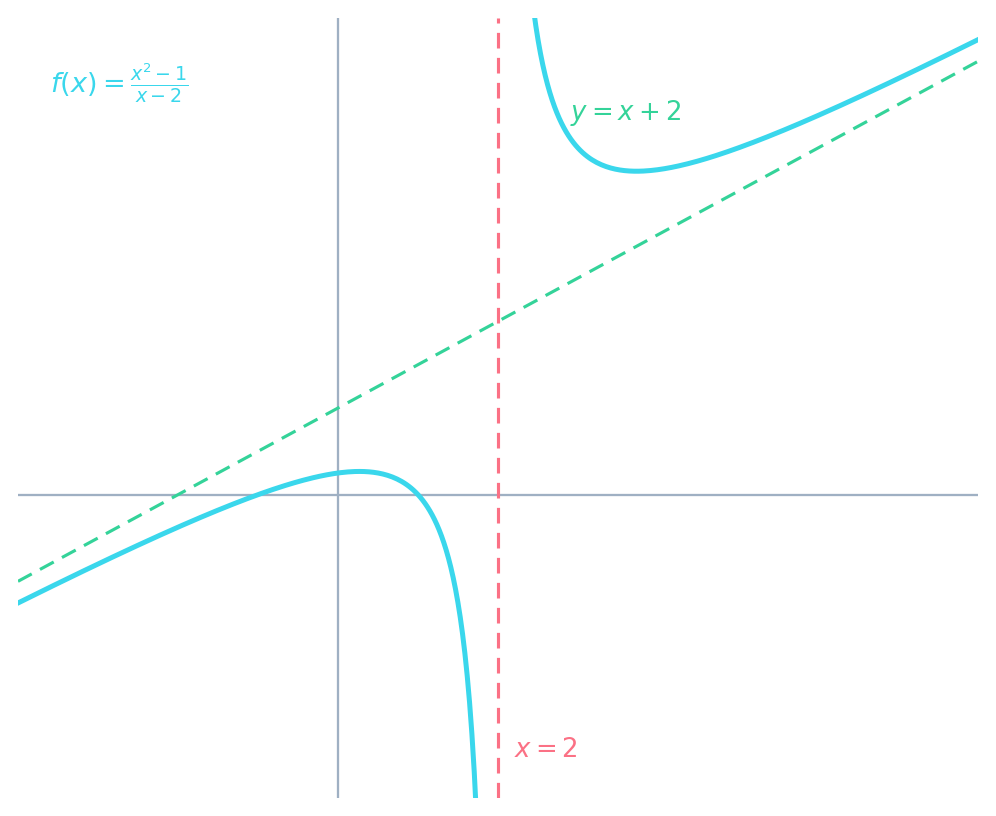
La curva se adhiere a la asíntota vertical x = 2 y a la asíntota oblica y = x + 2 lejos del origen.
No olvides el resto. Al dividir, la función es igual al cociente más el resto dividido por el divisor. La asíntota es solo el cociente; el resto indica desde qué lado de la asíntota se aproxima la curva.
A rational function has an oblique (slant) asymptote when the degree of the top is: · Una función racional tiene una asíntota oblicua (inclinada) cuando el grado del numerador es:
When the numerator's degree exceeds the denominator's, dividing out leaves a slant line the curve approaches. · Cuando el grado del numerador excede al del denominador, al dividir queda una línea inclinada a la que se aproxima la curva.
You find an oblique asymptote by: · Se encuentra una asíntota oblicua mediante:
Polynomial division gives the straight-line part the curve approaches far from the origin. · La división de polinomios da la parte de línea recta a la que se aproxima la curva lejos del origen.
For f(x) = (x²−1)/(x−2), divide to get f(x) = x + 2 + 3/(x−2). The oblique asymptote is y = x + ? · Para f(x) = (x²−1)/(x−2), al dividir se obtiene f(x) = x + 2 + 3/(x−2). La asíntota oblicua es y = x + ?
The quotient is x + 2, so the oblique asymptote is y = x + 2. · El cociente es x + 2, por lo tanto la asíntota oblicua es y = x + 2.
Related graphs
- You should relate $y = f(x)$ to:
- $y^2 = f(x)$ — only exists where $f(x) \geq 0$, symmetric about the $x$-axis.
- $y = \dfrac{1}{f(x)}$ — zeros become asymptotes, asymptotes become zeros.
- $y = |f(x)|$ — reflects negative parts above the $x$-axis.
- $y = f(|x|)$ — reflects the right half to the left.
Gráficas relacionadas
- Debes relacionar $y = f(x)$ con:
- $y^2 = f(x)$ — existe solo donde $f(x) \geq 0$, simétrica respecto al eje $x$.
- $y = \dfrac{1}{f(x)}$ — los ceros se convierten en asíntotas y las asíntotas en ceros.
- $y = |f(x)|$ — refleja las partes negativas hacia arriba del eje $x$.
- $y = f(|x|)$ — refleja la mitad derecha hacia la izquierda.
For y = 1/f(x), the zeros of f(x) become vertical asymptotes. · Para y = 1/f(x), los ceros de f(x) se convierten en asíntotas verticales.
Where f(x) = 0, 1/f(x) is undefined — giving a vertical asymptote. · Donde f(x) = 0, 1/f(x) no está definido — generando una asíntota vertical.
The graph of y = |f(x)| is obtained from y = f(x) by: · La gráfica de y = |f(x)| se obtiene de y = f(x) mediante:
The modulus reflects any part of the graph below the x-axis to above it. · El módulo refleja cualquier parte de la gráfica que esté debajo del eje x hacia arriba.
Worked example — sketching $y = \dfrac{1}{f(x)}$
- If $f(x) = x^2 - 4$ (roots at $\pm 2$, minimum at $(0, -4)$):
- $\dfrac{1}{f(x)}$ has vertical asymptotes at $x = \pm 2$.
- The minimum of $f$ at $-4$ becomes a local maximum of $\dfrac{1}{f}$ at $-\dfrac{1}{4}$.
- Find the set of values a rational function takes using the discriminant, and its turning points.
Ejemplo resuelto — esbozar $y = \dfrac{1}{f(x)}$
- Si $f(x) = x^2 - 4$ (raíces en $\pm 2$, mínimo en $(0, -4)$):
- $\dfrac{1}{f(x)}$ tiene asíntotas verticales en $x = \pm 2$.
- El mínimo de $f$ en $-4$ se convierte en un máximo local de $\dfrac{1}{f}$ en $-\dfrac{1}{4}$.
- Encuentra el conjunto de valores que toma una función racional usando el discriminante y sus puntos de giro.
You've got it
- a rational function = polynomial ÷ polynomial
- top degree > bottom degree → an oblique asymptote (found by division)
- learn the related graphs: $y^2 = f$, $1/f$, $|f|$, $f(|x|)$
Lo has logrado
- una función racional = polinomio ÷ polinomio
- grado superior > grado inferior → una asíntota oblica (se halla mediante división)
- aprende las gráficas relacionadas: $y^2 = f$, $1/f$, $|f|$, $f(|x|)$