Efficiency and market failure
Introducido| English | Significado |
|---|---|
| allocative efficiency/ˈæləkətɪv ɪˈfɪʃənsi/ | Eficiencia asignativa |
| marginal cost/ˈmɑːdʒɪnl kɒst/ | Coste marginal |
| productive efficiency/prəˈdʌktɪv ɪˈfɪʃənsi/ | Eficiencia productiva |
| average cost/ˈævrɪdʒ kɒst/ | Coste medio |
| Pareto efficiency/pæˈriːtəʊ ɪˈfɪʃənsi/ | Eficiencia de Pareto |
| deadweight loss/ˈdedweɪt lɒs/ | pérdida de eficiencia |
Cheap but unwanted, wanted but costly
- A factory can make phones at the lowest possible cost per phone and still waste resources, if it makes phones nobody wants at that price. Another firm can make exactly what people want, but at twice the necessary cost. Economists call the first failure allocative and the second productive.
- "Efficient" has precise meanings in economics. A market that misses them is failing, and the size of the failure can be measured as lost welfare.
Two kinds of efficiency
| Allocative efficiency 配置效率 | Productive efficiency 生产效率 | |
|---|---|---|
| Question | Are we making what society values most? | Are we making it at the lowest cost? |
| Condition | price = marginal cost 边际成本 (P = MC) | output at the minimum of average cost 平均成本 |
| On a PPC | the right point on the frontier | any point on the frontier |
- When both hold, no one can be made better off without making someone worse off: Pareto efficiency 帕累托效率.
Match each condition to its type of efficiency.
Dificultad 2/5 · 140 monedas + un pequeño bono en el primer intento de hoy
Each is a precise meaning of "efficient".
Worked example: why P = MC
A bakery sells bread at $3 a loaf. The marginal cost of the last loaf is$2.
Reading: consumers value the last loaf at $3 (the price they pay), but it costs society only$2 in resources. Society would gain $1 from one more loaf, so too little bread is being made.
If P < MC (for example P = $3, MC =$4): the last loaf costs more in resources than it is worth to buyers, so too much is made. Only at P = MC is no gain left from changing output.
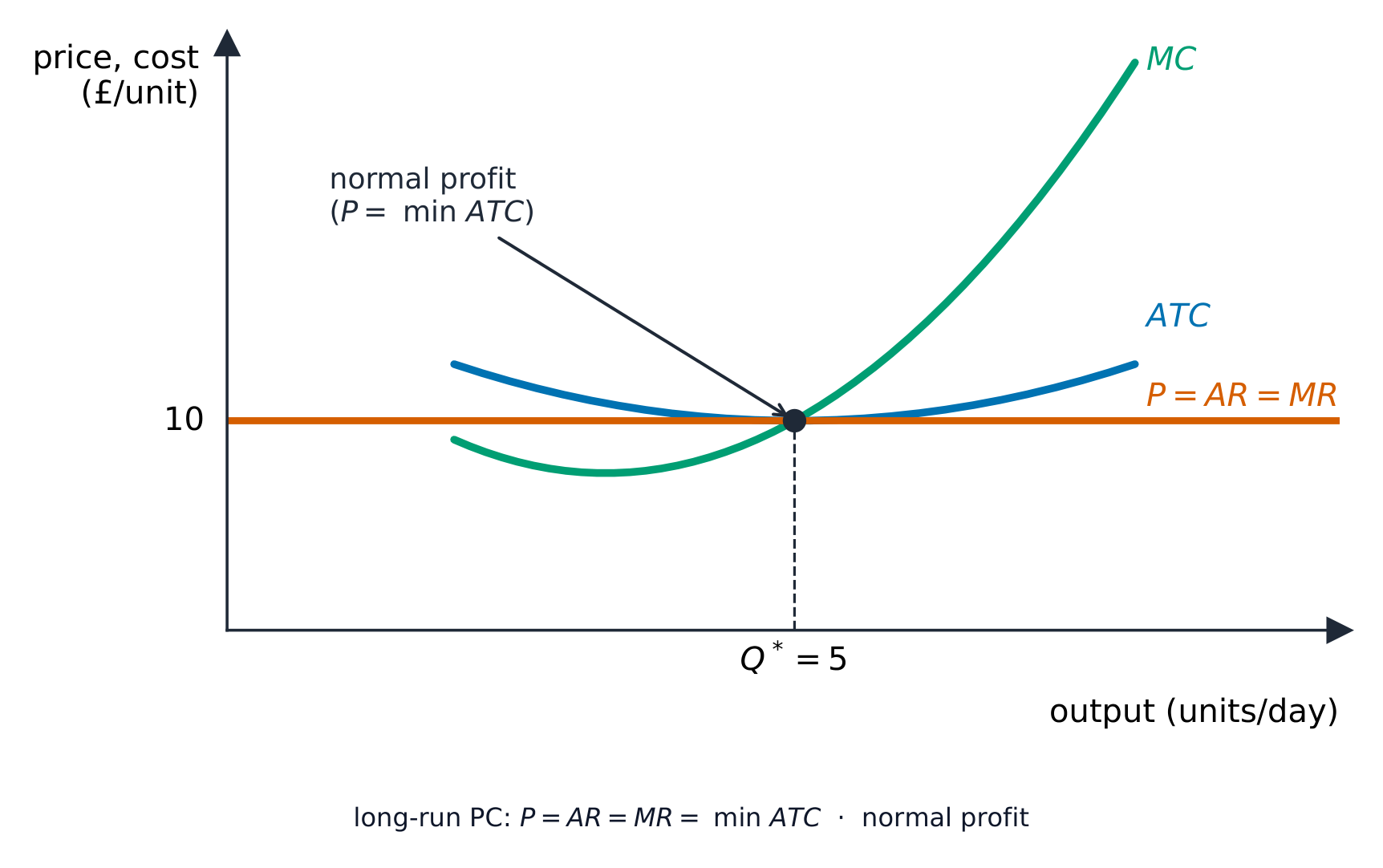
Eficiencia asignativa
The market is allocatively efficient where supply meets demand — price equals marginal cost. Market failure pushes it away from that point.
Price is $5 and marginal cost is$3. What does this show?
Dificultad 1/5 · 100 monedas + un pequeño bono en el primer intento de hoy
Buyers value the last unit more than it costs.
Why markets fail to be efficient
- Externalities (pollution: price leaves out the cost to others), public goods (no one pays for street lights), market power (a monopoly sets P above MC) and information gaps (buyers cannot judge quality).
- Each leads to too much or too little output and a deadweight loss 无谓损失: welfare that nobody gains.
Which are causes of market failure?
Dificultad 2/5 · 140 monedas + un pequeño bono en el primer intento de hoy
P = MC is the efficient condition.
Worked exam answer (8 marks style)
Question: Explain why a monopoly may be allocatively and productively inefficient.
Answer: A monopolist maximises profit where MR = MC, then sets the price on the demand curve above that point, so P > MC. Consumers value the last unit more than it costs to make, so output is lower than society would choose: allocative inefficiency and a deadweight loss (AO2). With no competitors, the monopolist has less pressure to cut costs and may not produce at the minimum of average cost: productive inefficiency (AO2). However, a large monopoly may gain economies of scale and produce at lower cost than many small firms, so the outcome depends on the market (AO3).
Producing on the PPC is not enough for allocative efficiency. Every point on the frontier is productively efficient, but only one mix matches what society values.
Every point on a production possibility curve is allocatively efficient.
Dificultad 1/5 · 100 monedas + un pequeño bono en el primer intento de hoy
All are productively efficient; only one mix is allocatively efficient.
Allocative efficiency means P = MC: resources go to what society values most. Productive efficiency means producing at minimum average cost. Externalities, public goods, market power and information gaps break efficiency and cause a deadweight loss.
Practice (8 marks). Explain why a factory that pollutes a river may produce an allocatively inefficient output.
Link the externality to P ≠ MC.