Economic growth · Crecimiento económico
| English | Español |
|---|---|
| business cycle/ˈbɪznəs ˈsaɪkl/ | ciclo empresarial |
| potential growth/pəˈtenʃl ɡrəʊθ/ | crecimiento potencial |
| actual growth/ˈæktʃuːəl ɡrəʊθ/ | crecimiento real |
| recession/rɪˈseʃn/ | recesión |
| recovery/rɪˈkʌvəri/ | recuperación |
| human capital/ˈhjuːmən ˈkæpɪtl/ | capital humano |
Why economies boom and bust
- No economy grows in a smooth line — it surges, overheats, slumps, and recovers, again and again.
- Understanding the business cycle 经济周期 and what drives growth is the heart of macro policy.
Por qué las economías crecen y declinan
- Ninguna economía crece en una línea recta — se acelera, se sobrecalienta, cae y se recupera, una y otra vez.
- Comprender el ciclo económico 经济周期 y lo que impulsa el crecimiento es el núcleo de la política macroeconómica.
Potential growth is best shown on a PPF as: · El crecimiento potencial se representa mejor en una PCP como:
Potential (capacity) growth shifts the whole PPF out; actual growth can be a move toward/along it. · El crecimiento potencial (capacidad) desplaza toda la PCP hacia afuera; el crecimiento real puede ser un movimiento hacia/along ella.
Actual vs potential growth 潜在增长
- Actual growth 实际增长 = the real rise in GDP this year (moving toward, or along, the PPF).
- Potential growth = the rise in the economy's capacity (the PPF shifting out) — from more or better resources and technology.
Crecimiento real vs potencial 潜在增长
- Crecimiento real 实际增长 = el aumento efectivo del PIB este año (acercándose a él o moviéndose a lo largo de la PPF).
- Crecimiento potencial = el aumento de la capacidad de la economía (la PPF desplazándose hacia afuera) — debido a más o mejores recursos y tecnología.
Economic growth shifts the frontier out · El crecimiento económico desplaza la frontera hacia afuera
Growth means the economy can produce more of BOTH goods — the whole frontier moves outward as resources or technology improve. · El crecimiento significa que la economía puede producir más de AMBOS bienes: toda la frontera se mueve hacia afuera a medida que mejoran los recursos o la tecnología.
A recession is conventionally two consecutive quarters of falling real GDP. · Una recesión se define convencionalmente como dos trimestres consecutivos de caída del PIB real.
Two quarters of negative real GDP growth is the common definition. · Dos trimestres de crecimiento negativo del PIB real son la definición común.
Put the phases of the business cycle in order, starting from the peak. · Ordena las fases del ciclo económico, comenzando desde el pico.
The cycle runs boom → slowdown → recession → recovery, then back to boom. · El ciclo transcurre auge → desaceleración → recesión → recuperación, y luego vuelve al auge.
The business cycle
- Real GDP cycles around its long-run trend: boom → slowdown → recession 衰退 → recovery 复苏.
- A recession is conventionally two consecutive quarters of falling real GDP.
Real GDP swings above and below its long-run trend — booms and recessions.
Worked example. GDP rises from 500bn to 520bn in a year. Growth rate = (20 ÷ 500) × 100 = 4%.
El ciclo económico
- El PIB real oscila alrededor de su tendencia a largo plazo: expansión → desaceleración → recesión 衰退 → recuperación 复苏.
- Una recesión se define convencionalmente como dos trimestres consecutivos de caída del PIB real.
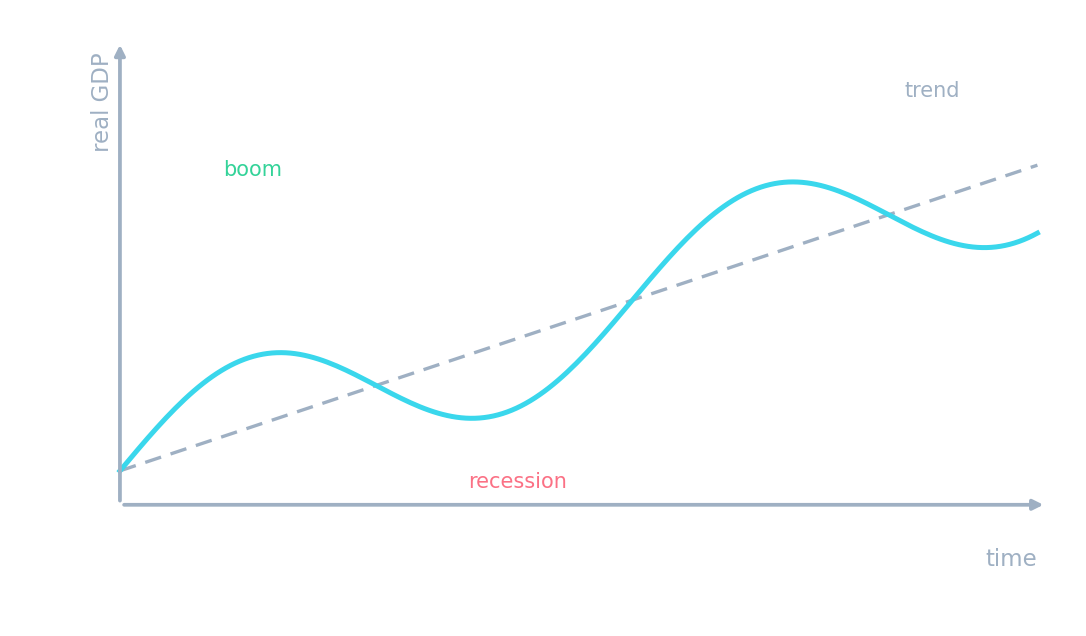
El PIB real oscila por encima y por debajo de su tendencia a largo plazo — expansiones y recesiones.
Ejemplo resuelto. El PIB pasa de 500 mil millones a 520 mil millones en un año. Tasa de crecimiento = (20 ÷ 500) × 100 = 4%.
GDP rises from 500bn to 520bn in a year. What is the growth rate (%)? · El PIB aumenta de 500 mil millones a 520 mil millones en un año. ¿Cuál es la tasa de crecimiento (%)?
(20 / 500) × 100 = 4%.
Causes and costs
- Causes of growth: investment, technology, education (human capital 人力资本), more labour.
- Benefits: higher incomes, more jobs, better public services. Costs: inflation risk, inequality, environmental damage, resource depletion.
Causas y costes
- Causas del crecimiento: inversión, tecnología, educación (capital humano 人力资本), mayor oferta laboral.
- Beneficios: mayores ingresos, más empleo, mejores servicios públicos. Costes: riesgo de inflación, desigualdad, daño ambiental, agotamiento de recursos.
Spending by firms on capital goods, which raises future capacity, is called ______. · El gasto de las empresas en bienes de capital, que aumenta la capacidad futura, se llama ______.
Investment is a key driver of both actual and potential growth. · La inversión es un motor clave tanto del crecimiento real como del potencial.
You've got it
- actual growth = real GDP rise; potential growth = capacity rise (PPF shifts out)
- the business cycle: boom → slowdown → recession → recovery, around a rising trend
- growth comes from investment, technology, human capital; it has benefits and costs
Ya lo has entendido
- crecimiento real = aumento del PIB; crecimiento potencial = aumento de capacidad (la PPF se desplaza hacia afuera)
- el ciclo económico: expansión → desaceleración → recesión → recuperación, alrededor de una tendencia ascendente
- el crecimiento proviene de la inversión, la tecnología y el capital humano; tiene beneficios y costes