National income statistics · Estadísticas de ingreso nacional
| English | Español |
|---|---|
| national income/ˈnæʃənl ˈɪŋkʌm/ | renta nacional |
| GDP/ˌdʒiː diː ˈpiː/ | PIB |
| GNI/ˌdʒiː en ˈaɪ/ | RNI |
| nominal/ˈnɒmɪnl/ | nominal |
| real GDP/rɪəl ˌdʒiː diː ˈpiː/ | el PIB real |
| GDP per capita/ˌdʒiː diː ˈpiː pɜː ˈkæpɪtə/ | PIB per cápita |
| living standards/ˈlɪvɪŋ ˈstændədz/ | nivel de vida |
Measuring a whole economy
- How do you say whether a country had a "good year"? You add up everything it produced — its national income 国民收入.
- That single figure, GDP 国内生产总值, drives headlines, elections and policy. But it must be read with care.
Medir una economía en su conjunto
- ¿Cómo saber si un país tuvo un "buen año"? Se suman todos los bienes y servicios que produjo —su ingreso nacional 国民收入.
- Esa cifra única, el PIB 国内生产总值, impulsa titulares de prensa, elecciones y políticas públicas. Pero debe leerse con cuidado.
National income flow · Flujo de ingreso nacional
Watch spending become income, output and expenditure in the circular flow. · Observar cómo el gasto se convierte en ingreso, producción y gasto en el flujo circular.
GDP, GNI 国民总收入 and GNP
- GDP (gross domestic product) = the value of all output produced within a country in a year.
- GNI (gross national income) = GDP plus net income earned abroad by the country's residents.
- Measured three equivalent ways: total output = total income = total expenditure.
National income is the value of all the goods and services a country produces
PIB, RNI 国民总收入 y PNB
- PIB (producto interno bruto) = el valor de toda la producción realizada dentro de un país en un año.
- RNI (ingreso nacional bruto) = PIB más el ingreso neto ganado en el extranjero por los residentes del país.
- Se mide de tres formas equivalentes: total producción = total ingresos = total gasto.

El ingreso nacional es el valor de todos los bienes y servicios que produce un país
GDP measures the value of all output produced: · El PIB mide el valor de toda la producción realizada:
GDP is output produced within the country's borders; GNI adds net income from abroad. · El PIB es la producción realizada dentro de las fronteras del país; el RNI suma los ingresos netos del extranjero.
GNI equals GDP plus net income earned ______ by residents. · El RNI es igual al PIB más los ingresos netos ganados ______ por los residentes.
GNI = GDP + net primary income from abroad. · RNI = PIB + renta primaria neta del extranjero.
Real vs nominal 名义
- Nominal GDP is measured at current prices; real GDP 实际GDP strips out inflation to show true changes in output.
- Only real GDP tells you whether the economy actually grew.
Worked example. Nominal GDP rises 5% but prices rise 5%. Real GDP growth = 5% − 5% = 0% — no real growth at all.
Macroeconomic equilibrium where AD meets AS
Real vs nominal 名义
- El PIB nominal se mide a precios corrientes; el PIB real 实际GDP elimina la inflación para mostrar los cambios verdaderos en la producción.
- Solo el PIB real te dice si la economía creció realmente.
Ejemplo resuelto. El PIB nominal sube un 5 % pero los precios también suben un 5 %. Crecimiento del PIB real = 5 % − 5 % = 0 % — no hay crecimiento real alguno.
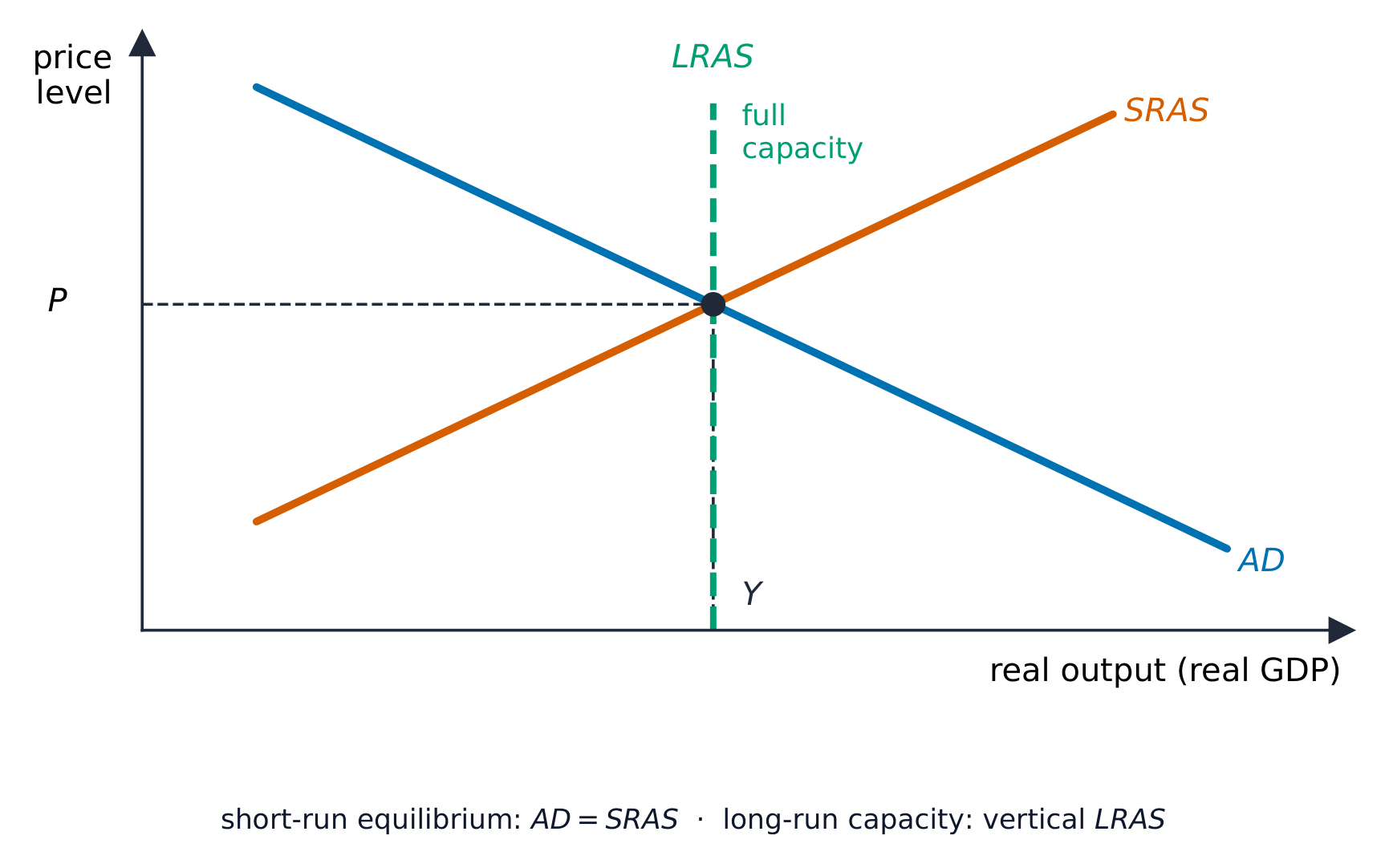
Equilibrio macroeconómico donde la DA se encuentra con la OF
Nominal GDP rises 5% while prices rise 5%. What is real GDP growth (%)? · El PIB nominal aumenta un 5% mientras que los precios aumentan un 5%. ¿Cuál es el crecimiento del PIB real (%)?
Real growth ≈ nominal growth − inflation = 5% − 5% = 0%. · Crecimiento real ≈ crecimiento nominal − inflación = 5% − 5% = 0%.
GDP per capita 人均GDP and limitations
- GDP per capita = GDP ÷ population — a better guide to living standards 生活水平 than total GDP.
- Limitations: it ignores the distribution of income, non-market activity (home/black-market work), and wellbeing (leisure, environment).
Bigger GDP ≠ better off. A country can grow its GDP while most people see no gain (if the rise goes to a few) or while pollution rises. GDP measures output, not welfare.
PIB per cápita 人均GDP y limitaciones
- PIB per cápita = PIB ÷ población — una mejor guía para el nivel de vida 生活水平 que el PIB total.
- Limitaciones: ignora la distribución de los ingresos, la actividad no mercantil (trabajo doméstico/black-market) y el bienestar (ocio, medio ambiente).
Mayor PIB ≠ mayor bienestar. Un país puede aumentar su PIB mientras la mayoría de la gente no ve ningún beneficio (si el aumento va a unos pocos) o mientras aumenta la contaminación. El PIB mide producción, no bienestar.
A country has GDP of 600 billion dollars and a population of 30 million. What is GDP per capita (in dollars)? · Un país tiene un PIB de 600 mil millones de dólares y una población de 30 millones. ¿Cuál es el PIB per cápita (en dólares)?
600,000,000,000 / 30,000,000 = 20,000 per person. · 600,000,000,000 / 30,000,000 = 20,000 por persona.
GDP per capita ignores how income is distributed across the population. · El PIB per cápita ignora cómo se distribuye el ingreso entre la población.
An average hides inequality — a key limitation of GDP as a welfare measure. · Un promedio oculta la desigualdad: una limitación clave del PIB como medida de bienestar.
You've got it
- GDP = output produced within a country; GNI = GDP + net income from abroad
- real GDP removes inflation (only real growth counts); nominal is at current prices
- GDP per capita = GDP ÷ population; GDP ignores distribution, non-market work and wellbeing
Ya lo dominas
- PIB = producción realizada dentro de un país; RNI = PIB + ingreso neto del extranjero
- El PIB real elimina la inflación (solo cuenta el crecimiento real); el nominal está a precios corrientes
- PIB per cápita = PIB ÷ población; el PIB ignora la distribución, el trabajo no mercantil y el bienestar