Price controls, regulation and government failure
Introducido| English | Significado |
|---|---|
| shortage/ˈʃɔːtɪdʒ/ | escasez |
| surplus/ˈsɜːpləs/ | excedente |
| price ceiling/praɪs ˈsiːlɪŋ/ | techo de precios |
| price floor/praɪs flɔː/ | piso de precios |
| government failure/ˈɡʌvənmənt ˈfeɪlɪə/ | fracaso gubernamental |
| unintended consequences/ˌʌnɪnˈtendɪd ˈkɒnsɪkwənsɪz/ | consecuencias no intencionadas |
When the government sets the price
- Rent caps to help tenants, minimum wages to help workers — governments sometimes override the market price directly.
- But forcing price away from equilibrium always creates a shortage 短缺 or a surplus 过剩.
A maximum price (price ceiling) set below equilibrium causes a:
Dificultad 1/5 · 100 monedas + un pequeño bono en el primer intento de hoy
Below equilibrium, demand exceeds supply → a persistent shortage.
A price ceiling is a legal ______ price (it binds when set below equilibrium).
Dificultad 1/5 · 100 monedas + un pequeño bono en el primer intento de hoy
A ceiling is a maximum; a floor is a minimum.
Maximum price (price ceiling 价格上限)
- A price ceiling set below equilibrium (e.g. rent control) makes the good cheaper — but demand now exceeds supply.
- The result is a persistent shortage (and often queues or black markets).
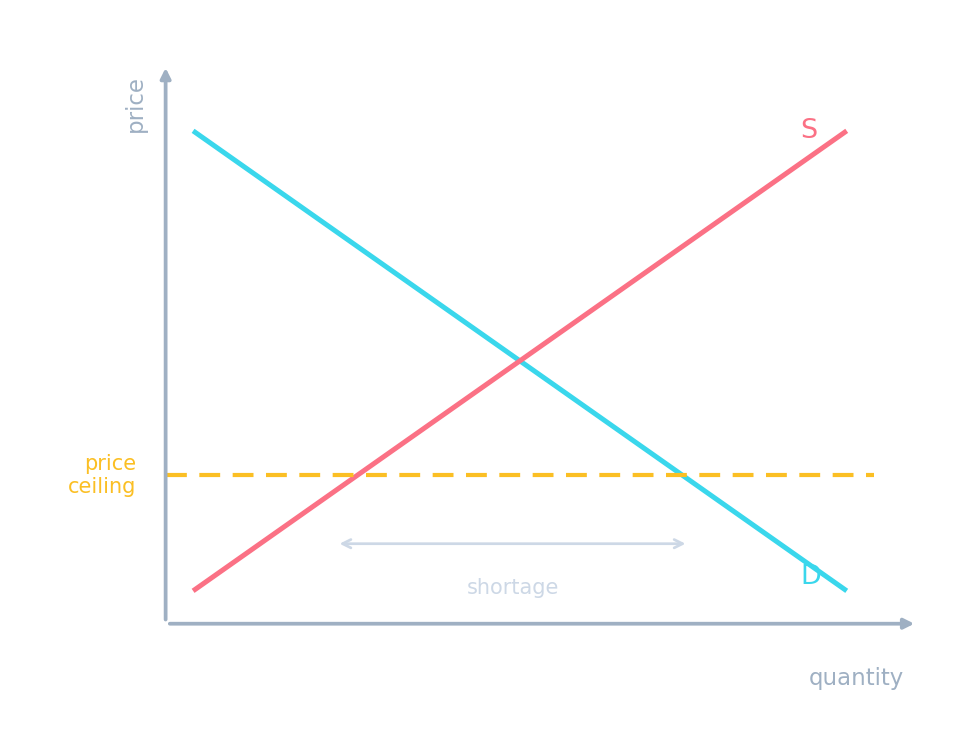
A ceiling below equilibrium: quantity demanded exceeds quantity supplied — a shortage.
Price controls
A price set away from equilibrium causes a shortage or a excedente.
A maximum price below equilibrium
The equilibrium price is 20. A maximum price of 14 raises quantity demanded and cuts quantity supplied, so a shortage opens and only the smaller quantity is traded. The straight-line curves here are illustrative. A maximum set above 20 changes nothing.
A minimum wage (a price floor in the labour market) set above equilibrium can cause:
Dificultad 1/5 · 100 monedas + un pequeño bono en el primer intento de hoy
Above equilibrium, supply exceeds demand → a surplus, i.e. unemployment.
Match each control to its result.
Dificultad 2/5 · 140 monedas + un pequeño bono en el primer intento de hoy
A binding ceiling creates excess demand; a binding floor creates excess supply.
Minimum price (price floor 价格下限)
- A price floor set above equilibrium (e.g. a minimum wage, or farm price support) raises the price — but supply now exceeds demand.
- The result is a surplus (e.g. unemployment in a labour market, or unsold food).
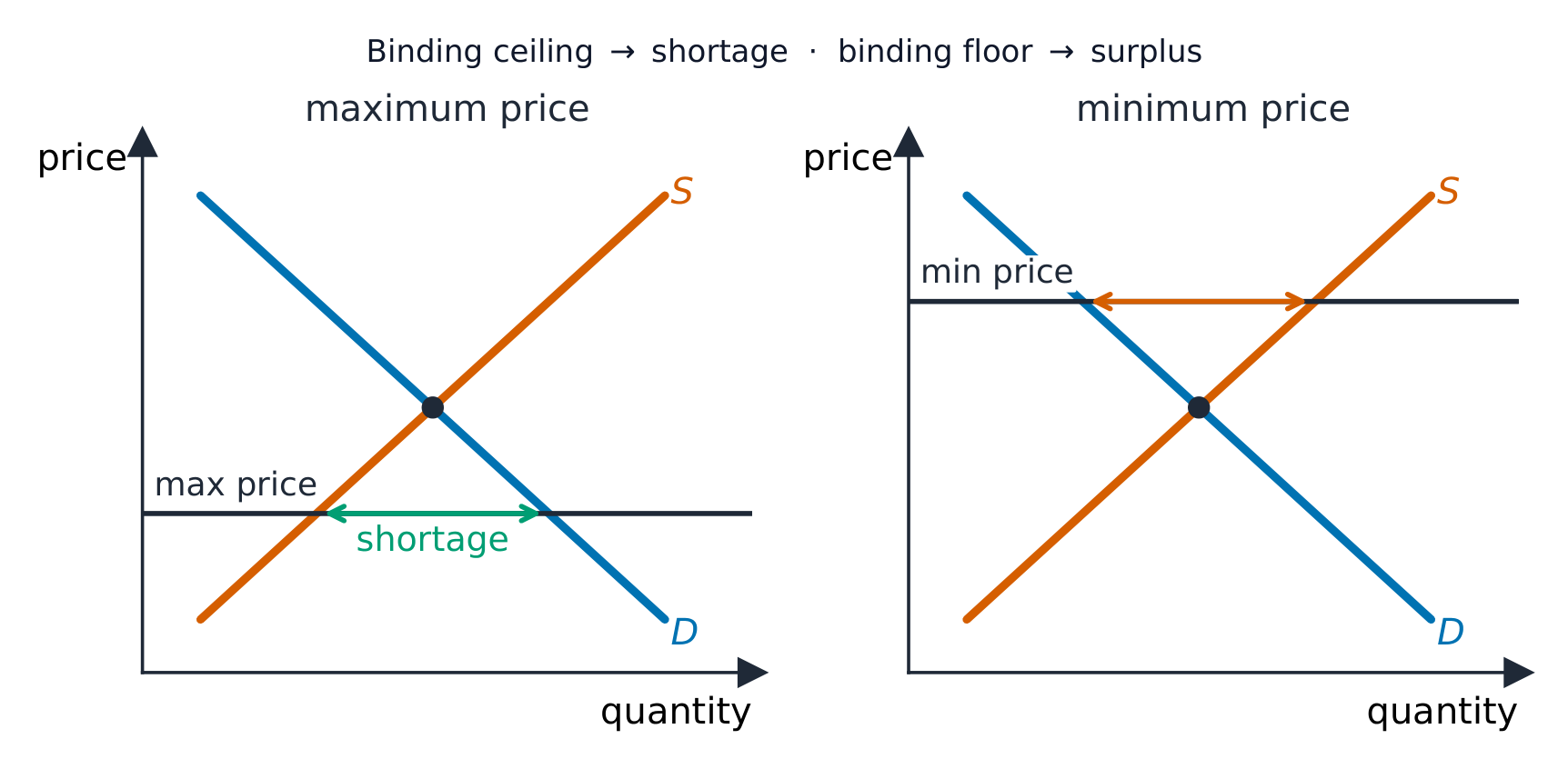
A maximum price causes a shortage; a minimum price causes a surplus
Government failure occurs when intervention creates unintended consequences that worsen welfare.
Dificultad 1/5 · 100 monedas + un pequeño bono en el primer intento de hoy
E.g. rent caps can reduce the supply of housing over time.
Government failure 政府失灵
- Intervention can make things worse — government failure — through:
- unintended consequences 意外后果 (rent caps → fewer flats built), information gaps, and administrative costs.
Ceiling = shortage, floor = surplus. A ceiling is a maximum (binds below equilibrium → shortage); a floor is a minimum (binds above → surplus). Don't swap them.
Worked example: a rent cap
In a city, the free-market rent is £1,200 a month, with 50,000 flats let. The council caps rent at £900. At £900, 70,000 households want flats but landlords offer only 40,000. Analyse the result.
- The ceiling is below equilibrium, so there is a shortage of 30,000 flats (70,000 − 40,000). Fewer flats are let than before (40,000 vs 50,000).
- Tenants who find a flat gain, but others queue or pay illegal "key money" (a black market), and landlords may let quality fall or sell up. Fewer new flats are built: an unintended consequence, a form of government failure.
At a maximum price, quantity demanded is 900 units and quantity supplied is 650. How large is the shortage?
Dificultad 2/5 · 140 monedas + un pequeño bono en el primer intento de hoy
900 − 650 = 250.
A minimum price set below the equilibrium price has no effect on the market.
Dificultad 1/5 · 100 monedas + un pequeño bono en el primer intento de hoy
The market price is already above the floor, so the floor does not bind.
You've got it
- price ceiling (max, below equilibrium) → shortage; price floor (min, above) → surplus
- both move the market away from equilibrium, creating excess demand or supply
- government failure: intervention with unintended consequences can worsen welfare
Write from a maximum price of 14
- The equilibrium price is 20.
- The government sets a maximum price of 14.
Does this maximum price bind, and what shortage pressure follows?
A maximum price binds only below equilibrium.
What does a maximum price of 14 do here?
Dificultad 1/5 · 100 monedas + un pequeño bono en el primer intento de hoy
A ceiling below equilibrium is effective.