Price elasticity of supply · Elasticidad precio de la oferta
| English | Español |
|---|---|
| price elasticity of supply/praɪs ɪlæˈstɪsɪti ɒv səˈplaɪ/ | elasticidad precio de la oferta |
| elastic/ɪˈlæstɪk/ | elástica |
| inelastic/ɪnɪˈlæstɪk/ | inelástica |
| spare capacity/speə kəˈpæsɪti/ | capacidad holgada |
| mobility of factors/məʊˈbɪlɪti ɒv ˈfæktəz/ | movilidad de factores |
Why farmers can't react overnight
- If strawberry prices jump, a factory can boost output in days — but a farmer must wait a whole growing season. Producers differ in how fast they respond.
- Price elasticity of supply 供给价格弹性 (PES) measures that responsiveness.
Por qué los agricultores no pueden reaccionar de un día para otro
- Si el precio de las fresas sube, una fábrica puede aumentar la producción en días — pero un agricultor debe esperar una temporada completa de cultivo. Los productores difieren en la rapidez con que responden.
- La elasticidad precio de la oferta (EPO) mide esa capacidad de respuesta.
Measuring PES
- PES measures how quantity supplied responds to a price change:
- It is normally positive (price and quantity supplied move together).
Equilibrium price and quantity where demand meets supply
Medición de la EPO
- La EPO mide cómo responde la cantidad ofrecida a un cambio de precio:
- Generalmente es positiva (el precio y la cantidad ofrecida se mueven en la misma dirección).
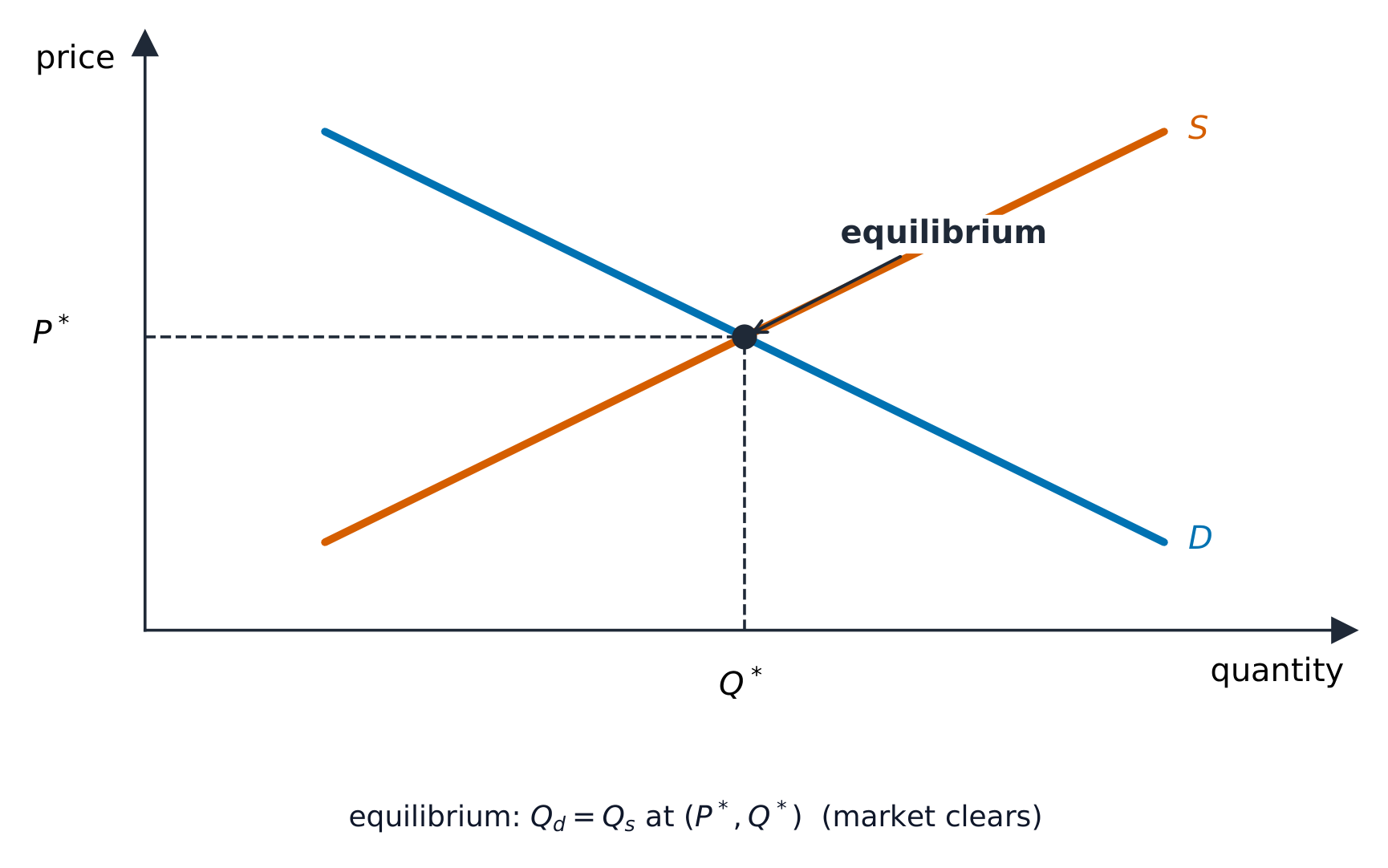
Precio y cantidad de equilibrio donde la demanda encuentra a la oferta
Demand & supply · Demanda y oferta
Supply elasticity is how much quantity responds to price. · La elasticidad de la oferta es cuánto responde la cantidad al precio.
Price rises 20% and quantity supplied rises 30%. What is the PES? · El precio sube un 20% y la cantidad ofrecida aumenta un 30%. ¿Cuál es el PEOS?
PES = 30% / 20% = 1.5 — elastic. · PEOS = 30% / 20% = 1,5 — elástica.
PES = (% change in quantity supplied) ÷ (% change in ______). · PEOS = (% variación en la cantidad ofrecida) ÷ (% variación en ______).
PES divides the % change in quantity supplied by the % change in price. · El PEOS divide la % variación en la cantidad ofrecida entre la % variación en el precio.
Elastic 富有弹性 vs inelastic 缺乏弹性 supply
- $\text{PES} > 1$ → elastic (output responds easily — spare capacity 闲置产能, easy to store).
- $\text{PES} < 1$ → inelastic (output is hard to change quickly — farming, limited capacity).
A steep supply curve is inelastic; a flat one is elastic. Spare capacity and time make supply more elastic.
Worked example. Price rises 20% and quantity supplied rises 30%. PES $= \dfrac{30\%}{20\%} = 1.5$ — elastic.
Oferta elástica富有弹性 vs inelástica缺乏弹性
- $\text{PES} > 1$ → elástica (la producción responde fácilmente — capacidad ociosa闲置产能, fácil almacenamiento).
- $\text{PES} < 1$ → inelástica (la producción es difícil de cambiar rápidamente — agricultura, capacidad limitada).

Una curva de oferta empinada es inelástica; una plana es elástica. La capacidad ociosa y el tiempo hacen que la oferta sea más elástica.
Ejemplo resuelto. El precio aumenta un 20% y la cantidad ofrecida aumenta un 30%. $= \dfrac{30\%}{20\%} = 1.5$ — elástica.
Supply is elastic when PES is: · La oferta es elástica cuando el PEOS es:
PES > 1 means quantity supplied responds strongly to price. · Un PEOS > 1 significa que la cantidad ofrecida responde fuertemente al precio.
Why is the supply of a farm crop usually inelastic in the short run? · ¿Por qué la oferta de cultivos agrícolas suele ser inelástica a corto plazo?
Production takes a season, so quantity supplied can't respond quickly to price — inelastic. · La producción requiere una temporada, por lo que la cantidad ofrecida no puede responder rápidamente al precio — es inelástica.
Time is the key
- The longer the time period, the more elastic supply becomes — firms can build capacity, hire, and adjust.
- Other determinants: spare capacity, ease of storing stock, and mobility of factors 要素流动性.
El tiempo es la clave
- Cuanto mayor es el periodo de tiempo, más elástica se vuelve la oferta — las empresas pueden construir capacidad, contratar personal y ajustar su producción.
- Otros determinantes: capacidad ociosa, facilidad para almacenar existencias y movilidad de los factores要素流动性.
Supply tends to be more elastic over a longer time period. · La oferta tiende a ser más elástica en periodos de tiempo más largos.
Given time, firms can expand capacity, so supply responds more — more elastic. · Con el paso del tiempo, las empresas pueden expandir su capacidad, por lo que la oferta responde más — siendo más elástica.
You've got it
- $\text{PES} = \dfrac{\%\Delta Q_s}{\%\Delta P}$, normally positive
- $\text{PES}>1$ elastic, $\text{PES}<1$ inelastic
- supply is more elastic with more time, spare capacity, and storable stock
Lo has entendido
- $\text{PES} = \dfrac{\%\Delta Q_s}{\%\Delta P}$, generalmente positiva
- $\text{PES}>1$ elástica, $\text{PES}<1$ inelástica
- la oferta es más elástica con más tiempo, capacidad ociosa y existencias almacenables