Análisis del punto de equilibrio
Introducido| English | Significado |
|---|---|
| break-even point/breɪk ˈiːvən pɔɪnt/ | punto de equilibrio |
| contribution/ˌkɒntrɪˈbjuːʃn/ | contribución |
| fixed costs/fɪkst kɒsts/ | Costes fijos |
| break-even output/breɪk ˈiːvən ˈaʊtpʊt/ | producción de equilibrio |
| total revenue/ˈtəʊtl ˈrevənjuː/ | ingreso total |
| margin of safety/ˈmɑːdʒɪn ɒv ˈseɪfti/ | margen de seguridad |
The point where you stop losing money
- A new café pays rent and wages from day one, but takings build slowly. At some level of sales, it finally covers its costs.
- That magic level is the break-even point 盈亏平衡点.
El precio de venta es 15 y el costo variable por unidad es 9. ¿Cuál es la contribución por unidad?
Dificultad 2/5 · 140 monedas + un pequeño bono en el primer intento de hoy
Contribución = 15 − 9 = 6.
Precio de venta menos costo variable por unidad da la ______ por unidad.
Dificultad 1/5 · 100 monedas + un pequeño bono en el primer intento de hoy
La contribución cubre los costos fijos y luego se convierte en ganancia.
Contribution 贡献
- Contribution per unit = selling price − variable cost per unit.
- Each unit sold "contributes" this much towards covering fixed costs 固定成本.
Los costos fijos son 3,000 y la contribución por unidad es 6. ¿Cuál es la producción en el punto de equilibrio (unidades)?
Dificultad 2/5 · 140 monedas + un pequeño bono en el primer intento de hoy
Punto de equilibrio = 3000 ÷ 6 = 500 unidades.
En el punto de equilibrio, la empresa obtiene:
Dificultad 1/5 · 100 monedas + un pequeño bono en el primer intento de hoy
Los ingresos equivalen exactamente a los costos totales: ni ganancia ni pérdida.
The break-even point
- Break-even output 盈亏平衡产量 = fixed costs ÷ contribution per unit.
- At this output, total revenue 总收入 exactly equals total cost — no profit, no loss.
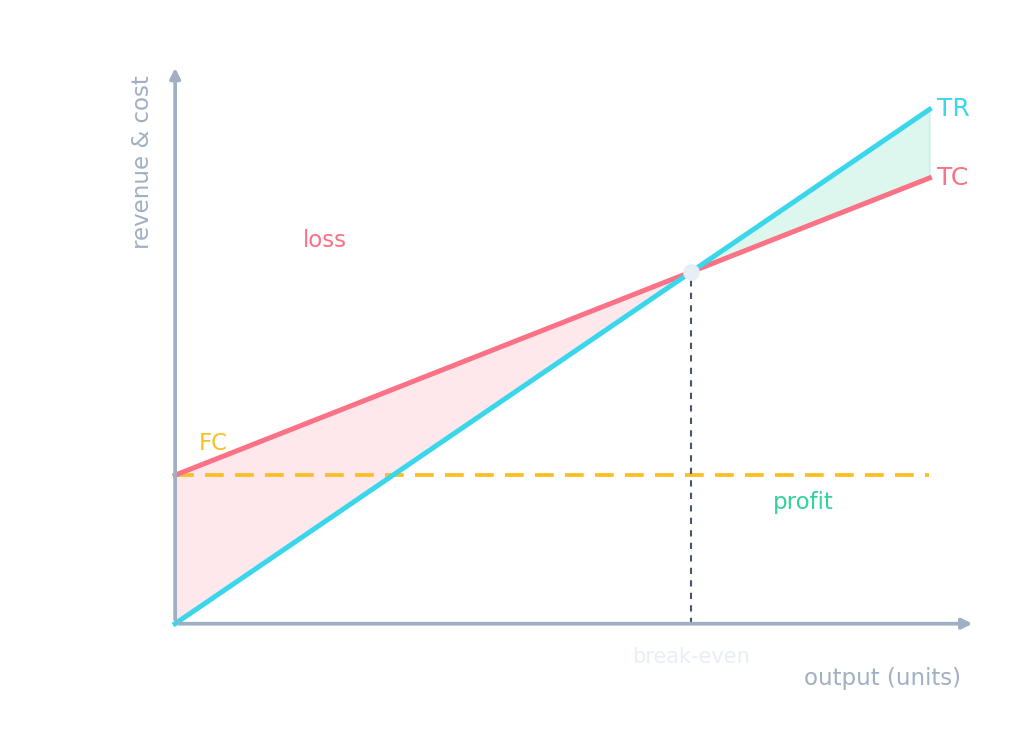
Below break-even the firm makes a loss; above it, a profit.
La producción en el punto de equilibrio es 400 y la empresa vende 520. ¿Cuál es el margen de seguridad (unidades)?
Dificultad 2/5 · 140 monedas + un pequeño bono en el primer intento de hoy
Margen de seguridad = 520 − 400 = 120 unidades.
Margin of safety 安全边际
- Margin of safety = actual output − break-even output.
- It shows how far sales can fall before the firm makes a loss.
Worked example. Price 20, variable cost 12 → contribution = 8. Fixed costs 4,000 → break-even = 4000 ÷ 8 = 500 units. If the firm sells 650, the margin of safety is 650 − 500 = 150 units.
Test the assumptions behind break-even
$Q_{BE}=\frac{F}{p-v};\quad \pi=(p-v)Q-F$
Changing sales volume changes profit while fixed costs remain. The starting values match the lesson example.
You've got it
- contribution per unit = price − variable cost per unit
- break-even output = fixed costs ÷ contribution per unit (revenue = total cost)
- margin of safety = actual − break-even output: how far sales can fall
Write from the data: find the margin of safety
- Price is 20 and variable cost is 12. Fixed costs are 1600.
- The firm sells 260 units.
- Find contribution, break-even output and the margin of safety.
El precio es 20, el costo variable por unidad es 12 y los costos fijos son 1600. La empresa vende 260 unidades. ¿Cuáles son la contribución por unidad, la producción de equilibrio y el margen de seguridad?
Precio menos costo variable es 8. Costo fijo dividido entre 8 es 200. Ventas menos 200 es 60.
¿Cuál es el margen de seguridad?
Dificultad 1/5 · 100 monedas + un pequeño bono en el primer intento de hoy
Las ventas de 260 están 60 por encima del nivel de equilibrio. Otras opciones — 120 unidades (el margen de la lección); 200 unidades (el nivel de equilibrio).