- Recordar las reacciones (reactivos y condiciones) mediante las cuales se pueden producir alcanos: (a) adición de hidrógeno a un alqueno en una reacción de hidrogenación, $\text{H}_2\text{(g)}$ y catalizador de $\text{Pt/Ni}$ y calor (b) craqueo de un alcano de cadena más larga, calor con $\text{Al}_2\text{O}_3$
- Describir: (a) la combustión completa e incompleta de alcanos (b) la sustitución por radicales libres de alcanos por $\text{Cl}_2$ o $\text{Br}_2$ en presencia de luz ultravioleta, tal como lo ejemplifican las reacciones del etano
- Describir el mecanismo de sustitución por radicales libres con referencia a los pasos de iniciación, propagación y terminación
- Sugerir cómo el craqueo puede utilizarse para obtener alcanos y alquenos más útiles de menor $M_r$ a partir de fracciones más pesadas del petróleo bruto
- Comprender la baja reactividad general de los alcanos, incluido hacia reactivos polares, en términos de la fuerza de los enlaces $\text{C–H}$ y su relativa falta de polaridad
- Reconocer las consecuencias medioambientales del monóxido de carbono, óxidos de nitrógeno e hidrocarburos no quemados derivados de la combustión de alcanos en motores de combustión interna, así como su eliminación catalítica
Hidrocarburos
A-Level Química · Tema 14
 9:53
Hidrocarburos
Dos líquidos transparentes, ambos nada más que carbono e hidrógeno. Y dos tubos de ensayo con agua de bromo naranja. Agita el primer líquido en un tubo, el segundo en el…
Narración en inglés · subtítulos en inglés y 中文 que puedes cambiar
14.1
Alcanos

Syllabus
Fuente: Plan de estudios Cambridge International
English
Alkanes 烷烃 are saturated hydrocarbons (general formula $\text{C}_n\text{H}_{2n+2}$).
Making alkanes
- hydrogenation 氢化: add hydrogen to an alkene 烯烃, using a $\text{Pt}$ or $\text{Ni}$ catalyst and heat.
- cracking 裂化: break a long-chain alkane into shorter ones by heating with $\text{Al}_2\text{O}_3$.
$$\text{CH}_2{=}\text{CH}_2 + \text{H}_2 \rightarrow \text{CH}_3\text{CH}_3 \qquad (\text{Ni catalyst, about } 150\,^{\circ}\text{C})$$
$$\text{C}_{10}\text{H}_{22} \rightarrow \text{C}_8\text{H}_{18} + \text{C}_2\text{H}_4 \qquad (\text{hot Al}_2\text{O}_3)$$
Cracking always gives at least one alkene: an alkane has too few hydrogen atoms to make two smaller alkanes.
Worked example. $\text{C}_{14}\text{H}_{30}$ is cracked to give octane, $\text{C}_8\text{H}_{18}$, and three molecules of one other product. Find that product. Carbon: $14 - 8 = 6$ left over; hydrogen: $30 - 18 = 12$ left over. Shared between three molecules, each has $2$ C and $4$ H, so the product is ethene, $\text{C}_2\text{H}_4$: $\text{C}_{14}\text{H}_{30} \rightarrow \text{C}_8\text{H}_{18} + 3\text{C}_2\text{H}_4$.
Combustion
In combustion 燃烧 an alkane burns in oxygen:
- complete combustion 完全燃烧 (plenty of oxygen) gives carbon dioxide and water.
- incomplete combustion 不完全燃烧 (not enough oxygen) gives water plus toxic carbon monoxide 一氧化碳 ($\text{CO}$) and soot (carbon).
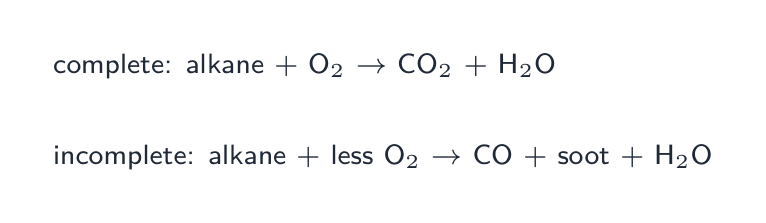
$$\text{CH}_4 + 1\tfrac12\,\text{O}_2 \rightarrow \text{CO} + 2\text{H}_2\text{O} \qquad \text{CH}_4 + \text{O}_2 \rightarrow \text{C} + 2\text{H}_2\text{O}$$
You are often asked to write the balanced equation. Balance it in a fixed order - carbon first, then hydrogen, and oxygen last - because oxygen is the only element left on just one side:
$$\text{C}_6\text{H}_{14} + 9\tfrac{1}{2}\,\text{O}_2 \rightarrow 6\,\text{CO}_2 + 7\,\text{H}_2\text{O}$$
The 6 carbons fix $6\,\text{CO}_2$; the 14 hydrogens fix $7\,\text{H}_2\text{O}$; counting the oxygens on the right gives $12 + 7 = 19$, so the left needs $19 \div 2 = 9\tfrac{1}{2}$. A half of $\text{O}_2$ is perfectly acceptable in this equation - and if the question asks for whole numbers, simply double everything ($2\,\text{C}_6\text{H}_{14} + 19\,\text{O}_2 \rightarrow 12\,\text{CO}_2 + 14\,\text{H}_2\text{O}$).
Free-radical substitution
Alkanes react with chlorine or bromine by free-radical substitution 自由基取代, in ultraviolet light 紫外线. For ethane and chlorine the mechanism has three steps:
- initiation 引发 — UV light splits the halogen into two free radicals 自由基: $\;\text{Cl}_2 \rightarrow 2\,\text{Cl}\cdot$ This kind of break is homolytic fission 均裂: the bond splits evenly, one electron going to each atom, which is what makes two radicals. (The opposite, heterolytic fission 异裂, sends both electrons to one atom and makes a pair of ions - that is what happens in the polar mechanisms such as electrophilic addition.) Examiners ask for this word by name, so use it.
- propagation 增长 — radicals react and make new radicals:
$$\text{Cl}\cdot + \text{C}_2\text{H}_6 \rightarrow \text{C}_2\text{H}_5\cdot + \text{HCl} \qquad \text{C}_2\text{H}_5\cdot + \text{Cl}_2 \rightarrow \text{C}_2\text{H}_5\text{Cl} + \text{Cl}\cdot$$
- termination 终止 — two radicals join, ending the chain: $\;\text{Cl}\cdot + \text{C}_2\text{H}_5\cdot \rightarrow \text{C}_2\text{H}_5\text{Cl}$
Any two radicals can meet in termination, so there are three possible steps:
$$\text{Cl}\cdot + \text{Cl}\cdot \rightarrow \text{Cl}_2 \qquad \text{C}_2\text{H}_5\cdot + \text{Cl}\cdot \rightarrow \text{C}_2\text{H}_5\text{Cl} \qquad \text{C}_2\text{H}_5\cdot + \text{C}_2\text{H}_5\cdot \rightarrow \text{C}_4\text{H}_{10}$$
The small amount of butane found in the products is evidence for this mechanism: it can only form when two ethyl radicals join. A $\text{Cl}\cdot$ can also attack the chloroethane already made, giving $\text{C}_2\text{H}_4\text{Cl}_2$ and further products, so the reaction gives a mixture. Using an excess of ethane makes this less likely.

Why cracking is useful, and why alkanes are unreactive
Cracking turns heavy fractions of crude oil 原油 into more useful, lower-$M_r$ alkanes and alkenes. (A fraction 馏分 is a group of molecules with a similar boiling-point range.) Crude oil contains more of the heavy fractions than people need, and less petrol than people need, so cracking matches supply to demand. The shorter alkanes are used as fuels such as petrol, and the alkenes are the starting materials for polymers and other chemicals.
Alkanes are generally unreactive, especially towards polar reagents. This is because the C–H and C–C bonds are strong and have little polarity 极性, so there is no charge to attract an attacking species.
Environmental effects
Burning alkanes in an internal combustion engine gives off carbon monoxide, oxides of nitrogen and unburnt hydrocarbons. A catalytic converter removes these by turning them into harmless gases.
- Carbon monoxide, CO, comes from incomplete combustion of the fuel. It is toxic: it binds to haemoglobin, so the blood carries less oxygen.
- Oxides of nitrogen, $\text{NO}_x$, form because $\text{N}_2$ and $\text{O}_2$ from the air react at the high temperature in the engine: $\text{N}_2 + \text{O}_2 \rightarrow 2\text{NO}$, then $2\text{NO} + \text{O}_2 \rightarrow 2\text{NO}_2$. They cause acid rain and photochemical smog.
- Unburnt hydrocarbons are fuel that passes through without burning. They cause photochemical smog, and some are carcinogens.
The catalytic converter 催化转化器 holds platinum and rhodium on a ceramic honeycomb, which gives a large surface area. On its surface, CO and NO react together, and the hydrocarbons are oxidised:
$$2\text{CO} + 2\text{NO} \rightarrow 2\text{CO}_2 + \text{N}_2$$
$$\text{C}_8\text{H}_{18} + 12\tfrac12\,\text{O}_2 \rightarrow 8\text{CO}_2 + 9\text{H}_2\text{O}$$
In the first reaction, CO is oxidised (carbon goes from $+2$ to $+4$) while NO is reduced (nitrogen goes from $+2$ to $0$).
Explorar
El carbono tetraédrico
Cada carbono en un alcano tiene cuatro pares de enlace y ningún par solitario — se separan lo máximo posible en un tetraedro (109.5°).
Explorar
Sustitución de radicales libres
El metano reacciona con el cloro bajo luz UV mediante una cadena de pasos de radicales.
Vocabulario
Entrenar
| English | Español |
|---|---|
| alkane/ˈælkeɪn/ | alcano |
| hydrogenation/haɪˈdrɒdʒəneɪʃn/ | hidrogenación |
| alkene/ˈælkiːn/ | alqueno |
| cracking/ˈkrækɪŋ/ | craqueo |
| combustion/kəmˈbʌstʃn/ | combustión |
| complete combustion/kəmˈpliːt kəmˈbʌstʃn/ | combustión completa |
| incomplete combustion/ɪŋkəmˈpliːt kəmˈbʌstʃn/ | combustión incompleta |
| carbon monoxide/ˈkɑːbən mʌˈnɒksaɪd/ | monóxido de carbono |
| free-radical substitution/friː ˈrædɪkl ˌsʌbstɪˈtjuːʃn/ | sustitución por radicales libres |
| free radical/friː ˈrædɪkl/ | radical libre |
| ultraviolet light/ˌʊltrəˈvaɪəlɪt laɪt/ | luz ultravioleta |
| initiation/ɪˌnɪʃɪˈeɪʃn/ | iniciación |
| homolytic fission/ˌhɒməˈlɪtɪk ˈfɪʃn/ | fisión homolítica |
| heterolytic fission/ˌhetrəˈlɪtɪk ˈfɪʃn/ | fisión heterolítica |
| propagation/ˌprɒpəˈɡeɪʃn/ | propagación |
| termination/ˌtɜːmɪˈneɪʃn/ | terminación |
| crude oil/kruːd ɔɪl/ | petróleo crudo |
| fraction/ˈfrækʃn/ | fracción |
| polarity/pəʊˈlærɪti/ | polaridad |
| catalytic converter/ˌkætəˈlɪtɪk kənˈvɜːtə/ | A device that uses catalysts to convert harmful vehicle exhaust gases into less harmful substances. |
14.2
Alquenos
Syllabus
- Recordar las reacciones (incluyendo los reactivos y condiciones) mediante las cuales se pueden producir alquenos: (a) eliminación de $\text{HX}$ de un haloalcano mediante $\text{NaOH}$ etanólica y calor (b) deshidratación de un alcohol, utilizando un catalizador calentado (p. ej. $\text{Al}_2\text{O}_3$) o un ácido concentrado (p. ej. $\text{H}_2\text{SO}_4$ concentrado) (c) craqueo de un alcano de cadena más larga
- Describir las siguientes reacciones de los alquenos: (a) la adición electrofílica de (i) hidrógeno en una reacción de hidrogenación, $\text{H}_2\text{(g)}$ y catalizador $\text{Pt/Ni}$ y calor (ii) vapor de agua, $\text{H}_2\text{O(g)}$ y catalizador $\text{H}_3\text{PO}_4$ (iii) un haluro de hidrógeno, $\text{HX(g)}$, a temperatura ambiente (iv) un halógeno, $\text{X}_2$ (b) la oxidación con $\text{KMnO}_4$ diluido y acidificado frío para formar el diol (c) la oxidación con $\text{KMnO}_4$ concentrado y acidificado caliente que conduce a la ruptura del doble enlace carbono–carbono y la identificación de los productos subsiguientes para determinar la posición de los enlaces de alqueno en moléculas más grandes (d) polimerización por adición exemplificada por las reacciones del eteno y propeno
- Describir el uso de bromo acuoso para demostrar la presencia de un enlace C=C
- Describir el mecanismo de adición electrofílica en alquenos, usando bromeno/eteno y bromuro de hidrógeno/propano como ejemplos
- Describir y explicar los efectos inductivos de los grupos alquilo sobre la estabilidad de cationes primarios, secundarios y terciarios formados durante la adición electrofílica (esto debe utilizarse para explicar la adición de Markovnikov)
Fuente: Plan de estudios Cambridge International
English
Alkenes have a C=C double bond (general formula $\text{C}_n\text{H}_{2n}$). The double bond is the functional group, so alkenes are reactive.
Making alkenes
- elimination 消去 of $\text{HX}$ from a halogenoalkane 卤代烷, using $\text{NaOH}$ dissolved in ethanol, with heat.
- dehydration 脱水 of an alcohol 醇, using a hot $\text{Al}_2\text{O}_3$ catalyst or concentrated sulfuric acid.
- cracking of a longer-chain alkane.
Reactions of alkenes
Most reactions are electrophilic addition 亲电加成 across the double bond:
| Reagent and conditions | Product |
|---|---|
| $\text{H}_2$, $\text{Pt/Ni}$ catalyst, heat | alkane |
| steam 水蒸气 ($\text{H}_2\text{O}$), $\text{H}_3\text{PO}_4$ catalyst | alcohol |
| a hydrogen halide 卤化氢 ($\text{HX}$), room temperature | halogenoalkane |
| a halogen $\text{X}_2$ | a di-substituted alkane |
The equations, using propene:
$$\text{CH}_3\text{CH}{=}\text{CH}_2 + \text{H}_2 \rightarrow \text{CH}_3\text{CH}_2\text{CH}_3 \qquad \text{CH}_3\text{CH}{=}\text{CH}_2 + \text{Br}_2 \rightarrow \text{CH}_3\text{CHBrCH}_2\text{Br}$$
$$\text{CH}_3\text{CH}{=}\text{CH}_2 + \text{H}_2\text{O} \rightarrow \text{CH}_3\text{CH(OH)CH}_3 \qquad \text{CH}_3\text{CH}{=}\text{CH}_2 + \text{HBr} \rightarrow \text{CH}_3\text{CHBrCH}_3$$
The steam and HBr additions give mainly the product with the OH or Br on the middle carbon (propan-2-ol and 2-bromopropane), for the reason explained under Markovnikov's rule below. With bromine, both carbons of the old C=C gain a Br: 1,2-dibromopropane.
There are also two oxidation reactions with acidified $\text{KMnO}_4$:
- cold, dilute $\text{KMnO}_4$ adds two $\text{–OH}$ groups to give a diol 二醇.
- hot, concentrated $\text{KMnO}_4$ breaks the C=C bond right apart, and what each half turns into tells you exactly where the double bond used to be.
That second reaction is worth learning properly, because it is how the exam asks you to locate a double bond in a large molecule. Oxidation is written with $[\text{O}]$, meaning “an oxygen atom from the oxidising agent”. Cut the molecule at the C=C, then look at what each of the two carbons was carrying:
| The C=C carbon carries | It becomes |
|---|---|
| two alkyl groups ($\text{=CR}_2$) | a ketone 酮, $\text{R}_2\text{C=O}$ |
| one alkyl and one $\text{H}$ ($\text{=CHR}$) | a carboxylic acid 羧酸, $\text{RCOOH}$ |
| two hydrogens ($\text{=CH}_2$) | $\text{CO}_2$ and water |
The pattern is simply how many hydrogens that carbon had: none stops at a ketone, one is pushed on to an acid, and two are oxidised all the way to $\text{CO}_2$.
Worked example. Give the products when $(\text{CH}_3)_2\text{C=CHCH}_3$ is heated with hot concentrated acidified $\text{KMnO}_4$. Cut at the C=C and take each carbon separately. The left carbon carries two methyl groups and no hydrogen, so it stops at a ketone: $(\text{CH}_3)_2\text{C=O}$, which is propanone. The right carbon carries one methyl and one H, so it goes on to a carboxylic acid: $\text{CH}_3\text{COOH}$, ethanoic acid. So:
$$(\text{CH}_3)_2\text{C=CHCH}_3 + 3[\text{O}] \rightarrow \text{CH}_3\text{COCH}_3 + \text{CH}_3\text{COOH}$$
Now run it backwards, which is the way the question is usually set. Given the products, rebuild the alkene by putting the two carbonyl carbons back together as a C=C: a ketone means that carbon had two alkyl groups, an acid means one alkyl and one H, and $\text{CO}_2$ means the chain ended in $\text{=CH}_2$. Getting $\text{CO}_2$ is the strongest clue of all - it can only come from a terminal double bond.
Test for a C=C bond
Shake the compound with orange bromine water 溴水. An alkene decolourises it (turns it colourless) by electrophilic addition. An alkane does not.

Addition polymerisation
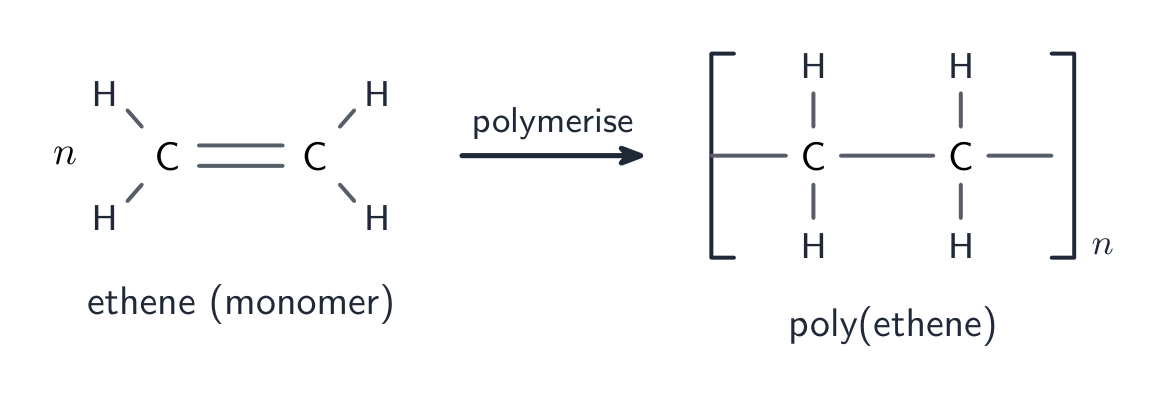
In addition polymerisation 加成聚合, many alkene molecules join into one long chain, with no other product. Ethene gives poly(ethene). The long-chain product is a polymer 聚合物. Propene gives poly(propene): $n\,\text{CH}_2{=}\text{CHCH}_3 \rightarrow -(\text{CH}_2{-}\text{CH(CH}_3))_n-$, where the $\text{CH}_3$ is a side group on every second carbon of the chain.
The mechanism and Markovnikov's rule
In electrophilic addition, the electron-rich C=C attracts an electrophile 亲电试剂 (an electron-pair acceptor). This forms a positive intermediate called a carbocation 碳正离子, which the negative part then attacks. The syllabus uses two examples: bromine with ethene, and hydrogen bromide with propene.

Where the $\delta+$ comes from. $\text{Br}_2$ is not polar on its own. As it comes close to the C=C, the cloud of electrons in the double bond repels the electrons in Br–Br. This makes an induced dipole 诱导偶极: the nearer Br becomes $\delta+$ and the further Br $\delta-$. $\text{HBr}$ already has a permanent dipole, with H $\delta+$.
Drawing it for full marks (Br$_2$ + ethene):
- the dipole on Br–Br, $\delta+$ on the Br nearer the C=C.
- a curly arrow from the C=C double bond to the $\delta+$ Br.
- a curly arrow from the Br–Br bond to the $\delta-$ Br.
- the carbocation, with a full $+$ on the carbon that did not gain the Br.
- a curly arrow from a lone pair on $\text{Br}^-$ to that $\text{C}^+$, and the product.
In the first step the Br–Br bond breaks heterolytically: both electrons go to one Br, which leaves as $\text{Br}^-$.
Common mistakes.
- An arrow starting at a carbon atom, not at the middle of the double bond.
- An arrow from the $\delta+$ Br towards the C=C. The electrons move from the double bond to the electrophile.
- The $+$ drawn on the carbon that has just bonded to Br. The other carbon has lost its share of the C=C pair.
- An arrow starting from the minus sign of $\text{Br}^-$. Draw the lone pair and start there.
With bromine water the carbocation meets far more water molecules than $\text{Br}^-$ ions, so a lone pair on water often attacks it instead. The main product is then 2-bromoethanol, not 1,2-dibromoethane. The colour still goes, because the $\text{Br}_2$ is used up either way.
Alkyl groups push electrons towards the positive carbon — this is the inductive effect 诱导效应. So a carbocation with more alkyl groups is more stable: tertiary is more stable than secondary, which is more stable than primary. When $\text{HBr}$ adds to propene, the more stable carbocation forms, so hydrogen adds to the carbon that already has more hydrogens. This pattern is Markovnikov's rule 马氏规则.

Worked example. Predict the major product when $\text{HBr}$ adds to propene, $\text{CH}_3\text{CH=CH}_2$. The $\text{H}^{+}$ adds first, and it adds in whichever way makes the more stable carbocation. Adding the $\text{H}$ to the end carbon puts the positive charge on the middle carbon, giving a secondary carbocation, which is stabilised by electron-releasing alkyl groups on two sides. Adding it to the middle carbon would leave a less stable primary carbocation. The bromide ion then attacks the secondary carbocation, so the major product is 2-bromopropane. That is Markovnikov's rule - but quote the reason (carbocation stability: tertiary > secondary > primary), because the rule on its own is not the explanation.
Explorar
Ruta de adición alqueno
Siga cómo se abre el enlace C=C y se añaden nuevos átomos.
Vocabulario
Entrenar
| English | Español |
|---|---|
| elimination/ɪˌlɪmɪˈneɪʃn/ | eliminación |
| halogenoalkane/ˈheɪləʊdʒnəʊlkeɪn/ | haloalcano |
| dehydration/ˌdiːhaɪˈdreɪʃn/ | deshidratación |
| alcohol/ˈælkəhɒl/ | alcohol |
| electrophilic addition/ɪˌlektrəʊˈfɪlɪk əˈdɪʃn/ | adición electrofílica |
| steam/stiːm/ | vapor de agua |
| hydrogen halide/ˈhaɪdrədʒn ˈhælaɪd/ | haluro de hidrógeno |
| diol/dɪˈɒl/ | diol |
| ketone/ˈketəʊn/ | cetona |
| carboxylic acid/ˌkɑːbəkˈsɪlɪk ˈæsɪd/ | ácido carboxílico |
| bromine water/ˈbrəʊmaɪn ˈwɔːtə/ | agua bromurada |
| addition polymerisation/əˈdɪʃn ˌpɒlɪməraɪˈzeɪʃn/ | polimerización por adición |
| polymer/ˈpɒlɪmə/ | polímero |
| electrophile/ɪˌlektrəʊˈfaɪl/ | electrófilo |
| carbocation/ˌkɑːbəˈkeɪʃn/ | carbocatión |
| induced dipole/ɪnˈdjuːst ˈdaɪpəʊl/ | dipolo inducido |
| inductive effect/ɪnˈdʌktɪv ɪˈfekt/ | efecto inductivo |
| Markovnikov's rule/ˈmɑːkəvnɪkɒvz ruːl/ | regla de Markovnikov |
14.2
Consejos de examen
English
- Alkanes: free-radical substitution needs UV light — show initiation, propagation and termination with the radical dots.
- Alkenes: electrophilic addition via a carbocation; draw curly arrows from the $\text{C}=\text{C}$.
- Markovnikov: H adds to the carbon with more H's, via the more stable carbocation (alkyl groups are electron-releasing).
- In cracking questions, balance the carbon and hydrogen atoms to find a missing product; at least one product is an alkene.
- For the catalytic converter, give an equation (for example $2\text{CO} + 2\text{NO} \rightarrow 2\text{CO}_2 + \text{N}_2$) and say what is oxidised and what is reduced.
- Test for $\text{C}=\text{C}$: bromine water decolourises (orange → colourless) — state the observation.
Lecciones interactivas sobre este tema
Trátalo paso a paso, con ejercicios de verificación instantánea.