Skip to content

IGCSE Physics · November 2023 · Paper 62 · Difficulty 3 · Standard

Question 2

2

A student investigates the resistance of a wire.

Fig. 2.1 shows the circuit used.

(a)

The student places a sliding contact S at a distance $l = 40.0\text{ cm}$ from B.

She measures the potential difference (p.d.) $V$ across the length $l$ of the resistance wire.

She measures the current $I$ in the circuit.

The meters are shown in Fig. 2.2 and Fig. 2.3.

(i)

Write down the current $I$.

$I =$ [1]

(ii)

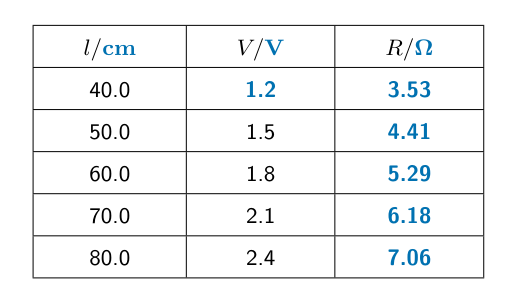
Record the potential difference $V$ reading in the first row of Table 2.1.[1]

(b)

The student repeats the procedure in (a) using $l = 50.0\text{cm}$, $60.0\text{cm}$, $70.0\text{cm}$ and $80.0\text{cm}$.

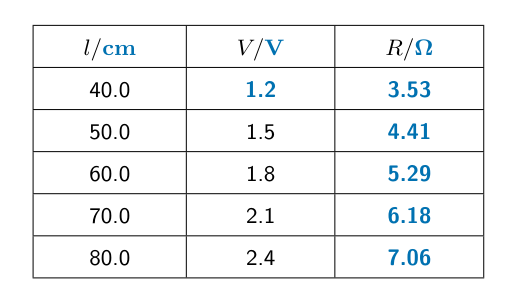
The readings are shown in Table 2.1.

(i)

Calculate, and record in Table 2.1, the values of resistance $R$ using the equation

$$R = \frac{V}{I} .$$

[2]

(ii)

Complete the column headings in Table 2.1.[1]

Table 2.1

$l/$$V/$$R/$
40.0
50.01.5
60.01.8
70.02.1
80.02.4
(c)

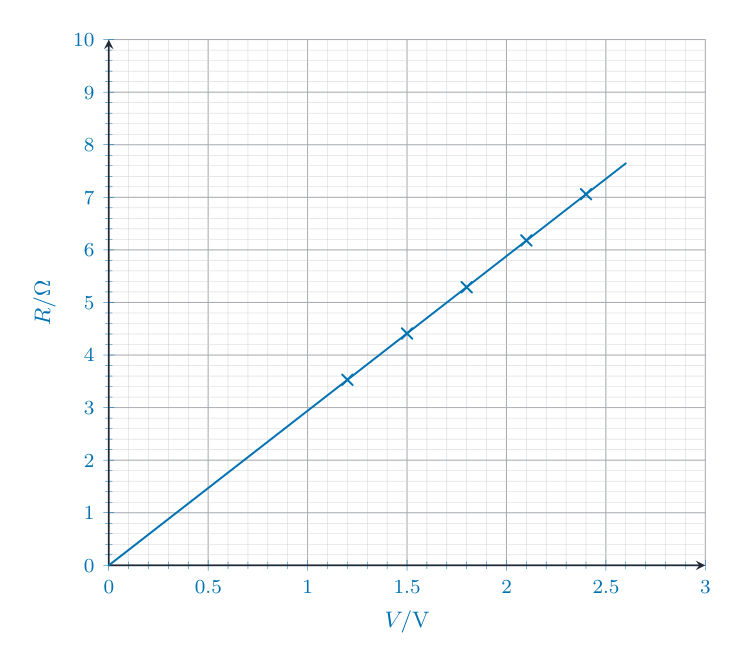
Plot a graph of $R$ ($y$-axis) against $V$ ($x$-axis). Start both axes at the origin $(0,0)$.

Draw the best-fit line.

[4]

(d)

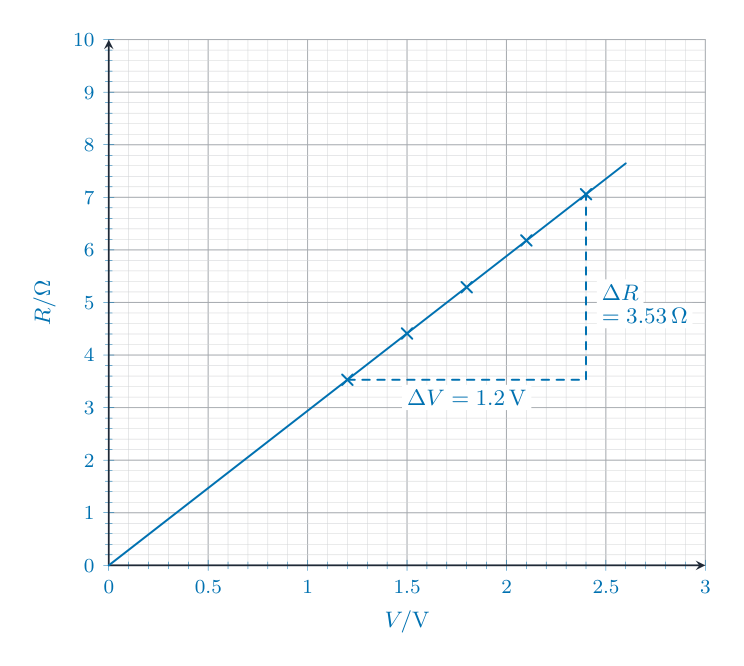
Determine the gradient $G$ of the graph. Show clearly on the graph how you obtained the necessary information.

$G =$ [2]

[Total: 11]
Show the mark scheme

These are the official mark-scheme rows. Each point that matches your answer earns a mark.

Tap the mark scheme to open it full size.

Show a worked answer

How to reach each mark, step by step. Try the question yourself first.

2(a)(i)

  • Read the ammeter: $I = \mathbf{0.34}\,\mathrm{A}$.

2(a)(ii)

  • Read the voltmeter: $V = \mathbf{1.2}\,\mathrm{V}$.
Worked answer drawing

2(b)(i)

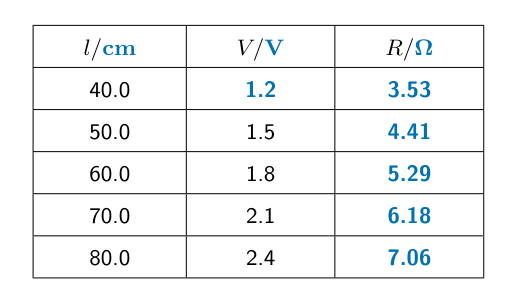
  • Use $R = V/I$ for each row, with $I = 0.34\,\mathrm{A}$. For example, $R = 1.2\,\mathrm{V}/0.34\,\mathrm{A} = 3.53\,\Omega$.
  • In row order the resistances are $\mathbf{3.53}$, $\mathbf{4.41}$, $\mathbf{5.29}$, $\mathbf{6.18}$ and $\mathbf{7.06}\,\Omega$, all to three significant figures.
Worked answer drawing

2(b)(ii)

  • Use the headings $l/\mathrm{cm}$, $V/\mathrm{V}$ and $R/\Omega$.
Worked answer drawing

2(c)

  • The completed graph is shown below. The best-fit line shows that $\mathbf{R\propto V}$ for this constant current.
Worked answer drawing

2(d)

  • Use $G = \Delta R/\Delta V$. Draw a large triangle on the best-fit line, using at least half the length between the extreme points.
  • For example, $G = (7.06-3.53)\,\Omega/(2.4-1.2)\,\mathrm{V} = \mathbf{2.9}\,\Omega/\mathrm{V}$. Use readings from your own line.
Worked answer drawing
Original question

Log in or create account

IGCSE, A-Level & AP