Skip to content

IGCSE Physics · November 2023 · Paper 62 · Difficulty 3 · Standard

Question 3

3

A student investigates the cooling of water under different conditions.

Fig. 3.1 shows the set-up.

(a)

The thermometer in Fig. 3.2 shows the room temperature $\theta_{\text{R}}$ at the beginning of the experiment. Record $\theta_{\text{R}}$.

$\theta_{\text{R}} =$ [1]

(b)

The student pours $200\text{ cm}^3$ of hot water into the beaker. He places the thermometer in the water.

He records the temperature $\theta$ of the hot water at time $t = 0$. He immediately starts a stop-watch.

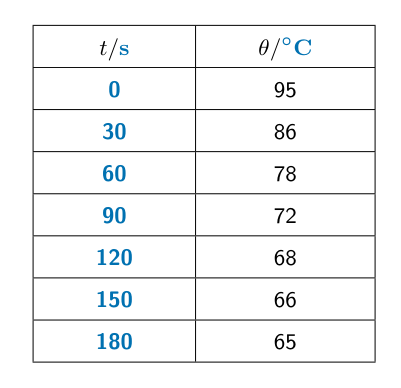
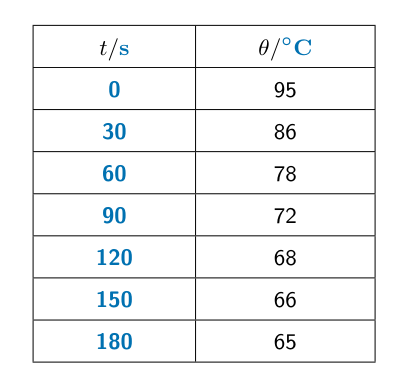
He records the temperature at $30\text{ s}$ intervals. The temperature readings are shown in Table 3.1.

(i)

Write the times in the first column of Table 3.1.[1]

(ii)

Complete the column headings in Table 3.1.

Table 3.1

$t\,/$$\theta\,/$
95
86
78
72
68
66
65

[1]

(c)
(i)

Calculate the decrease in temperature $\Delta\theta_1$ between time $t = 0$ and time $t = 90\text{ s}$.

$\Delta\theta_1 =$ [1]

(ii)

Calculate the difference in temperature $\Delta\theta_{\text{S}}$ between the temperature at time $t = 0$ and room temperature $\theta_{\text{R}}$.

$\Delta\theta_{\text{S}} =$ [1]

(iii)

Calculate the decrease in temperature $\Delta\theta_2$ between time $t = 90\text{ s}$ and time $t = 180\text{ s}$.

$\Delta\theta_2 =$

Calculate the difference in temperature $\Delta\theta_{\text{T}}$ between the temperature at time $t = 90\text{ s}$ and room temperature $\theta_{\text{R}}$.

$\Delta\theta_{\text{T}} =$ [1]

(d)

A student suggests that the decrease in temperature of the water in $90\text{ s}$ should be greater when the starting temperature is greater.

(i)

State whether the results agree with this suggestion. Justify your statement by reference to the results.

statement

justification

[2]

(ii)

Suggest how you would continue the experiment, using the same apparatus and method, to investigate the suggestion.

[2]

(e)

Refer to Table 3.1. Estimate the temperature of the water in the beaker after cooling for a further $90\text{ s}$.

[1]

[Total: 11]
Show the mark scheme

These are the official mark-scheme rows. Each point that matches your answer earns a mark.

Tap the mark scheme to open it full size.

Show a worked answer

How to reach each mark, step by step. Try the question yourself first.

3(a)

  • Read the thermometer: $\theta_R = \mathbf{22}\,^{\circ}\mathrm{C}$.

3(b)(i)

  • Starting at zero, add $30\,\mathrm{s}$ each time: $\mathbf{0}$, $\mathbf{30}$, $\mathbf{60}$, $\mathbf{90}$, $\mathbf{120}$, $\mathbf{150}$, $\mathbf{180}\,\mathrm{s}$.
Worked answer drawing

3(b)(ii)

  • Use the headings $t/\mathrm{s}$ and $\theta/{}^{\circ}\mathrm{C}$.
Worked answer drawing

3(c)(i)

  • Use $\Delta\theta_1 = \theta_0 - \theta_{90}$. Then $\Delta\theta_1 = 95\,^{\circ}\mathrm{C} - 72\,^{\circ}\mathrm{C} = \mathbf{23}\,^{\circ}\mathrm{C}$.

3(c)(ii)

  • Use $\Delta\theta_S = \theta_0 - \theta_R$. Then $\Delta\theta_S = 95\,^{\circ}\mathrm{C} - 22\,^{\circ}\mathrm{C} = \mathbf{73}\,^{\circ}\mathrm{C}$.

3(c)(iii)

  • Use $\Delta\theta_2 = \theta_{90} - \theta_{180} = 72\,^{\circ}\mathrm{C} - 65\,^{\circ}\mathrm{C} = \mathbf{7}\,^{\circ}\mathrm{C}$.
  • Use $\Delta\theta_T = \theta_{90} - \theta_R = 72\,^{\circ}\mathrm{C} - 22\,^{\circ}\mathrm{C} = \mathbf{50}\,^{\circ}\mathrm{C}$.

3(d)(i)

  • Yes. Starting at $95\,^{\circ}\mathrm{C}$, the water cools by $23\,^{\circ}\mathrm{C}$ in 90 s.
  • Starting at the lower temperature of $72\,^{\circ}\mathrm{C}$, it cools by only $7\,^{\circ}\mathrm{C}$ in 90 s.

3(d)(ii)

  • Continue taking temperature readings at 30 s intervals for at least another 180 s, or until the temperature is close to room temperature.
  • Compare the decreases over further 90 s intervals with the starting temperature of each interval.

3(e)

  • Cooling is slowing down, so expect a drop of less than $7\,^{\circ}\mathrm{C}$ in the next 90 s. A suitable estimate is $\mathbf{61}\,^{\circ}\mathrm{C}$.
Original question

Log in or create account

IGCSE, A-Level & AP