A student investigates the resistance of a resistance wire.
Fig. 2.1 shows the circuit that he uses.

The student places a sliding contact C at a distance $l = 20.0\text{ cm}$ from B.
He measures the potential difference (p.d.) $V$ across length $l$ of the resistance wire. He measures the current $I$ in the circuit.
The meters are shown in Fig. 2.2 and Fig. 2.3.


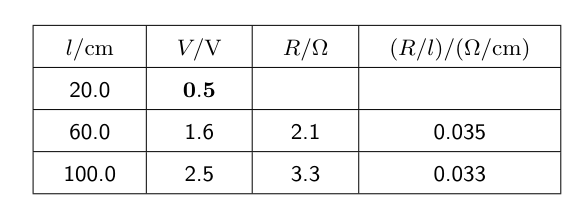
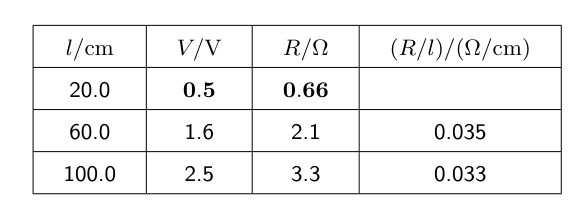
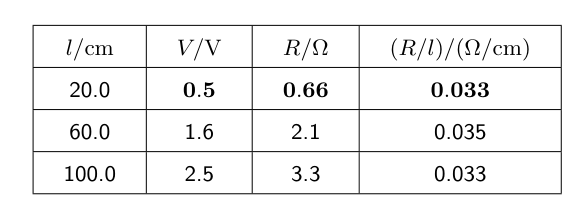
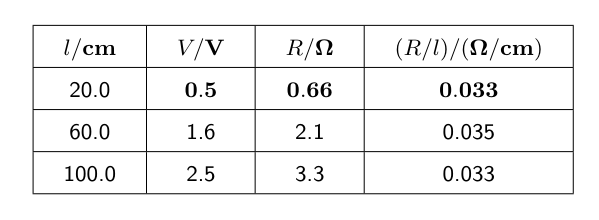
| $l/$ | $V/$ | $R/$ | $\frac{R}{l} /$ |
| 20.0 | |||
| 60.0 | 1.6 | 2.1 | 0.035 |
| 100.0 | 2.5 | 3.3 | 0.033 |
Write down the current $I$ shown on the student's ammeter.
$I =$ [1]
Record the potential difference $V$ shown on the student's voltmeter in the first row of Table 2.1.[1]
Calculate, and record in Table 2.1, the resistance $R$ of $20.0\text{ cm}$ of the resistance wire.
Use the equation $R = \frac{V}{I}$.[1]
Calculate, and record in the first row of Table 2.1, $\frac{R}{l}$ for $l = 20.0\text{ cm}$.[1]
Complete the column headings in Table 2.1.[2]
The student repeats the procedure using $l = 60.0\text{ cm}$ and $l = 100.0\text{ cm}$. The readings and results are shown in Table 2.1.
Look carefully at the values of $\frac{R}{l}$ in Table 2.1.
Write a conclusion about the relationship between $R$ and $l$.
[1]
Justify your conclusion by reference to the results.
[1]
Use the values in Table 2.1 to estimate the resistance $R_2$ of $2.000\text{ m}$ of the resistance wire.
Show your working.
$R_2 =$ [3]
[Total: 11]