A student determines the weight of a metre ruler using a balancing method.
Fig. 1.1 shows the set-up.

The student places the metre ruler on the pivot. She places a load P on the metre ruler at the $90.0\text{ cm}$ mark. She adjusts the position of the metre ruler on the pivot so that the metre ruler is as near as possible to being balanced.
The ruler balances with the pivot at the $75.0\text{ cm}$ mark.
Calculate the distance $a$ from the $90.0\text{ cm}$ mark to the pivot.
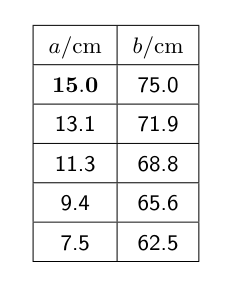
Record the value of $a$ in the first row of Table 1.1.[1]
She records, in Table 1.1, the distance $b$ from the pivot to the $0.0\text{ cm}$ end of the metre ruler.
She repeats the procedure placing the load P at the $85.0\text{ cm}$ mark, $80.0\text{ cm}$ mark, $75.0\text{ cm}$ mark and $70.0\text{ cm}$ mark. She records the values of $a$ and $b$ in Table 1.1.
Table 1.1
| $a/\text{cm}$ | $b/\text{cm}$ |
| 75.0 | |
| 13.1 | 71.9 |
| 11.3 | 68.8 |
| 9.4 | 65.6 |
| 7.5 | 62.5 |
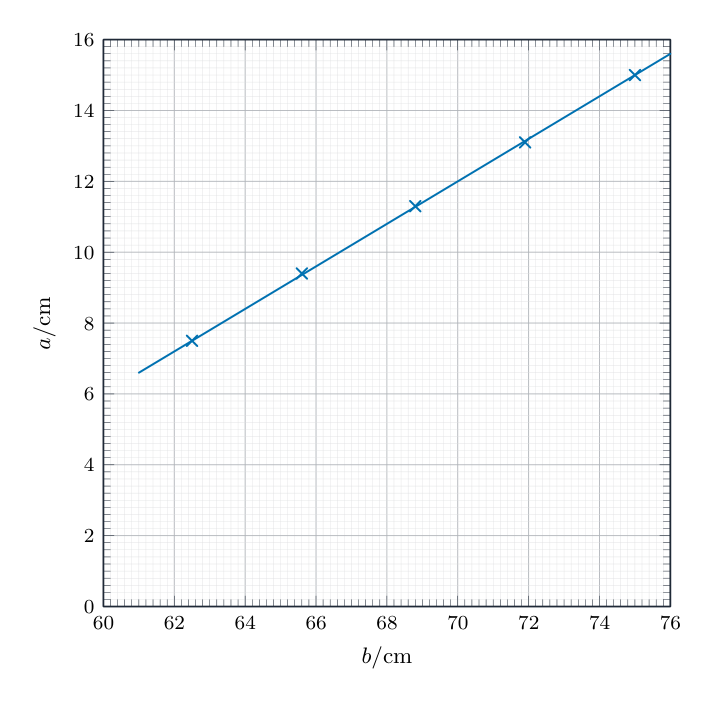
Plot a graph of $a/\text{cm}$ ($y$-axis) against $b/\text{cm}$ ($x$-axis). Start the $y$-axis at $a = 0.0\text{ cm}$. Start the $x$-axis at a suitable value for the results.
Draw the best-fit line.

[4]
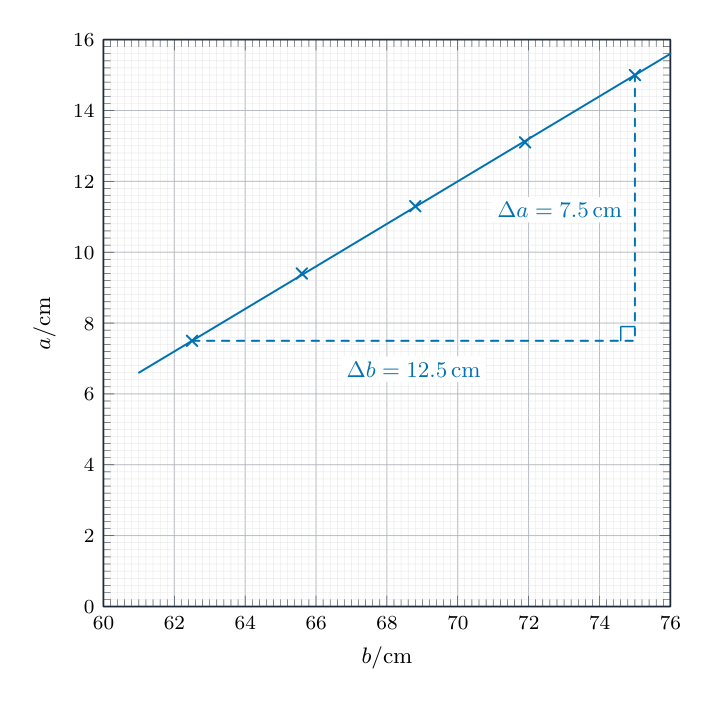
Determine the gradient $G$ of the graph. Show clearly on the graph how you obtained the necessary information.
$G =$ [2]
The weight $W$ of the metre ruler is numerically equal to $2G$.
Calculate the weight $W$ of the metre ruler.
$W =$ [2]
Suggest one practical reason why it is difficult to obtain accurate readings for $a$ and $b$.
[1]
Using only the apparatus provided for the experiment, explain briefly how you would determine the position of the centre of mass of the metre ruler.
[1]
[Total: 11]