A student investigates the magnification of the image produced by a lens.
Fig. 3.1 shows the set-up.


On Fig. 3.2, measure the height $h_O$ of the illuminated object.
$h_O$ = [2]
Fig. 3.1 is drawn to 1/10$^{th}$ scale.
On Fig. 3.1 measure the distance $u$.
$u$ = [1]
The actual object distance $U$ is 20.0 cm.
- The student places the lens at the distance $U$ = 20.0 cm from the illuminated object.
- He moves the screen slowly until a clearly focused image is formed on the screen.
- He measures the distance $V$ between the centre of the lens and the screen. On Fig. 3.1, this distance is represented to scale by the distance $v$.
Use Fig. 3.1 to determine the actual distance $V$ between the centre of the lens and the screen. Show your working.
$V$ = [2]
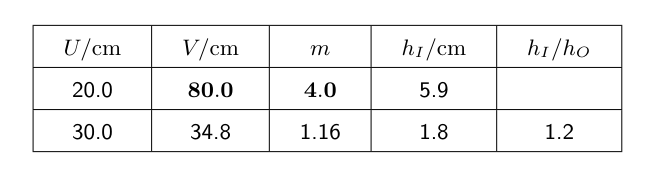
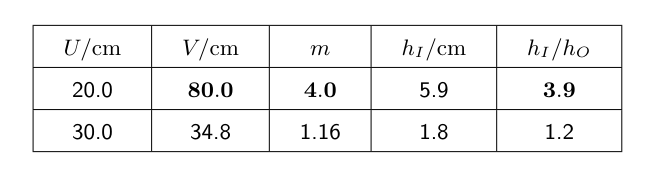
Calculate, and record in Table 3.1, the magnification $m$ using the equation $m = \frac{V}{U}$.[1]
The student measures the height of the image $h_I$ that is formed on the screen. The reading is shown in Table 3.1.
Calculate, and record in Table 3.1, the ratio $\frac{h_I}{h_O}$.
Table 3.1
| U/ cm | V/cm | m | $h_I$ /cm | $\frac{h_I}{h_O}$ |
| 20.0 | 5.9 | |||
| 30.0 | 34.8 | 1.16 | 1.8 | 1.2 |
[1]
The student repeats the procedure using $U$ = 30.0 cm. The readings and results are shown in Table 3.1.
Another student suggests that the magnification $m$ is equal to the ratio $\frac{h_I}{h_O}$.
State whether the results agree with the suggestion. Justify your statement by reference to the results.
statement
justification
[2]
Suggest how you would continue to use the same apparatus to test the suggestion that the magnification $m$ is equal to the ratio $\frac{h_I}{h_O}$.
[2]
[Total: 11]