A student investigates the time taken for water to evaporate to dryness when heated from above.
Fig. 4.1 shows the set-up. The power of the heater is constant.
The following is also available:
supply of water at room temperature
metre ruler.
Fig. 4.1
Plan an experiment to investigate how one factor affects the time taken for the water to evaporate.
You do not need to write about safety precautions.
You should:
state any additional apparatus required
explain briefly how you would do the investigation
state the key variables that you would keep constant
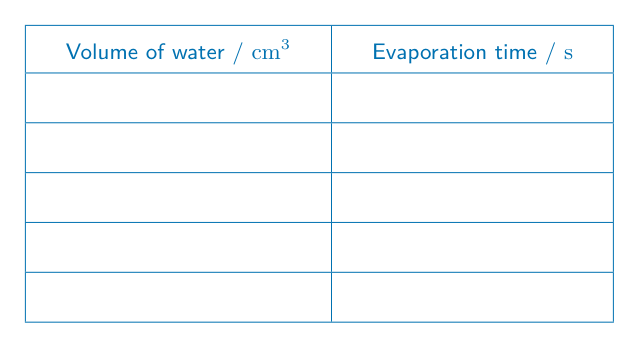
draw a table, or tables, with column headings, to show how you would display your readings (you are not required to enter any readings in the table)
explain how you would use your readings to reach a conclusion.
[7]
Show the mark scheme
These are the official mark-scheme rows. Each point that matches your answer earns a mark.
Tap the mark scheme to open it full size.
Show a worked answer
How to reach each mark, step by step. Try the question yourself first.
Use a stopwatch and a measuring cylinder. Measure a volume of water into the dish. Use the ruler to set the heater at a fixed height.
Switch on the heater and time until the dish is dry. Repeat for several water volumes. Keep heater height, water surface area and initial water temperature constant.
Make a table with columns headed volume of water / $\mathrm{cm^3}$ and evaporation time / $\mathrm{s}$. Record each pair of readings.
Plot evaporation time against volume, or compare the table values, to see how volume affects the time.