In this experiment, you will investigate the cooling of hot water.
Complete the following instructions, referring to Fig. 3.1.

Use the thermometer to measure the room temperature $\theta_{\text{R}}$.
$\theta_{\text{R}} =$ [1]
Pour $200\text{ cm}^3$ of hot water into the beaker. Place the thermometer in the water in the beaker.
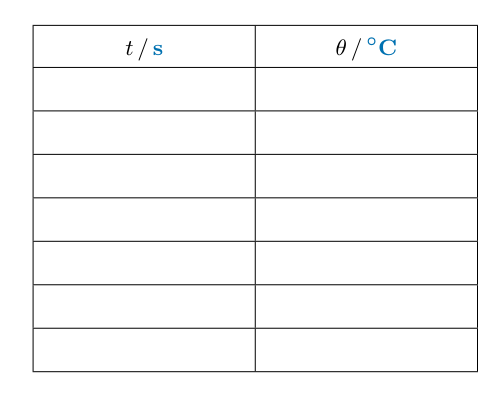
Record in Table 3.1 the temperature $\theta$ of the hot water at time $t = 0$. Immediately start the stop-watch.
Continue recording the temperature and the time in Table 3.1 at $30\text{ s}$ intervals until you have seven sets of readings.[2]
Complete the column headings in Table 3.1.
Table 3.1
| $t/$ | $\theta\,/$ |
[1]
Calculate the decrease in temperature $\Delta\theta_1$ between time $t = 0$ and time $t = 90\text{ s}$.
$\Delta\theta_1 =$ [1]
Calculate the difference in temperature $\Delta\theta_{\text{S}}$ between the temperature at time $t = 0$ and room temperature $\theta_{\text{R}}$.
$\Delta\theta_{\text{S}} =$ [1]
Calculate the decrease in temperature $\Delta\theta_2$ between time $t = 90\text{ s}$ and time $t = 180\text{ s}$.
$\Delta\theta_2 =$
Calculate the difference in temperature $\Delta\theta_{\text{T}}$ between the temperature at time $t = 90\text{ s}$ and room temperature $\theta_{\text{R}}$.
$\Delta\theta_{\text{T}} =$ [1]
A student suggests that the decrease in temperature of the water in $90\text{ s}$ should be greater when the starting temperature is greater.
State whether your results agree with this suggestion. Justify your statement by reference to your results.
statement
justification
[2]
Suggest how you would continue the experiment, using the same apparatus and method, to investigate the suggestion.
[2]
[Total: 11]