Skip to content

IGCSE Physics · November 2023 · Paper 42 · Difficulty 3 · Standard

Question 7

7

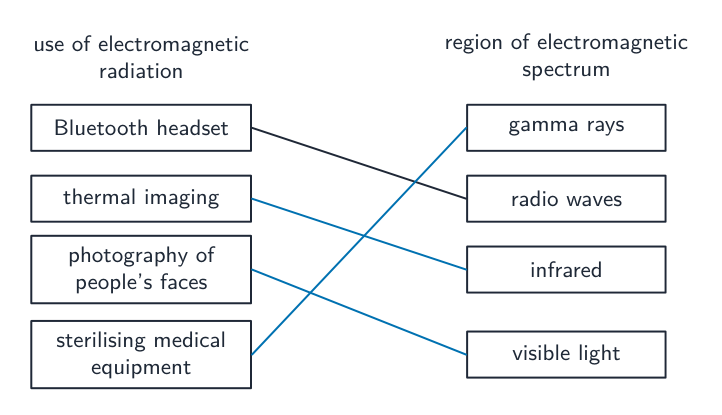
Fig. 7.1 shows some uses of electromagnetic radiation and different regions of the electromagnetic spectrum.

(a)

Draw a line from each use to the correct region of the spectrum. Each region of the spectrum is used once. One line has been completed for you.[2]

(b)

State the speed of electromagnetic waves in a vacuum.

speed = [1]

(c)

A Bluetooth headset can be used to listen to music on a mobile (cell) phone without the need for wires to connect the headset to the phone.

(i)

The headset uses frequencies in the range 2.40–2.48 GHz.

Calculate the wavelength of the radio waves when the frequency is in the middle of the frequency range.

wavelength = [3]

(ii)

Suggest why a Bluetooth headset only works well over short distances.

[1]

[Total: 7]
Show the mark scheme

These are the official mark-scheme rows. Each point that matches your answer earns a mark.

Tap the mark scheme to open it full size.

Show a worked answer

How to reach each mark, step by step. Try the question yourself first.

7(a)

  • Bluetooth headset: radio waves, which carry the signal from the phone.
  • Thermal imaging: infrared, which is emitted by warm objects.
  • Photography of faces: visible light, which reflects from faces into the camera.
  • Sterilising equipment: gamma rays, which kill microorganisms.
Worked answer drawing

7(b)

  • The speed is $\mathbf{3.0\times10^8}\,\mathrm{m/s}$.

7(c)(i)

  • The middle frequency is $(2.40 + 2.48)\,\mathrm{GHz}/2 = 2.44\,\mathrm{GHz} = 2.44\times10^9\,\mathrm{Hz}$.
  • Use $v = f\lambda$, so $\lambda = v/f$.
  • $\lambda = \frac{3.0\times10^8\,\mathrm{m/s}}{2.44\times10^9\,\mathrm{Hz}} = \mathbf{0.12}\,\mathrm{m}$.

7(c)(ii)

  • The radio signal gets weaker as it travels, especially when it passes through walls.
Original question

Log in or create account

IGCSE, A-Level & AP