A student investigates a light-dependent resistor (LDR).
The student assembles a series circuit consisting of a power supply, a switch, a $470\,\Omega$ resistor and an LDR.
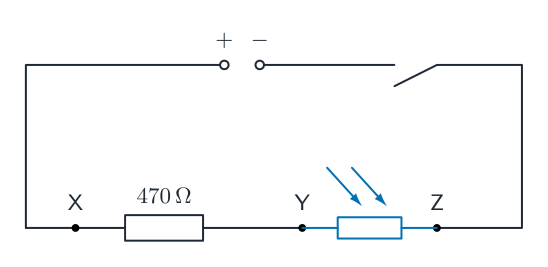
Fig. 2.1 shows part of the circuit that the student assembles.

Complete the circuit by adding the correct symbol for an LDR between Y and Z. Choose from the list provided in Fig. 2.2.

[1]
The student:
- closes the switch
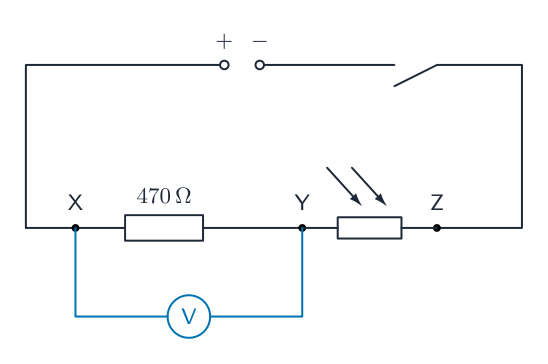
- connects a voltmeter across the $470\,\Omega$ resistor
- records the reading on the voltmeter
- opens the switch.
On Fig. 2.1, draw a voltmeter connected to measure the potential difference (p.d.) across the $470\,\Omega$ resistor.[1]
The voltmeter reading is shown in Fig. 2.3.

Record the voltmeter reading $V_{XY}$.
$V_{XY} =$ V[1]
The current $I$ in the circuit is calculated using the equation:
where $R = 470\,\Omega$.
Use your voltmeter reading in (b)(ii) to calculate the current $I$.
$I =$ [2]
The student:
- closes the switch
- connects the voltmeter between points Y and Z
- records the voltmeter reading $V_{YZ}$
- opens the switch.
$V_{YZ} =$ 2.2V
Calculate the resistance $R_B$ of the LDR in bright light using the equation:
$R_B =$ $\Omega$[1]
The student covers the LDR with a piece of card and repeats the procedure described in (b) and (d).
$V_{XY} =$ 0.15V
$V_{YZ} =$ 2.9V
Calculate the resistance $R_D$ of the LDR in the dark using the equation:
$R_D =$ $\Omega$[1]
The student removes the card from the top of the LDR and slowly lifts it vertically upwards away from the LDR until the card is $30\text{ cm}$ above the LDR. The student observes and records the readings on the voltmeter across the LDR ($V_{YZ}$) as the card is raised.
Table 2.1 shows the student’s results.
Table 2.1
| distance/cm | potential difference $V_{YZ}$/V |
| 0 | 2.9 |
| 5 | 2.5 |
| 10 | 2.4 |
| 15 | 2.3 |
| 20 | 2.2 |
| 25 | 2.2 |
| 30 | 2.2 |
Describe how the p.d. across the LDR ($V_{YZ}$) changes as the distance between the card and the LDR increases.[2]
When the LDR is covered by the card, the current in the circuit changes.
Use the student’s results from (b)(ii), (d) and (e)(i) to show how this change in current affects the value of the total potential difference ($V_{XY} + V_{YZ}$).[2]
[Total: 11]