A student investigates the image formed by a converging lens.
Refer to Fig. 3.1.
The student:
- switches on the lamp
• places the screen a distance $D = 80.0\text{ cm}$ from the illuminated object (a triangular hole in a piece of card)
• places the lens close to the illuminated object
• moves the lens away from the illuminated object until a magnified, inverted, sharp image of the illuminated object is formed on the screen.
Fig. 3.1 shows the position of the lens when the image is sharp.

On Fig. 3.1, measure, to the nearest $0.1\text{ cm}$, the object distance $x$ from the centre of the lens to the illuminated object.
$x =$ $\text{cm}$[1]
Fig. 3.1 is drawn to a scale of one-fifth full size.
Calculate the actual object distance $X$.
$X =$ $\text{cm}$[1]
The student:
- continues to move the lens away from the illuminated object until a second sharp image, which is diminished and inverted, is formed on the screen
• measures, to the nearest $0.1\text{ cm}$, the object distance $Y$ from the centre of the lens to the illuminated object.
$Y =$ $\text{59.8 cm}$
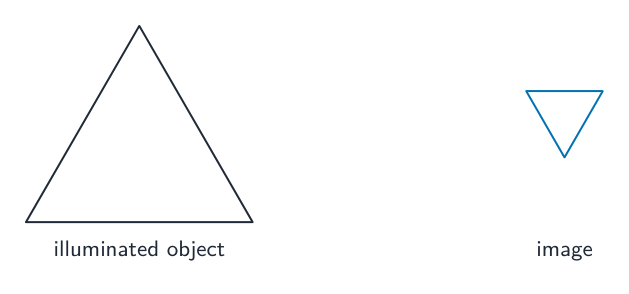
Fig. 3.2 shows the illuminated object.
On Fig. 3.2, draw a diminished, inverted image in the space provided.

[1]
Calculate the value $d = (Y - X)$.
$d =$ $\text{cm}$[1]
The focal length $f$ of the lens can be found using the equation:
Use the value of $D$ from (a) and $d$ from (b)(ii) to calculate a value $f_1$ for the focal length of the lens.
Give your answer to 3 significant figures.
$f_1 =$ $\text{cm}$[2]
The student repeats the procedure in (a) and (b) for an object to screen distance $D = 100.0\text{ cm}$.
The student records the values of $X$, $Y$ and $d$.
$X =$ $\text{18.1 cm}$
$Y =$ $\text{81.8 cm}$
$d =$ $\text{63.7 cm}$
Calculate a second value $f_2$ for the focal length of the lens using the equation in (c).
$f_2 =$ $\text{cm}$[1]
Two quantities can be considered to be equal within the limits of experimental accuracy if their values are within 10% of each other.
State whether your values of $f_1$ and $f_2$ from (c) and (d) can be considered equal.
Support your statement with a calculation.
statement
[2]
State one technique to use when doing this type of experiment to ensure that the image on the screen is focused as clearly as possible.
[1]
This experiment is usually done in a darkened room.
Explain how this makes it easier to see when the image is in focus.
[1]
[Total: 11]