Skip to content

IGCSE Physics · June 2025 · Paper 62 · Difficulty 4 · Challenging

Question 4

4

Hot water is poured into a glass beaker and allowed to cool down for 5 minutes.

Plan an experiment to investigate whether the rate of cooling of the hot water depends upon the initial temperature of the hot water.

The rate of cooling of the water can be calculated using the equation:

$$\text{rate}\ of\ \text{cooling} = \frac{decrease\ in\ \text{temperature}}{\text{time}\ \text{taken}}$$

You are provided with:

  • a supply of cold water
  • an electric kettle
  • a 250 cm$^{3}$ glass beaker
  • a measuring cylinder.

You may use any other common laboratory apparatus.

In your plan, include:

  • any other apparatus needed
  • a brief description of the method, including what you will measure and how you will make sure your measurements are accurate
  • the variables you will control
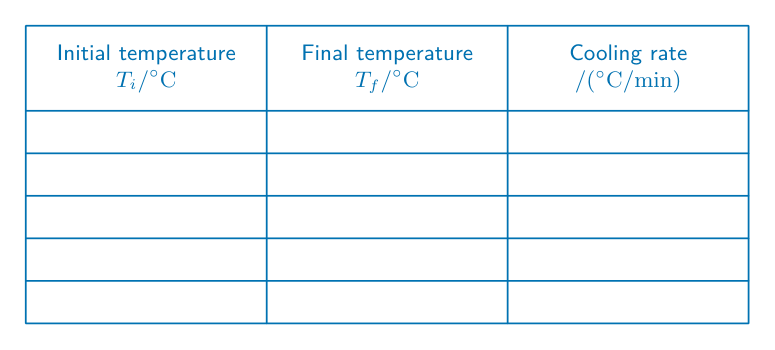
  • a results table to record your measurements (you are not required to enter any readings in the table)
  • how you will process your results to reach a conclusion.

You may include a labelled diagram.
Show the mark scheme

These are the official mark-scheme rows. Each point that matches your answer earns a mark.

Tap the mark scheme to open it full size.

Show a worked answer

How to reach each mark, step by step. Try the question yourself first.

  • Use a thermometer and stopwatch. Put a fixed volume of hot water in the beaker. Record its temperature and start the timer. Record the temperature after five minutes. Stir before each reading and read the thermometer at eye level.
  • Repeat at five different initial temperatures. Keep the water volume, cooling time and room temperature the same. Repeat each measurement and average the results.
  • Use the results table below. Record the initial temperature $T_i$ and final temperature $T_f$ for each run.
  • Calculate $\text{cooling rate}=(T_i-T_f)/5$ in $^\circ\mathrm{C}/\mathrm{min}$. **Compare cooling rates at different initial temperatures** to see whether and how the rate changes.
Worked answer drawing
Original question

Log in or create account

IGCSE, A-Level & AP