Skip to content

IGCSE Physics · June 2024 · Paper 42 · Difficulty 4 · Challenging

Question 6

6
(a)

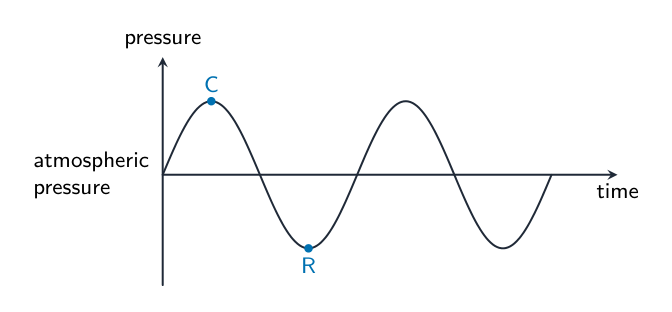
A sound wave travels through air. Fig. 6.1 shows a pressure–time graph for the air at one place.

(i)

On Fig. 6.1:

  • label one point C to indicate a compression
  • label one point R to indicate a rarefaction. [2]

(ii)

Explain why this graph cannot be used to find the wavelength of the sound wave.[1]

(iii)

The sound becomes louder and of lower pitch.

State what happens to:

the amplitude of the sound

the frequency of the sound.[1]

(b)

A sound of frequency 13 kHz is transmitted through water.

The speed of sound in water is 1500 m/s.

Calculate the wavelength of this sound in water.

wavelength = [3]

(c)

State the approximate speed of sound in air.

speed = [1]

[Total: 8]
Show the mark scheme

These are the official mark-scheme rows. Each point that matches your answer earns a mark.

Tap the mark scheme to open it full size.

Show a worked answer

How to reach each mark, step by step. Try the question yourself first.

6(a)(i)

  • Mark C at a peak, where the pressure is greatest.
  • Mark R at a trough, where the pressure is lowest.
Worked answer drawing

6(a)(ii)

  • The graph shows pressure against time, not distance along the wave.

6(a)(iii)

  • The amplitude increases and the frequency decreases.

6(b)

  • Use $v = f\lambda$ for wave speed.
  • $f = 13\,\mathrm{kHz} = 13000\,\mathrm{Hz}$.
  • $\lambda = (1500\,\mathrm{m/s})/(13000\,\mathrm{Hz}) = \mathbf{0.12}\,\mathrm{m}$.

6(c)

  • The approximate speed is $\mathbf{340}\,\mathrm{m/s}$.
Original question

Log in or create account

IGCSE, A-Level & AP