Skip to content

IGCSE Physics · June 2024 · Paper 42

Question 5

5

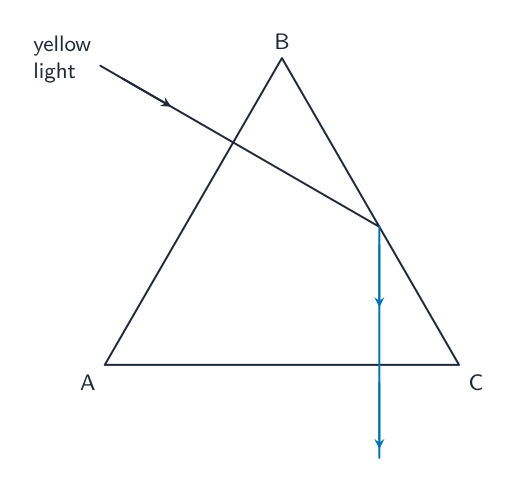
Fig. 5.1 shows a ray of yellow light incident on a glass prism ABC.

Fig. 5.1
(a)

Explain why the ray does not change direction when it enters the prism at face AB. [1]

(b)

The critical angle for the glass is $42^{\circ}$ .

(i)

Calculate the refractive index of the glass. Show your working.

refractive index = [2]

(ii)

On Fig. 5.1, continue the path of the light through the prism and after it leaves the prism.[3]

(c)

Internet data can be transferred using infrared waves in optical fibres.

State two advantages of using optical fibres to transmit data.

1

2[2]
Show the mark scheme

These are the official mark-scheme rows. Each point that matches your answer earns a mark.

Tap the mark scheme to open it full size.

Show a worked answer

How to reach each mark, step by step. Try the question yourself first.

5(a)

  • The ray travels along the normal, so its angle of incidence is zero.

5(b)(i)

  • Use $n = 1/\sin c$ for the refractive index.
  • $n = 1/\sin 42^{\circ} = \mathbf{1.5}$.

5(b)(ii)

  • Draw the ray totally internally reflected at BC, with no ray emerging there.
  • Continue it to AC along the normal, then straight out into the air without a change of direction.
Worked answer drawing

5(c)

  • Optical fibres can carry large amounts of data.
  • There is little signal loss during transmission.
Original question

Log in or create account

IGCSE, A-Level & AP