Skip to content

IGCSE Physics · June 2023 · Paper 33 · Difficulty 3 · Standard

Question 9

9

Fig. 9.1 represents an atom of beryllium. The labels A, B and C indicate three types of particle.

(a)
(i)

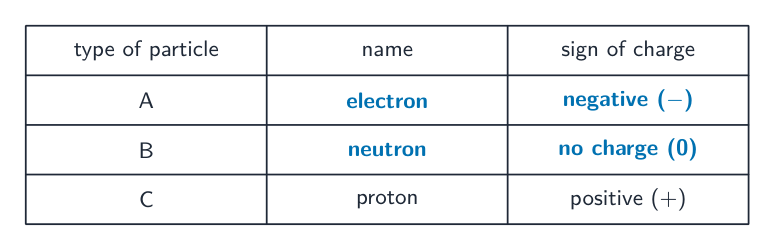
Complete Table 9.1.

Name each type of particle and state the sign of its charge.

One row is done for you.

Table 9.1

type of particlenamesign of charge
A
B
Cprotonpositive (+)

[3]

(ii)

There are several different isotopes of beryllium.

State what is meant by the term isotope.[2]

(b)

Fig. 9.2 shows sources of background radiation that affect people.

Suggest the source of background radiation in region D.[1]

(c)

The nuclide notation for an atom of radon is:

$^{222}_{86}Rn$

(i)

State the number of protons in this atom of radon[1]

(ii)

State the number of particles in the nucleus of this atom of radon . [1] [Total: 8]
Show the mark scheme

These are the official mark-scheme rows. Each point that matches your answer earns a mark.

Tap the mark scheme to open it full size.

Show a worked answer

How to reach each mark, step by step. Try the question yourself first.

9(a)(i)

  • A is an electron with a negative charge; electrons are outside the nucleus.
  • B is a neutron with no charge; neutrons are the uncharged particles in the nucleus.
  • C is a proton with a positive charge, as already shown in the table.
Worked answer drawing

9(a)(ii)

  • Isotopes of an element have the same number of protons but different numbers of neutrons.

9(b)

  • Region D represents cosmic radiation from space.

9(c)(i)

  • The proton number is $\mathbf{86}$.

9(c)(ii)

  • The nucleon number is $\mathbf{222}$, so the nucleus contains that many particles.
Original question

Log in or create account

IGCSE, A-Level & AP