Skip to content

IGCSE Physics · June 2023 · Paper 33 · Difficulty 2 · Core

Question 10

10

Fig. 10.1 represents part of the Solar System.

Fig. 10.1 (not to scale)
(a)
(i)

State the name of planet A and the name of planet B.

planet A

planet B [2]

(ii)

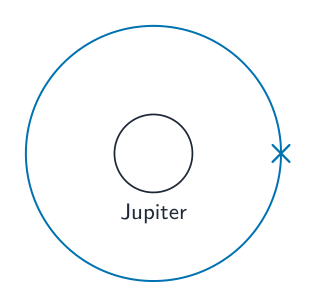
On Fig. 10.1, draw an X to represent a moon of Jupiter. Draw a line to show how this moon moves.[1]

(iii)

State two ways in which the four planets nearest to the Sun are different from the four planets furthest away from the Sun.

1

2[2]

(iv)

Complete the following sentences:

The galaxy that includes the Solar System is called the

The includes billions of galaxies.[2]

(b)

The distance between the Sun and the Earth is $1.5 \times 10^{11}$ m. The speed of an electromagnetic wave is $3.0 \times 10^{8}$ m/s.

Calculate the time taken for an electromagnetic wave to travel from the Sun to the Earth.

time taken = s[3]

[Total: 10]
Show the mark scheme

These are the official mark-scheme rows. Each point that matches your answer earns a mark.

Tap the mark scheme to open it full size.

Show a worked answer

How to reach each mark, step by step. Try the question yourself first.

10(a)(i)

  • Planet A is Mercury, the nearest planet to the Sun.
  • Planet B is Mars, between Earth and Jupiter.

10(a)(ii)

  • Draw X near Jupiter and draw a circular or oval orbit around Jupiter through X.
Worked answer drawing

10(a)(iii)

  • The four inner planets are rocky; the four outer planets are gaseous.
  • The inner planets are smaller than the outer planets.

10(a)(iv)

  • The Solar System is in the Milky Way. The Universe contains billions of galaxies.

10(b)

  • Use speed $v = d/t$, so $t = d/v$.
  • $t = (1.5\times10^{11}\,\mathrm{m})/(3.0\times10^8\,\mathrm{m/s}) = \mathbf{500}\,\mathrm{s}$.
Original question

Log in or create account

IGCSE, A-Level & AP