الألكينات
مُقدَّم| English | المعنى |
|---|---|
| double bond/ˈdʌbl bɒnd/ | رابطة ثنائية |
| alkenes/ˈælkiːnz/ | ألكينات |
| unsaturated/ʌnˈsætʃəreɪtɪd/ | غير مُشبَع |
| addition reactions/əˈdɪʃn rɪˈækʃnz/ | تفاعلات إضافة |
| bromine water/ˈbrəʊmaɪn ˈwɔːtə/ | ماء البروم |
The double-bond 双键 family
- The alkenes 烯烃 look similar to alkanes but have one crucial difference: a double bond.
- That double bond makes them much more reactive.
Alkenes contain a:
الصعوبة 1/5 · 100 عملة + مكافأة صغيرة عند الإنجاز الأول اليوم
The C=C double bond defines alkenes.
The general formula of the alkenes is:
الصعوبة 1/5 · 100 عملة + مكافأة صغيرة عند الإنجاز الأول اليوم
Alkenes follow CₙH₂ₙ.
The simplest alkene, with two carbon atoms, is ______.
الصعوبة 1/5 · 100 عملة + مكافأة صغيرة عند الإنجاز الأول اليوم
Ethene is C₂H₄.
The alkene family
- Alkenes have the general formula CₙH₂ₙ and contain a carbon–carbon double bond.
- Examples: ethene (C₂H₄), propene (C₃H₆).
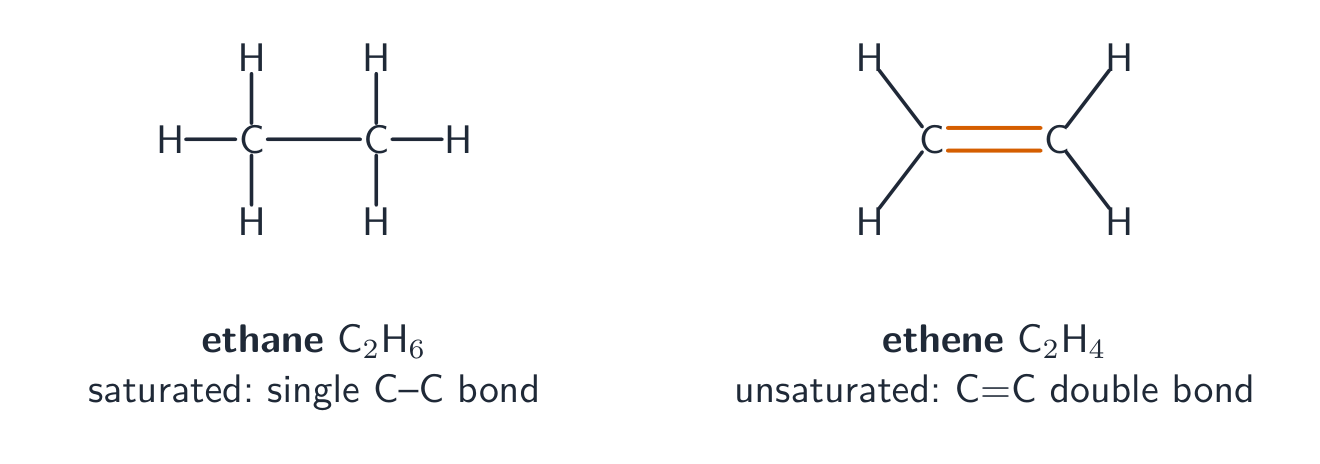
Alkenes are unsaturated — they contain a C=C double bond, unlike the saturated alkanes
إضافة عبر الرابطة المزدوجة C=C
Step through an addition reaction. The C=C double bond is an alkene's reactive spot — molecules add right across it, which also gives the bromine-water test.
Alkenes are saturated because they contain only single bonds.
الصعوبة 1/5 · 100 عملة + مكافأة صغيرة عند الإنجاز الأول اليوم
False. Alkenes are unsaturated: their C=C double bond can open to add other atoms. Alkanes are saturated.
Unsaturated 不饱和
- Alkenes are unsaturated — they have a double bond that can open up.
- This lets other atoms add across the double bond (addition reactions 加成反应).
Bromine water added to an alkene turns:
الصعوبة 1/5 · 100 عملة + مكافأة صغيرة عند الإنجاز الأول اليوم
The bromine adds across the double bond, decolourising.
Testing for a double bond
- Add bromine water 溴水 to an alkene: it turns from orange to colourless.
- This is the test that distinguishes alkenes (unsaturated) from alkanes (saturated).
Worked example. Shake an unknown hydrocarbon with orange bromine water. If it turns colourless, the compound is an alkene (the bromine adds across the double bond). If it stays orange, it's an alkane.

The bromine water test: an alkene decolourises the orange bromine water, while an alkane leaves it orange
Where alkenes come from and what they add
- Cracking breaks long alkanes into shorter, more useful molecules, including alkenes: heat with a catalyst, e.g. C₁₀H₂₂ → C₈H₁₈ + C₂H₄.
| Added across C=C | Conditions | Product from ethene |
|---|---|---|
| bromine | room temperature | 1,2-dibromoethane (test for C=C) |
| hydrogen | nickel catalyst, about 150 °C | ethane |
| steam | 300 °C, 6000 kPa, phosphoric acid catalyst | ethanol |
What is made when ethene reacts with steam over a phosphoric acid catalyst?
الصعوبة 1/5 · 100 عملة + مكافأة صغيرة عند الإنجاز الأول اليوم
Water (H and OH) adds across the double bond: C₂H₄ + H₂O → C₂H₅OH.
C₁₂H₂₆ → C₈H₁₈ + 2X. X is an alkene. How many carbon atoms are in one molecule of X?
الصعوبة 2/5 · 140 عملة + مكافأة صغيرة عند الإنجاز الأول اليوم
12 − 8 = 4 carbons are left for two molecules, so each has 2: X is ethene, C₂H₄ (26 − 18 = 8 H, 4 each).
You've got it
- alkenes are unsaturated (a C=C double bond), formula CₙH₂ₙ
- the double bond lets atoms add across it (addition reactions)
- the test: bromine water turns from orange to colourless with an alkene
Write from this case
- Propene is shaken with bromine water.
- Propene is C3H6 and has one carbon-carbon double bond. Ethene is the smallest alkene.
What happens to the bromine water, and why?
Addition across the double bond decolourises bromine water.
What does propene do to bromine water?
الصعوبة 1/5 · 100 عملة + مكافأة صغيرة عند الإنجاز الأول اليوم
The double bond undergoes addition.