Forms of Governance
مُقدَّم| English | المعنى |
|---|---|
| unitary state/ˈjuːnɪtəri steɪt/ | دولة مركزية |
| federal state/ˈfedərəl steɪt/ | دولة فيدرالية |
Same school, different rules
- A student in Texas and a student in California study under different state education laws, because the US Constitution leaves schools to the states. In France, the national education ministry in Paris sets one curriculum for the whole country.
- This difference is a form of governance: how a state divides power between the national (central) government and regional governments. AP Human Geography compares two main forms.
What does "form of governance" describe?
الصعوبة 1/5 · 100 عملة + مكافأة صغيرة عند الإنجاز الأول اليوم
Forms of governance are about where power sits inside the state, as the school-law example shows.
Unitary states
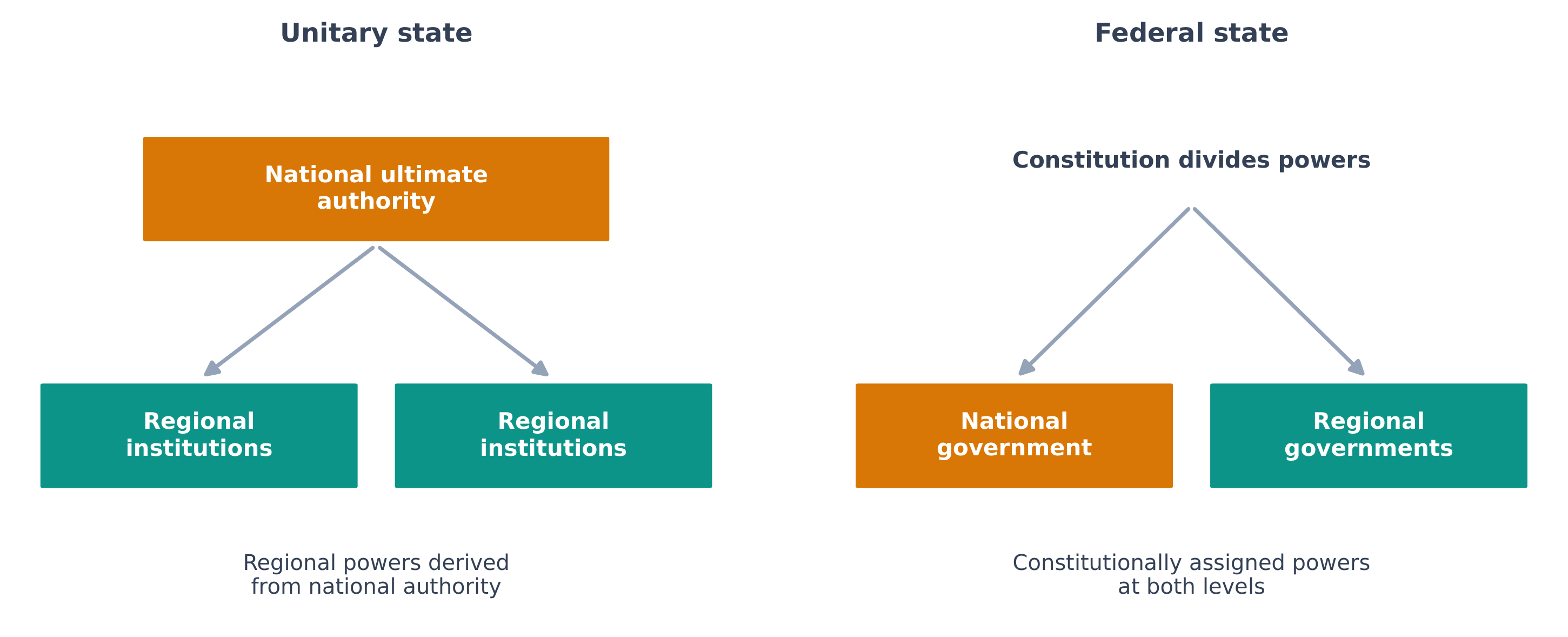
- A unitary state 单一制国家 keeps most power in the central government. Regions may have councils and officials, but their powers are given by the centre, and the centre can change or take them back.
- Examples: France, Japan and China. The United Kingdom is unitary too: since 1999 Scotland and Wales have their own parliaments, but these are devolved powers that the UK Parliament granted and could legally change.
Because Scotland has its own parliament, the United Kingdom is a federal state.
الصعوبة 1/5 · 100 عملة + مكافأة صغيرة عند الإنجاز الأول اليوم
Scotland's powers were devolved by the UK Parliament, which could legally change them, so the UK remains unitary.
Federal states
- A federal state 联邦制国家 divides power between the centre and regional governments (states, provinces), and the division is written in the constitution, so the centre cannot simply take regional powers away.
- Examples: the United States, Germany, India, Brazil, Nigeria and Canada. Most are large or culturally diverse, and federalism lets regions with different languages, religions or histories govern some of their own affairs.
Unitary or federal?
Sort each feature as belonging to a unitary or federal state.
What makes a state federal rather than unitary?
الصعوبة 1/5 · 100 عملة + مكافأة صغيرة عند الإنجاز الأول اليوم
The source of regional power is the test. Size and regional offices exist in unitary states too.
Match each country to its form of governance.
الصعوبة 2/5 · 140 عملة + مكافأة صغيرة عند الإنجاز الأول اليوم
China is large but unitary; Germany and India give their states constitutional powers.
Strengths and weaknesses
| Unitary | Federal | |
|---|---|---|
| Strength | fast, uniform national policy; cheaper government | gives diverse regions a voice; local policies fit local needs |
| Weakness | can ignore distant or minority regions | slower; disputes between levels; unequal services between regions |
| Fits best | smaller or culturally uniform states | large or culturally diverse states |
- These are tendencies, not rules: China is huge and unitary, while Switzerland is small and federal because of its language regions.
Which are common weaknesses of federal states?
الصعوبة 2/5 · 140 عملة + مكافأة صغيرة عند الإنجاز الأول اليوم
Giving regions a voice is a strength of federalism; ignoring minority regions is a risk of unitary systems.
Worked FRQ answer
(A) Define a federal state. A state in which the constitution divides power between the national government and regional governments, so each level has powers the other cannot take away.
(B) Explain ONE reason a culturally diverse country might adopt a federal system. India has many language groups, so giving states power over matters such as education and language lets each group govern itself in its own language, which reduces pressure to break away.
(C) Explain ONE disadvantage of a unitary system for a large state. Decisions made in a distant capital may not fit conditions in far-away regions, so people there may feel ignored, which can strengthen regional independence movements.
- Why it scores: (A) names the key feature (constitutional division of power), not just "power is shared"; (B) and (C) each give a real example or situation and finish with a consequence.
Which definition of a federal state would earn the FRQ point?
الصعوبة 1/5 · 100 عملة + مكافأة صغيرة عند الإنجاز الأول اليوم
"Power is shared" is too vague, size is not the definition, and an example alone is not a definition.
Having regional governments does not make a state federal. The test is the source of their power: if the centre gave it and can take it back (UK, France), the state is unitary; if the constitution guarantees it (USA, Germany), the state is federal.
France has regional councils, so it cannot be a unitary state.
الصعوبة 1/5 · 100 عملة + مكافأة صغيرة عند الإنجاز الأول اليوم
Their powers come from the central government, so France is unitary.
A unitary state concentrates power in the central government; regional powers are delegated and can be withdrawn (France, Japan, China, the UK with devolution). A federal state divides power by constitution between centre and regions (USA, Germany, India). Federalism often suits large, diverse states, but size and diversity are tendencies, not rules.
FRQ practice. (A) Identify ONE unitary state. (B) Explain ONE advantage of a unitary system. (C) Explain ONE reason a state might devolve power to a region without becoming federal.
Know the test (source of power) and use one real example per part.