Buffer Capacity
مُقدَّم 8:23
الأحماض والقواعد
شريطان من الورق — أحدهما أحمر والآخر أزرق. أغمسهما في سائل ويتغير اللون، وهذا اللون يخبرك ما إذا كان السائل حمضاً أم قاعداً.…
سرد باللغة الإنجليزية · ترجمة نصية بالإنجليزية و中文 يمكنك التبديل بينهما
في هذا الدرس
| English | المعنى |
|---|---|
| buffer capacity/ˈbʌfə kəˈpæsɪti/ | سعة المحلول المنظم |
Every buffer has a limit
- Two ethanoate buffers both have pH 4.74. One is $1.0\ \text{M}$ in each partner, the other $0.010\ \text{M}$. Add a few drops of acid and both hold steady. Keep adding, and the dilute one gives up first.
- Buffer capacity 缓冲容量 is the amount of strong acid or strong base a buffer can absorb before its pH changes a lot (often taken as 1 pH unit).
More of each partner, more capacity
- The partners are used up by the added acid or base, mole for mole. A buffer with more moles of HA and $\text{A}^-$ can absorb more before one partner runs low.
- Two buffers can have the same pH (same ratio) but very different capacity (different amounts).
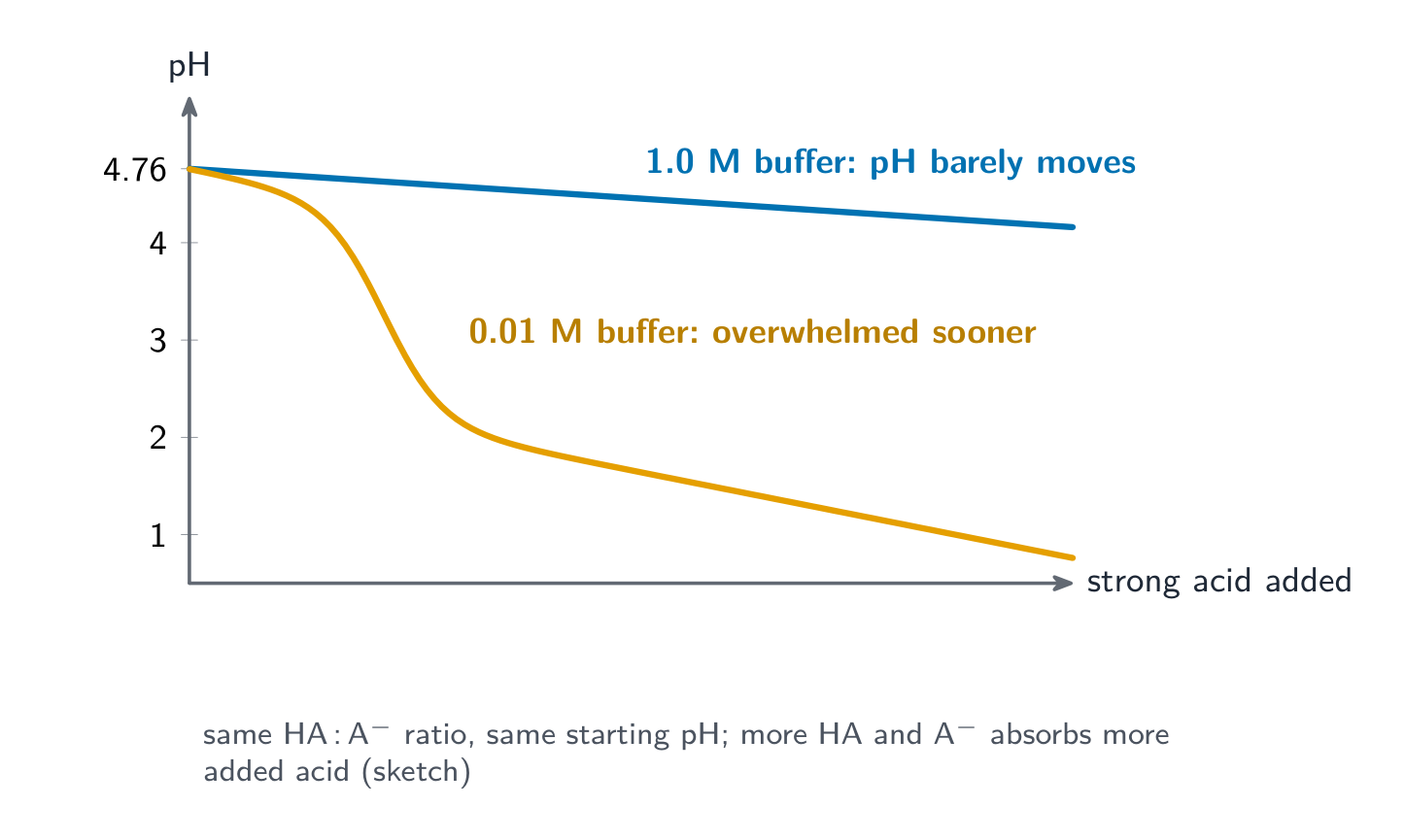
A $0.50\ \text{M}$ HA / $0.50\ \text{M}\ \text{A}^-$ buffer and a $0.050\ \text{M}$ / $0.050\ \text{M}$ buffer of the same acid have the same pH.
الصعوبة 1/5 · 100 عملة + مكافأة صغيرة عند الإنجاز الأول اليوم
The ratio is 1 in both, so pH $=$ $\text{p}K_a$ in both. Only the capacity differs.
Which $1.0\ \text{L}$ buffer has the greatest capacity against added acid?
الصعوبة 1/5 · 100 عملة + مكافأة صغيرة عند الإنجاز الأول اليوم
It has the most $\text{A}^-$ to react with added acid.
$1.00\ \text{L}$ of buffer: $0.10\ \text{mol}$ HA and $0.10\ \text{mol}\ \text{A}^-$ ($\text{p}K_a=4.74$). How much HCl lowers the pH by 1 unit, to 3.74?
- pH 3.74 needs $\dfrac{[\text{A}^-]}{[\text{HA}]}=10^{-1}$. After adding $x$ mol $\text{H}^+$: $\dfrac{0.10-x}{0.10+x}=0.10$.
- $0.10-x=0.010+0.10x$, so $1.10x=0.090$ and $x=0.082\ \text{mol}$.
- A buffer ten times more dilute (0.010 mol each) takes only $0.0082\ \text{mol}$: ten times less.
$1.00\ \text{L}$ of buffer has $0.20\ \text{mol}$ HA and $0.20\ \text{mol}\ \text{A}^-$. How many moles of NaOH raise the pH by exactly 1 unit? (Round to 3 decimal places.)
الصعوبة 2/5 · 140 عملة + مكافأة صغيرة عند الإنجاز الأول اليوم
Need $\dfrac{0.20+x}{0.20-x}=10$: $0.20+x=2.0-10x$, so $11x=1.8$ و $x=0.164\ \text{mol}$.
Balanced partners resist both ways equally
- When $[\text{HA}]=[\text{A}^-]$ (pH $=$ $\text{p}K_a$), the buffer can absorb the same amount of acid as of base. This gives the best all-round capacity for a given total amount.
- A lopsided buffer is strong in one direction only. With little $\text{A}^-$, it runs out quickly when acid is added.
What raises buffer capacity?
Sort each buffer by whether it resists more or less added acid/base.
Buffer X: $0.18\ \text{mol}$ HA + $0.02\ \text{mol}\ \text{A}^-$. Buffer Y: $0.10\ \text{mol}$ of each. Both are in $1.00\ \text{L}$ ($\text{p}K_a=4.74$). Which resists added HCl better?
- X starts at pH $4.74+\log\dfrac{0.02}{0.18}=3.79$ and has only $0.02\ \text{mol}\ \text{A}^-$ to use up acid.
- Y has $0.10\ \text{mol}\ \text{A}^-$, five times more. Y resists added HCl far better, although both contain $0.20\ \text{mol}$ in total.
- X is better against added base: it has $0.18\ \text{mol}$ HA.
A buffer has $0.25\ \text{mol}\ \text{A}^-$ و $0.05\ \text{mol}$ HA. Against which addition is it weakest?
الصعوبة 1/5 · 100 عملة + مكافأة صغيرة عند الإنجاز الأول اليوم
Only $0.05\ \text{mol}$ HA is available to react with added $\text{OH}^-$.
When the buffer fails
- Once one partner is used up, there is nothing left to absorb more acid (or base). The excess strong acid or base then sets the pH directly, and the pH drops (or rises) sharply.
- To find the pH after failure, subtract moles as usual and use the excess strong acid or base.
$0.050\ \text{mol}$ HCl is added to $1.00\ \text{L}$ of buffer containing $0.010\ \text{mol}$ HA and $0.010\ \text{mol}\ \text{A}^-$.
- All $0.010\ \text{mol}\ \text{A}^-$ is used up; $0.040\ \text{mol}\ \text{H}^+$ is left over.
- The weak acid adds almost nothing, so $[\text{H}^+]\approx0.040\ \text{M}$ and pH $\approx1.40$. The buffer has failed.
$0.030\ \text{mol}$ NaOH is added to $1.00\ \text{L}$ of buffer with $0.010\ \text{mol}$ HA and $0.010\ \text{mol}\ \text{A}^-$. Find the pH (ignore the weak base).
الصعوبة 2/5 · 140 عملة + مكافأة صغيرة عند الإنجاز الأول اليوم
HA is used up; excess $\text{OH}^-=0.020\ \text{mol}$, so pOH $1.70$ and pH $12.30$.
Capacity depends on the amounts of the partners; pH depends on their ratio. Diluting a buffer with water keeps the pH (the ratio does not change) but lowers its capacity. Do not say a more concentrated buffer has a different pH.
A buffer is diluted to ten times its volume with water. What happens?
الصعوبة 1/5 · 100 عملة + مكافأة صغيرة عند الإنجاز الأول اليوم
The ratio stays the same, so the pH stays the same, but each litre now holds less of each partner.
Buffer capacity is how much strong acid or base a buffer can absorb before the pH changes greatly. It grows with the moles of both partners and is best balanced when $[\text{HA}]\approx[\text{A}^-]$. Once a partner is used up, the excess strong acid or base sets the pH and the buffer fails.