Weak Acid and Base Equilibria
مُقدَّم| English | المعنى |
|---|---|
| weak acid/wiːk ˈæsɪd/ | An acid that only partially ionises in aqueous solution. |
| acid dissociation constant/ˈæsɪd dɪˌsəʊsɪˈeɪʃn ˈkɒnstənt/ | ثابت تفكك الحمض |
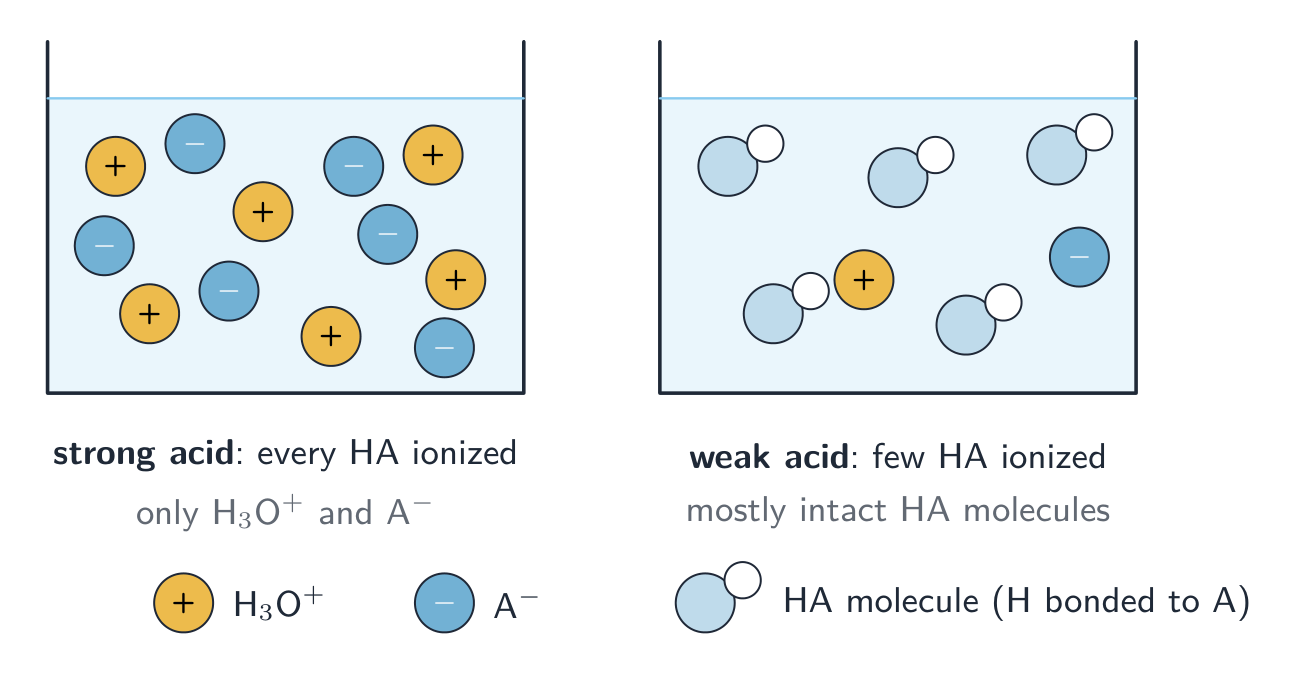
Most acids only partly ionize
- $0.10\ \text{M}$ HCl has pH $1.00$. $0.10\ \text{M}$ ethanoic (acetic) acid has pH about $2.87$: it holds most of its protons. Only about 1 molecule in 75 gives its proton away.
- A weak acid 弱酸 ionizes partly and reaches an equilibrium: $\text{HA}(aq)+\text{H}_2\text{O}(l)\rightleftharpoons\text{H}_3\text{O}^+(aq)+\text{A}^-(aq)$.
The acid dissociation constant, Ka
- The equilibrium constant is the acid dissociation constant 酸解离常数: $K_a=\dfrac{[\text{H}^+][\text{A}^-]}{[\text{HA}]}$. Water is the solvent, so it is left out.
- A larger $K_a$ means a stronger acid. Ethanoic acid has $K_a=1.8\times10^{-5}$; HF has $K_a=6.8\times10^{-4}$, so HF is the stronger of the two.
Strong or weak?
Sort each acid or base by whether it ionises fully or only partly.
Which acid is the strongest?
الصعوبة 1/5 · 100 عملة + مكافأة صغيرة عند الإنجاز الأول اليوم
The largest $K_a$ means the most ionization, so nitrous acid is the strongest of these.
The pH of a weak acid: ICE with small x
- Start: $[\text{HA}]=c$, no ions. Change: $-x,\ +x,\ +x$. So $K_a=\dfrac{x^2}{c-x}$.
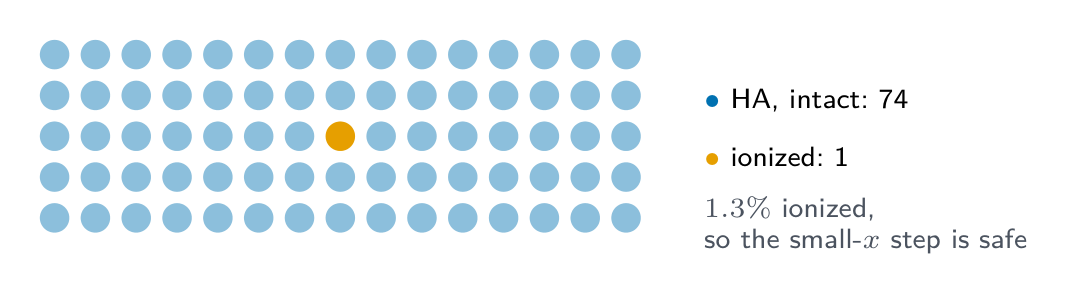
- $K_a$ is small, so try $c-x\approx c$. Then $x=[\text{H}^+]=\sqrt{K_a\,c}$. Check the 5% rule afterwards.
Find the pH of $0.10\ \text{M}$ ethanoic acid, $K_a=1.8\times10^{-5}$.
- $\dfrac{x^2}{0.10}=1.8\times10^{-5}$, so $x^2=1.8\times10^{-6}$ and $x=[\text{H}^+]=1.3\times10^{-3}\ \text{M}$.
- Check: $\dfrac{1.3\times10^{-3}}{0.10}=1.3\%$, under 5% ✓
- $\text{pH}=-\log(1.3\times10^{-3})=2.87$
Find the pH of $0.20\ \text{M}\ \text{HNO}_2$, $K_a=4.0\times10^{-4}$.
الصعوبة 2/5 · 140 عملة + مكافأة صغيرة عند الإنجاز الأول اليوم
$x=\sqrt{4.0\times10^{-4}\times0.20}=8.9\times10^{-3}\ \text{M}$ (4.5% of 0.20, just under 5%). $\text{pH}=-\log(8.9\times10^{-3})=2.05$.
Percent ionization
- $\text{percent ionization}=\dfrac{[\text{H}^+]_{\text{eq}}}{[\text{HA}]_{\text{initial}}}\times100\%$. For $0.10\ \text{M}$ ethanoic acid it is $1.3\%$.
- Diluting a weak acid raises its percent ionization. At $0.010\ \text{M}$: $x=\sqrt{1.8\times10^{-7}}=4.2\times10^{-4}$, which is $4.2\%$. Fewer particles per litre means the ions meet and recombine less often.
A $0.25\ \text{M}$ weak acid has $[\text{H}^+]=2.0\times10^{-3}\ \text{M}$ at equilibrium. What is its percent ionization?
الصعوبة 2/5 · 140 عملة + مكافأة صغيرة عند الإنجاز الأول اليوم
$\dfrac{2.0\times10^{-3}}{0.25}\times100\%=0.80\%$.
Diluting a weak acid lowers its percent ionization.
الصعوبة 1/5 · 100 عملة + مكافأة صغيرة عند الإنجاز الأول اليوم
Dilution raises the percent ionization, even though $[\text{H}^+]$ itself falls.
Working backwards: Ka from pH
- If you measure the pH, you know $x=[\text{H}^+]=10^{-\text{pH}}$. Then $[\text{A}^-]=x$ and $[\text{HA}]=c-x$.
- Put them into $K_a$. This is how $K_a$ values are found in the lab.
A $0.050\ \text{M}$ solution of a weak acid HA has pH $3.00$. Find $K_a$.
- $[\text{H}^+]=[\text{A}^-]=10^{-3.00}=1.0\times10^{-3}\ \text{M}$; $[\text{HA}]=0.050-0.0010=0.049\ \text{M}$.
- $K_a=\dfrac{(1.0\times10^{-3})^2}{0.049}=2.0\times10^{-5}$
A $0.10\ \text{M}$ weak acid has pH $2.50$. Find $K_a$, in units of $10^{-5}$.
الصعوبة 2/5 · 140 عملة + مكافأة صغيرة عند الإنجاز الأول اليوم
$[\text{H}^+]=10^{-2.50}=3.16\times10^{-3}$; $[\text{HA}]=0.0968$. $K_a=\dfrac{(3.16\times10^{-3})^2}{0.0968}=1.03\times10^{-4}$, which is $10.3\times10^{-5}$.
Weak bases work the same way
- A weak base takes $\text{H}^+$ from water: $\text{B}+\text{H}_2\text{O}\rightleftharpoons\text{BH}^++\text{OH}^-$, with $K_b=\dfrac{[\text{BH}^+][\text{OH}^-]}{[\text{B}]}$.
- The same ICE method gives $x=[\text{OH}^-]$. Find pOH first, then pH.
Find the pH of $0.10\ \text{M}$ ammonia, $K_b=1.8\times10^{-5}$.
- $\dfrac{x^2}{0.10}=1.8\times10^{-5}$, so $x=[\text{OH}^-]=1.3\times10^{-3}\ \text{M}$.
- $\text{pOH}=2.87$, so $\text{pH}=14.00-2.87=11.13$.
Find the pH of $0.050\ \text{M}$ methylamine, $K_b=4.4\times10^{-4}$, using the small-$x$ shortcut.
الصعوبة 2/5 · 140 عملة + مكافأة صغيرة عند الإنجاز الأول اليوم
$[\text{OH}^-]=\sqrt{4.4\times10^{-4}\times0.050}=4.7\times10^{-3}\ \text{M}$, pOH $2.33$, pH $11.67$. (The change is 9.4% of 0.050, so a full quadratic would give pH 11.65.)
Ka × Kb = Kw for a conjugate pair
- For an acid and its conjugate base, $K_a\times K_b=K_w=1.0\times10^{-14}$ at $25^\circ\text{C}$. A stronger acid has a weaker conjugate base.
- $\text{NH}_4^+$ is the conjugate acid of $\text{NH}_3$: $K_a=\dfrac{1.0\times10^{-14}}{1.8\times10^{-5}}=5.6\times10^{-10}$.
HF has $K_a=6.8\times10^{-4}$. Find $K_b$ for $\text{F}^-$ at $25^\circ\text{C}$, in units of $10^{-11}$.
الصعوبة 2/5 · 140 عملة + مكافأة صغيرة عند الإنجاز الأول اليوم
$K_b=\dfrac{1.0\times10^{-14}}{6.8\times10^{-4}}=1.5\times10^{-11}$.
Do not use $[\text{H}^+]=c$ for a weak acid: that is only true for strong acids. Remember to take a square root, check the 5% rule, and for a base, convert pOH to pH at the end.
Weak acid: $K_a=\dfrac{[\text{H}^+][\text{A}^-]}{[\text{HA}]}$, and $[\text{H}^+]\approx\sqrt{K_a c}$ when the 5% rule holds. Weak base: the same with $K_b$ and $[\text{OH}^-]$. Percent ionization rises on dilution. For a conjugate pair, $K_aK_b=K_w$.