Acid-Base Reactions and Buffers
مُقدَّم 8:23
الأحماض والقواعد
شريطان من الورق — أحدهما أحمر والآخر أزرق. أغمسهما في سائل ويتغير اللون، وهذا اللون يخبرك ما إذا كان السائل حمضاً أم قاعداً.…
سرد باللغة الإنجليزية · ترجمة نصية بالإنجليزية و中文 يمكنك التبديل بينهما
In this lesson
| English | المعنى |
|---|---|
| buffer/ˈbʌfə/ | محلول منظم |
What is left after the reaction?
- Mix an acid and a base, and the first job is always the same: let them react completely, then look at what is left. The leftover species decide the pH.
- With a strong acid or a strong base present, the reaction goes essentially to completion. So use a moles table (before, change, after), not an equilibrium table.
Four kinds of mixture
- Strong acid + strong base: $\text{H}^+ + \text{OH}^-\to\text{H}_2\text{O}$. Weak acid + strong base: $\text{HA}+\text{OH}^-\to\text{A}^-+\text{H}_2\text{O}$.
- Strong acid + weak base: $\text{B}+\text{H}^+\to\text{BH}^+$. Weak acid + weak base: only partial reaction, so it needs a full equilibrium treatment (rare on the AP exam).
What forms when HF reacts with excess NaOH?
الصعوبة 1/5 · 100 عملة + مكافأة صغيرة عند الإنجاز الأول اليوم
$\text{HF}+\text{OH}^-\to\text{F}^-+\text{H}_2\text{O}$ goes to completion.
Equal moles: the salt sets the pH
- When acid and base are in exactly equal moles, only the salt is left. Its ions decide the pH: $\text{A}^-$ from a weak acid is a weak base (pH above 7); $\text{BH}^+$ from a weak base is a weak acid (pH below 7).
- Ions from strong acids and strong bases, such as $\text{Na}^+$ and $\text{Cl}^-$, do not change the pH. A NaCl solution is neutral.
Match each salt solution with its pH at $25^\circ\text{C}$.
الصعوبة 2/5 · 140 عملة + مكافأة صغيرة عند الإنجاز الأول اليوم
Ions from strong acids and bases are neutral; $\text{CH}_3\text{COO}^-$ is a weak base; $\text{NH}_4^+$ is a weak acid.
Find the pH of $0.10\ \text{M}$ sodium ethanoate, $\text{CH}_3\text{COONa}$ ($K_a$ of ethanoic acid $=1.8\times10^{-5}$).
- $\text{CH}_3\text{COO}^-$ is a weak base: $K_b=\dfrac{1.0\times10^{-14}}{1.8\times10^{-5}}=5.6\times10^{-10}$.
- $[\text{OH}^-]=\sqrt{5.6\times10^{-10}\times0.10}=7.5\times10^{-6}\ \text{M}$, so pOH $5.13$.
- $\text{pH}=14.00-5.13=8.87$: basic, as expected.
Find the pH of $0.20\ \text{M}$ NaF ($K_a$ of HF $=6.8\times10^{-4}$).
الصعوبة 2/5 · 140 عملة + مكافأة صغيرة عند الإنجاز الأول اليوم
$K_b=1.5\times10^{-11}$; $[\text{OH}^-]=\sqrt{1.5\times10^{-11}\times0.20}=1.7\times10^{-6}$; pOH $5.77$; pH $8.23$.
Partial neutralization makes a buffer
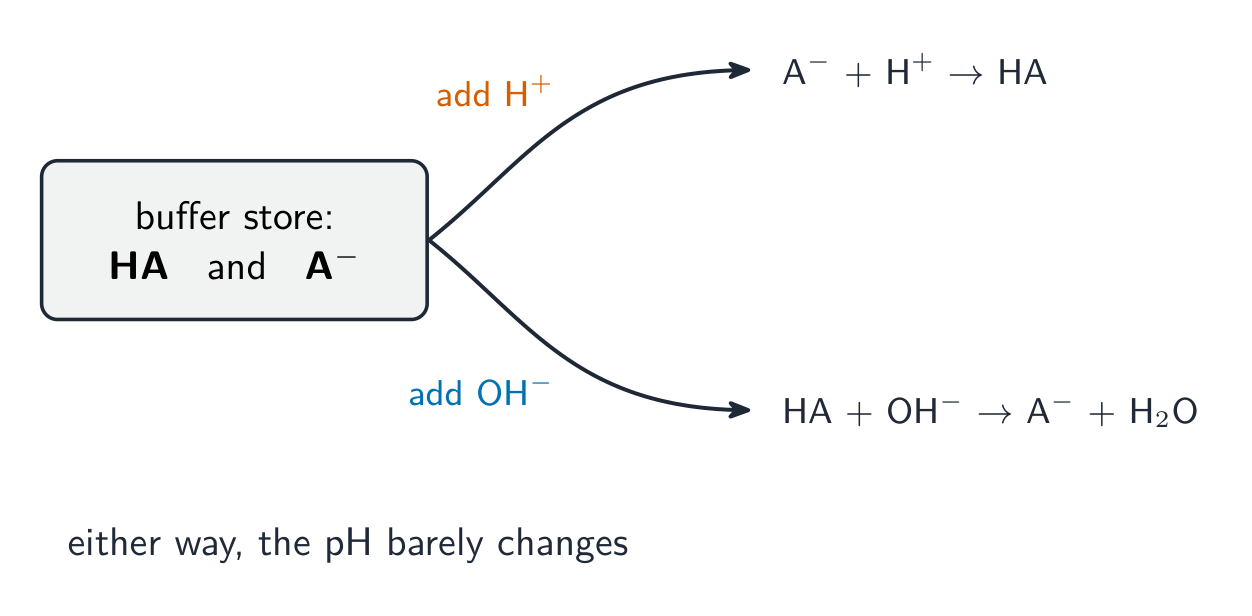
- If a weak acid is only partly neutralized, both the weak acid HA and its conjugate base $\text{A}^-$ remain in solution. This mixture is a buffer 缓冲溶液.
- A buffer resists pH change: its HA reacts with any added $\text{OH}^-$, and its $\text{A}^-$ reacts with any added $\text{H}^+$.
Is it a buffer?
Sort each mixture by whether it forms a buffer.
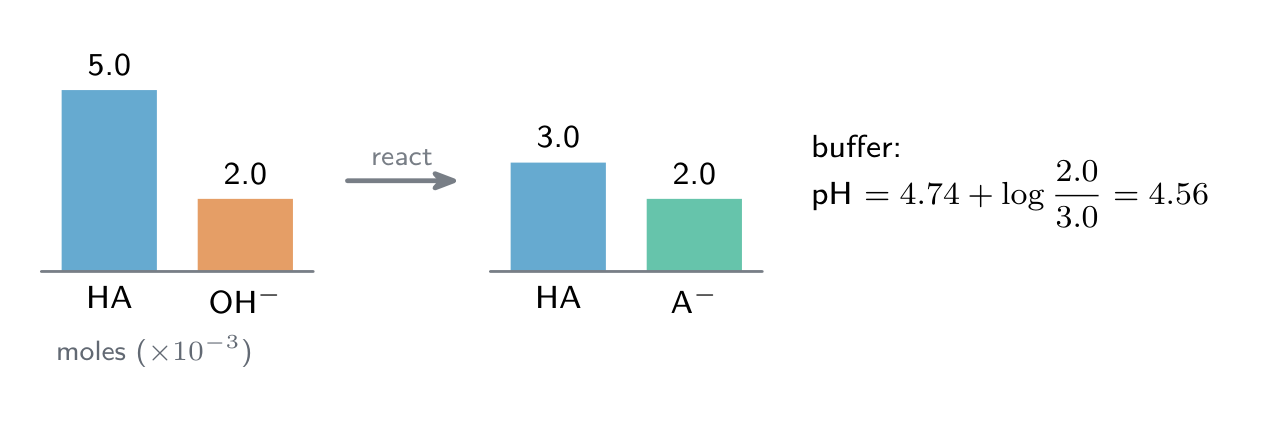
$5.0\times10^{-3}\ \text{mol}$ of HA (a weak acid, $\text{p}K_a=4.74$) reacts with $2.0\times10^{-3}\ \text{mol}$ of NaOH. What is in the solution afterwards?
- $\text{OH}^-$ is the limiting reagent and is used up completely.
- HA left: $5.0-2.0=3.0\times10^{-3}\ \text{mol}$. $\text{A}^-$ formed: $2.0\times10^{-3}\ \text{mol}$.
- Both HA and $\text{A}^-$ are present, so the solution is a buffer. (Its pH is $4.56$, from a method in lesson 8.9.)
Which mixture is a buffer?
الصعوبة 1/5 · 100 عملة + مكافأة صغيرة عند الإنجاز الأول اليوم
Half the weak acid is converted to its conjugate base, so both HA and $\text{A}^-$ remain.
$4.0\times10^{-3}\ \text{mol}$ HA reacts with $1.5\times10^{-3}\ \text{mol}$ NaOH. How many moles of HA are left, in units of $10^{-3}$?
الصعوبة 2/5 · 140 عملة + مكافأة صغيرة عند الإنجاز الأول اليوم
$\text{OH}^-$ is limiting: $4.0-1.5=2.5\times10^{-3}\ \text{mol}$ HA left, and $1.5\times10^{-3}\ \text{mol}\ \text{A}^-$ formed.
A routine for every mixing question
-
- Convert to moles. 2. Write the reaction that goes to completion and find the limiting reagent. 3. List what is left.
-
- Choose the method: excess strong acid or base → pH from the excess; weak acid alone → $K_a$; weak base alone → $K_b$; HA and $\text{A}^-$ together → buffer.
Put the routine for a mixing question in order.
الصعوبة 3/5 · 200 عملة + مكافأة صغيرة عند الإنجاز الأول اليوم
React first, then decide which equilibrium (if any) sets the pH.
$0.020\ \text{mol}\ \text{NH}_3$ is mixed with $0.020\ \text{mol}$ HCl in $0.40\ \text{L}$ of solution. Is the result acidic, basic or neutral?
- $\text{NH}_3+\text{H}^+\to\text{NH}_4^+$: equal moles, so only $0.050\ \text{M}\ \text{NH}_4^+$ (and $\text{Cl}^-$) remains.
- $\text{NH}_4^+$ is a weak acid ($K_a=5.6\times10^{-10}$), so the solution is acidic: $[\text{H}^+]=\sqrt{5.6\times10^{-10}\times0.050}=5.3\times10^{-6}$, pH $5.28$.
Equal moles of ammonia and hydrochloric acid give a neutral solution.
الصعوبة 1/5 · 100 عملة + مكافأة صغيرة عند الإنجاز الأول اليوم
Only $\text{NH}_4^+$ is left, and it is a weak acid, so the solution is acidic.
Do not use an ICE table with $K$ for the reaction between a strong base and a weak acid: it goes to completion, so subtract moles first. And "neutralized" does not mean pH 7: equal moles of a weak acid and a strong base give a basic solution.
React first, then decide. Reactions involving a strong acid or base go to completion: work in moles. Leftover strong acid/base → pH from the excess; only a salt → its weak-acid or weak-base ion sets the pH; weak acid plus its conjugate base → a buffer.