Introduction to Solubility Equilibria
مُقدَّم 8:24
التوازن
مصنع كيميائي وقت الغروب. بداخله، يتحول النيتروجين من الهواء إلى الأمونيا — السماد الذي يُغذي حوالي نصف سكان العالم اليوم. لكن الـ…
سرد باللغة الإنجليزية · ترجمة نصية بالإنجليزية و中文 يمكنك التبديل بينهما
في هذا الدرس
| English | المعنى |
|---|---|
| saturated solution/ˈsætʃəreɪtɪd səˈluːʃn/ | A solution containing the solute's equilibrium solubility limit at the stated conditions. |
| solubility product/ˌsɒljuːˈbɪlɪti ˈprɒdʌkt/ | حاصل الذوبانية |
| molar solubility/ˈməʊlə ˌsɒljuːˈbɪlɪti/ | الذوبانية المولية |
"Insoluble" still means a little dissolves
- Silver chloride is called insoluble, yet a litre of water dissolves about $2\ \text{mg}$ of it. Kidney stones and scale in kettles form when such small amounts come out of solution.
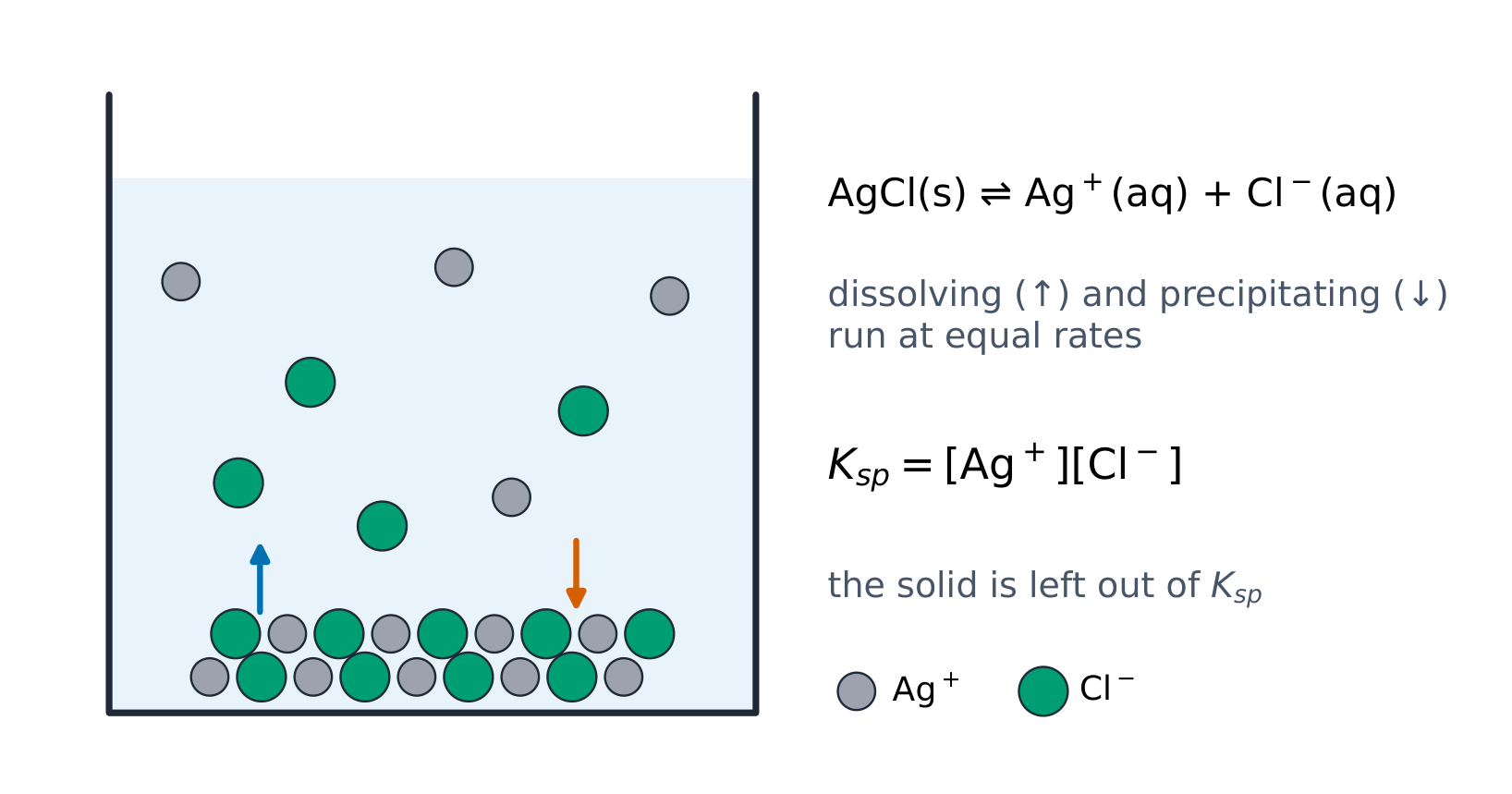
- In a saturated solution 饱和溶液 with solid present, ions leave the solid and rejoin it at the same rate. This is an equilibrium, and it has its own constant.
The solubility product, Ksp
- The solubility product 溶度积 $K_{sp}$ is $K$ for a solid dissolving into its ions. The solid is left out of the expression.
- Each ion is raised to its coefficient: $\text{AgCl}(s)\rightleftharpoons\text{Ag}^++\text{Cl}^-$ gives $K_{sp}=[\text{Ag}^+][\text{Cl}^-]$; $\text{CaF}_2(s)\rightleftharpoons\text{Ca}^{2+}+2\text{F}^-$ gives $K_{sp}=[\text{Ca}^{2+}][\text{F}^-]^2$.
Which is $K_{sp}$ for $\text{PbI}_2(s)\rightleftharpoons\text{Pb}^{2+}(aq)+2\text{I}^-(aq)$?
الصعوبة 1/5 · 100 عملة + مكافأة صغيرة عند الإنجاز الأول اليوم
The solid is left out, and the iodide concentration is squared because of its coefficient.
Molar solubility, s
- The molar solubility 摩尔溶解度 $s$ is the moles of solid that dissolve per litre of saturated solution. Each ion concentration is $s$ times its coefficient.
- So for $\text{AgCl}$, $[\text{Ag}^+]=[\text{Cl}^-]=s$ and $K_{sp}=s^2$. For $\text{CaF}_2$, $[\text{Ca}^{2+}]=s$ and $[\text{F}^-]=2s$, so $K_{sp}=s(2s)^2=4s^3$.
Solubility as an equilibrium
Sort each salt by whether its dissolving needs a solubility equilibrium (Ksp).
للدفاع $\text{Mg(OH)}_2(s)\rightleftharpoons\text{Mg}^{2+}+2\text{OH}^-$, how is $K_{sp}$ related to the molar solubility $s$?
الصعوبة 1/5 · 100 عملة + مكافأة صغيرة عند الإنجاز الأول اليوم
$[\text{Mg}^{2+}]=s$ و $[\text{OH}^-]=2s$, so $K_{sp}=s(2s)^2=4s^3$.
From $K_{sp}$ to solubility. $\text{CaF}_2$ has $K_{sp}=3.9\times10^{-11}$. Find its molar solubility.
- $K_{sp}=[\text{Ca}^{2+}][\text{F}^-]^2=s(2s)^2=4s^3$
- $4s^3=3.9\times10^{-11}$, so $s^3=9.8\times10^{-12}$ and $s=2.1\times10^{-4}\ \text{M}$.
- So $[\text{Ca}^{2+}]=2.1\times10^{-4}\ \text{M}$ and $[\text{F}^-]=4.3\times10^{-4}\ \text{M}$.
AgBr has $K_{sp}=5.0\times10^{-13}$. Find its molar solubility, in units of $10^{-7}\ \text{M}$.
الصعوبة 2/5 · 140 عملة + مكافأة صغيرة عند الإنجاز الأول اليوم
$s=\sqrt{5.0\times10^{-13}}=7.1\times10^{-7}\ \text{M}$.
From solubility to $K_{sp}$. A saturated solution of $\text{Ag}_2\text{CrO}_4$ contains $6.5\times10^{-5}\ \text{mol}$ of dissolved salt per litre. Find $K_{sp}$.
- $\text{Ag}_2\text{CrO}_4(s)\rightleftharpoons2\text{Ag}^++\text{CrO}_4^{2-}$, so $[\text{Ag}^+]=2s=1.3\times10^{-4}$ and $[\text{CrO}_4^{2-}]=s=6.5\times10^{-5}\ \text{M}$.
- $K_{sp}=(1.3\times10^{-4})^2(6.5\times10^{-5})=1.1\times10^{-12}$
The molar solubility of $\text{PbCl}_2$ هي $1.6\times10^{-2}\ \text{M}$. Calculate $K_{sp}$, in units of $10^{-5}$.
الصعوبة 2/5 · 140 عملة + مكافأة صغيرة عند الإنجاز الأول اليوم
$[\text{Pb}^{2+}]=0.016$, $[\text{Cl}^-]=0.032\ \text{M}$. $K_{sp}=(0.016)(0.032)^2=1.6\times10^{-5}$.
Comparing Ksp values: a trap
- If two salts give the same number of ions (both 1:1, for example), the one with the larger $K_{sp}$ is more soluble.
- If the formulas are different types, you must calculate $s$. $\text{Ag}_2\text{CrO}_4$ has a smaller $K_{sp}$ than AgCl ($1.1\times10^{-12}$ vs $1.8\times10^{-10}$), yet it is more soluble: $s=6.5\times10^{-5}\ \text{M}$ vs $1.3\times10^{-5}\ \text{M}$.
A salt with a smaller $K_{sp}$ always has a smaller molar solubility than a salt with a larger $K_{sp}$.
الصعوبة 1/5 · 100 عملة + مكافأة صغيرة عند الإنجاز الأول اليوم
Only true for salts that give the same number of ions. $\text{Ag}_2\text{CrO}_4$ has a smaller $K_{sp}$ than AgCl but dissolves more.
Grams per litre
- To change molar solubility into mass, multiply by the molar mass. AgCl: $s=\sqrt{1.8\times10^{-10}}=1.3\times10^{-5}\ \text{M}$.
- $1.3\times10^{-5}\ \text{mol/L}\times143.3\ \text{g/mol}=1.9\times10^{-3}\ \text{g/L}$, about $2\ \text{mg}$ per litre.
The molar solubility of $\text{BaSO}_4$ هي $1.0\times10^{-5}\ \text{M}$ (molar mass $233\ \text{g/mol}$). How many milligrams dissolve in $1.0\ \text{L}$?
الصعوبة 2/5 · 140 عملة + مكافأة صغيرة عند الإنجاز الأول اليوم
$1.0\times10^{-5}\times233=2.33\times10^{-3}\ \text{g}=2.33\ \text{mg}$.
Will a precipitate form?
- Calculate $Q$ (the ion product) with the concentrations after mixing. $Q>K_{sp}$: the solution holds too many ions, so solid precipitates until $Q=K_{sp}$. $Q<K_{sp}$: no precipitate.
- Remember that mixing two solutions dilutes both. Equal volumes halve each concentration.
$50\ \text{mL}$ of $0.0020\ \text{M}\ \text{AgNO}_3$ is mixed with $50\ \text{mL}$ of $0.0020\ \text{M}\ \text{NaCl}$. Does AgCl ($K_{sp}=1.8\times10^{-10}$) precipitate?
- After mixing, the volume doubles: $[\text{Ag}^+]=[\text{Cl}^-]=0.0010\ \text{M}$.
- $Q=(0.0010)(0.0010)=1.0\times10^{-6}$
- $Q>K_{sp}$, so yes: AgCl precipitates.
Equal volumes of $2.0\times10^{-4}\ \text{M}\ \text{Pb(NO}_3)_2$ و $2.0\times10^{-4}\ \text{M}\ \text{NaCl}$ are mixed. $\text{PbCl}_2$ has $K_{sp}=1.6\times10^{-5}$. What happens?
الصعوبة 1/5 · 100 عملة + مكافأة صغيرة عند الإنجاز الأول اليوم
After mixing each is $1.0\times10^{-4}\ \text{M}$. $Q=(1.0\times10^{-4})(1.0\times10^{-4})^2=1.0\times10^{-12}$, far below $K_{sp}$.
Common slips: forgetting to double (or triple) the ion concentration when the coefficient is 2 or 3, and then forgetting to square or cube it; comparing $K_{sp}$ values of salts with different formulas; and using the concentrations from before mixing instead of after.
$K_{sp}$ is $K$ for a dissolving solid, with the solid left out. Write each ion as coefficient × $s$, then solve: $K_{sp}=s^2$ for 1:1 salts, $4s^3$ for 1:2 or 2:1 salts. Compare solubilities through $s$, not $K_{sp}$, unless the formulas match. Precipitate forms when $Q>K_{sp}$.