The Common-Ion Effect
مُقدَّم 8:24
التوازن
مصنع كيميائي وقت الغروب. بداخله، يتحول النيتروجين من الهواء إلى الأمونيا — السماد الذي يُغذي حوالي نصف سكان العالم اليوم. لكن الـ…
سرد باللغة الإنجليزية · ترجمة نصية بالإنجليزية و中文 يمكنك التبديل بينهما
في هذا الدرس
| English | المعنى |
|---|---|
| common-ion effect/ˈkɒmən ˈaɪɒn ɪˈfekt/ | تأثير الأيون المشترك |
Less dissolves when an ion is already there
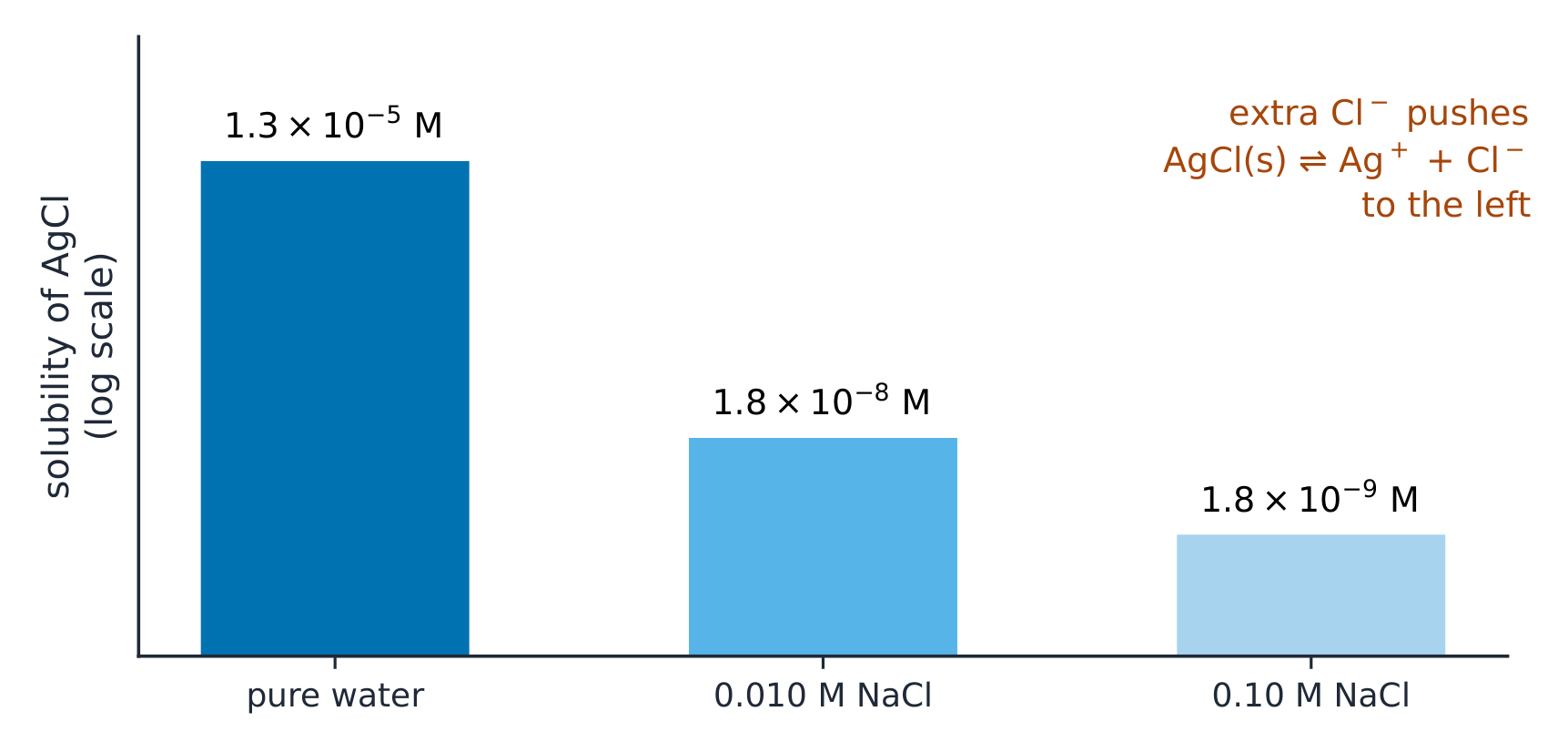
- Silver chloride dissolves about $1.3\times10^{-5}\ \text{mol}$ per litre of pure water. In seawater, which is full of chloride ions, it dissolves thousands of times less.
- This is the common-ion effect 同离子效应: a salt is less soluble in a solution that already contains one of its own ions.
A salt is less soluble in a solution that already holds one of its ions. This is the common-____ effect.
الصعوبة 1/5 · 100 عملة + مكافأة صغيرة عند الإنجاز الأول اليوم
The shared ion is called the common ion.
Why it happens
- Start with $\text{AgCl}(s)\rightleftharpoons\text{Ag}^+(aq)+\text{Cl}^-(aq)$ at equilibrium. Adding NaCl raises $[\text{Cl}^-]$, so $Q=[\text{Ag}^+][\text{Cl}^-]$ rises above $K_{sp}$.
- The net reaction goes in reverse: some AgCl precipitates until $Q=K_{sp}$ again. Less silver stays dissolved, but $K_{sp}$ itself does not change.
صلب $\text{NaCl}$ is added to a saturated AgCl solution. What happens?
الصعوبة 1/5 · 100 عملة + مكافأة صغيرة عند الإنجاز الأول اليوم
Extra $\text{Cl}^-$ raises $Q$ أعلى من $K_{sp}$, so the dissolving reaction runs in reverse.
The common-ion effect lowers the value of $K_{sp}$.
الصعوبة 1/5 · 100 عملة + مكافأة صغيرة عند الإنجاز الأول اليوم
It lowers the solubility. $K_{sp}$ depends only on temperature.
The ICE table starts with the common ion
- Put the common ion's concentration in the initial row. The dissolving salt adds $s$ (times the coefficient) on top of it.
- Because $K_{sp}$ is tiny, $s$ is usually tiny compared with the added ion. So the common ion's concentration stays almost exactly what you added.
Find the molar solubility of AgCl ($K_{sp}=1.8\times10^{-10}$) in $0.10\ \text{M}$ NaCl.
- Initial: $[\text{Ag}^+]=0$, $[\text{Cl}^-]=0.10$. Equilibrium: $[\text{Ag}^+]=s$, $[\text{Cl}^-]=0.10+s\approx0.10$.
- $K_{sp}=s(0.10)=1.8\times10^{-10}$, so $s=1.8\times10^{-9}\ \text{M}$.
- In pure water $s=1.3\times10^{-5}\ \text{M}$, so the chloride lowers the solubility about $7000$ times. Check: $s$ is far below $5\%$ of $0.10$ ✓
The common-ion effect
For AgCl -> Ag+ + Cl-, sort each addition by its effect on solubility.
AgBr has $K_{sp}=5.0\times10^{-13}$. Find its molar solubility in $0.050\ \text{M}$ NaBr, in units of $10^{-11}\ \text{M}$.
الصعوبة 2/5 · 140 عملة + مكافأة صغيرة عند الإنجاز الأول اليوم
$s(0.050)=5.0\times10^{-13}$, so $s=1.0\times10^{-11}\ \text{M}$.
Find the molar solubility of $\text{CaF}_2$ ($K_{sp}=3.9\times10^{-11}$) in $0.010\ \text{M}$ NaF.
- Equilibrium: $[\text{Ca}^{2+}]=s$, $[\text{F}^-]=0.010+2s\approx0.010$.
- $K_{sp}=s(0.010)^2=1.0\times10^{-4}\,s=3.9\times10^{-11}$, so $s=3.9\times10^{-7}\ \text{M}$.
- In pure water $s=2.1\times10^{-4}\ \text{M}$: the fluoride lowers it about $500$ times.
$\text{Mg(OH)}_2$ has $K_{sp}=5.6\times10^{-12}$. Find its molar solubility in a solution with $[\text{OH}^-]=0.010\ \text{M}$, in units of $10^{-8}\ \text{M}$.
الصعوبة 2/5 · 140 عملة + مكافأة صغيرة عند الإنجاز الأول اليوم
$s(0.010)^2=5.6\times10^{-12}$, so $s=5.6\times10^{-8}\ \text{M}$.
Which ion is common matters
- For $\text{CaF}_2$, adding $\text{F}^-$ has a bigger effect than adding the same concentration of $\text{Ca}^{2+}$, because $[\text{F}^-]$ is squared in $K_{sp}$.
- In $0.010\ \text{M}\ \text{Ca(NO}_3)_2$: $K_{sp}=(0.010)(2s)^2=0.040\,s^2$, so $s=3.1\times10^{-5}\ \text{M}$. Compare $3.9\times10^{-7}\ \text{M}$ in $0.010\ \text{M}$ NaF.
In which $0.10\ \text{M}$ solution is $\text{PbI}_2$ ($K_{sp}=[\text{Pb}^{2+}][\text{I}^-]^2$) least soluble?
الصعوبة 1/5 · 100 عملة + مكافأة صغيرة عند الإنجاز الأول اليوم
Iodide is squared in $K_{sp}$, so the same concentration of $\text{I}^-$ lowers the solubility more than $\text{Pb}^{2+}$ does. $\text{KNO}_3$ has no common ion.
Using the effect
- Chemists add a common ion on purpose to precipitate more of a salt. For example, excess sulfate makes sure almost all barium leaves solution as $\text{BaSO}_4$ before it is filtered and weighed.
- Only an ion that is part of the salt counts. In $\text{AgNO}_3$ solution, $\text{Ag}^+$ is a common ion for AgCl, but $\text{NO}_3^-$ is not, so it has no effect.
Which added solutions lower the solubility of $\text{BaSO}_4$? Select all that apply.
الصعوبة 2/5 · 140 عملة + مكافأة صغيرة عند الإنجاز الأول اليوم
Only solutions that contain $\text{Ba}^{2+}$ أو $\text{SO}_4^{2-}$ give a common ion.
The common-ion effect lowers the solubility, not $K_{sp}$; $K_{sp}$ only changes with temperature. Use the added ion's concentration in the $K_{sp}$ expression (raised to its power), and do not double it twice: the 2 in $(2s)$ applies to the ions from the dissolving salt only.
A common ion shifts the dissolving equilibrium back, so less salt dissolves. Solve by putting the common ion in the initial row, approximating $(c+s)\approx c$, and solving $K_{sp}$ for $s$. An ion that is squared in $K_{sp}$ has the bigger effect. $K_{sp}$ itself stays the same.