The Steps a Reaction Really Takes
مُقدَّم| English | المعنى |
|---|---|
| elementary step/ˌelɪˈmentəri step/ | خطوة أولية |
| reaction mechanism/rɪˈækʃn ˈmekənɪzəm/ | آلية التفاعل |
| intermediate/ˌɪntəˈmiːdɪət/ | وسيط |
The hidden choreography
- A single chlorine atom from a CFC can destroy thousands of ozone molecules in the stratosphere. The overall equation does not show how; the mechanism does.
- A reaction mechanism 反应机理 is the series of small elementary steps 基元反应 that add up to the overall reaction.
Elementary steps
- A reaction mechanism 反应机理 is a proposed sequence of elementary events; it must match the overall equation and observed rate law.
- Each elementary step 基元反应 is a single molecular event.
- Add up the steps and you get the overall reaction.
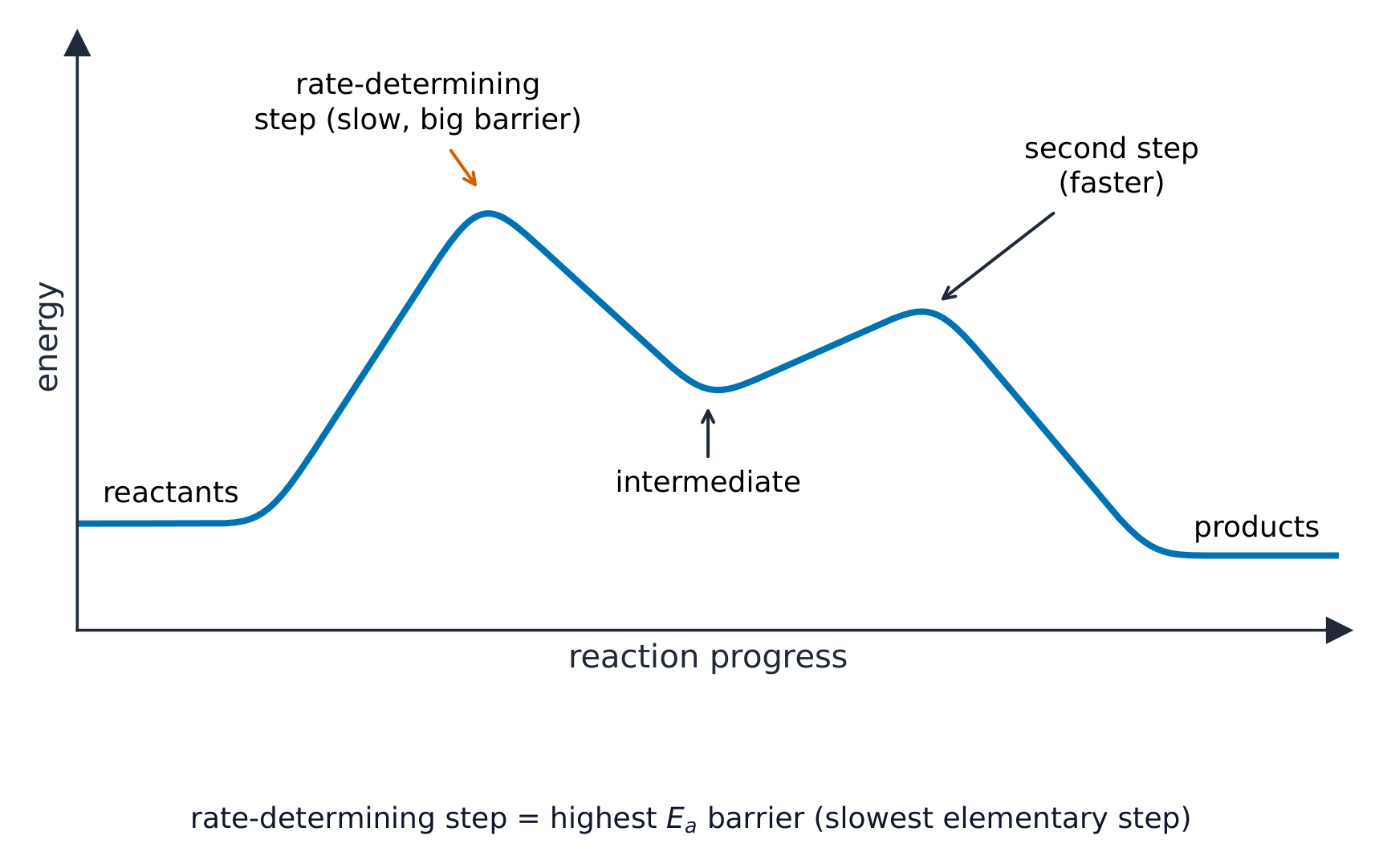
A two-step reaction: each step has its own barrier and the slow step sets the rate
The elementary steps of a mechanism add up to the overall reaction.
الصعوبة 1/5 · 100 عملة + مكافأة صغيرة عند الإنجاز الأول اليوم
Summing the steps (cancelling intermediates) gives the overall equation.
A single molecular event within a mechanism is an ____ step.
الصعوبة 1/5 · 100 عملة + مكافأة صغيرة عند الإنجاز الأول اليوم
Each single event is an elementary step.
Intermediates
- An intermediate 中间体 is made in one step and used up in a later one.
- It does not appear in the overall equation.
- Spot it: it shows up first as a product, then as a reactant.
An intermediate is a species that is...
الصعوبة 1/5 · 100 عملة + مكافأة صغيرة عند الإنجاز الأول اليوم
An intermediate forms then is consumed, so it cancels overall.
How many collide
- Molecularity counts how many particles meet in a single step.
- One particle is unimolecular; two is bimolecular.
- Three-particle collisions are rare, so most steps involve one or two.
Molecularity of a step
Classify each elementary step by how many particles must collide.
A single step in which two particles collide is called...
الصعوبة 1/5 · 100 عملة + مكافأة صغيرة عند الإنجاز الأول اليوم
Two colliding particles make a bimolecular step.
Steps requiring three particles to collide at once are common.
الصعوبة 1/5 · 100 عملة + مكافأة صغيرة عند الإنجاز الأول اليوم
Three-body collisions are very unlikely, so they are rare.
Steps: $A + B \to C$ (fast), then $C + B \to D$.
- $C$ is made and then consumed, so it is an intermediate.
- Add both sides: $A+B+C+B\to C+D$. Cancel C and combine the two B reactants to get $A+2B\to D$. The overall equation alone does not establish the mechanism or its rate law.
How does an intermediate differ from a catalyst?
الصعوبة 1/5 · 100 عملة + مكافأة صغيرة عند الإنجاز الأول اليوم
An intermediate appears as a product first; a catalyst appears as a reactant first.
Rate laws of elementary steps
| Elementary step | Molecularity | Rate law |
|---|---|---|
| A → products | unimolecular | rate = k[A] |
| A + B → products | bimolecular | rate = k[A][B] |
| 2A → products | bimolecular | rate = k[A]² |
| 2A + B → products | termolecular (rare) | rate = k[A]²[B] |
- Only for an elementary step can you read the orders from the coefficients.
The elementary step 2NO₂ → NO₃ + NO happens in one collision. What is its rate law?
الصعوبة 1/5 · 100 عملة + مكافأة صغيرة عند الإنجاز الأول اليوم
For an elementary step, the coefficients give the orders: two NO₂ collide, so second order in NO₂.
Ozone destruction. Step 1: $\text{Cl} + \text{O}_3 \rightarrow \text{ClO} + \text{O}_2$. Step 2: $\text{ClO} + \text{O} \rightarrow \text{Cl} + \text{O}_2$.
- Add and cancel: overall $\text{O}_3 + \text{O} \rightarrow 2\text{O}_2$.
- ClO is made in step 1 and used in step 2: an intermediate. Cl is used in step 1 and made again in step 2: a catalyst, which is why one atom destroys so much ozone.
Step 1: NO + O₃ → NO₂ + O₂. Step 2: NO₂ + O → NO + O₂. Which species is the catalyst?
الصعوبة 1/5 · 100 عملة + مكافأة صغيرة عند الإنجاز الأول اليوم
NO is used in step 1 and re-formed in step 2. NO₂ is the intermediate (made, then used).
- Intermediate: made first, used later. Catalyst: used first, made again later. Neither appears in the overall equation.
- Read orders from coefficients only for an elementary step, never for the overall equation.
- Most elementary steps are uni- or bimolecular; three-particle collisions are rare.
A reaction mechanism is the sequence of elementary steps that add up to the overall reaction. An intermediate is made in one step and used up later, so it cancels from the overall equation. Molecularity counts the particles meeting in a step — almost always one or two.