Why Collisions Do or Do Not React
مُقدَّم| English | المعنى |
|---|---|
| collision theory/kəˈlɪʒn ˈθɪəri/ | نظرية الاصطدام |
| activation energy/ˌæktɪˈveɪʃn ˈenədʒi/ | طاقة التنشيط |
| catalyst/ˈkætəlɪst/ | A substance that increases a reaction rate without being used up overall. |
Not every bump makes a bond
- In a gas at room temperature, each molecule is hit billions of times a second. If every hit reacted, every reaction would be over instantly.
- Most hits bounce off unchanged. A successful hit needs enough energy and the right orientation.
Collision theory
- Collision theory 碰撞理论: particles must collide to react, and a collision works only if both conditions are met.
- The rate depends on how often effective collisions happen, not on how often particles collide in total.
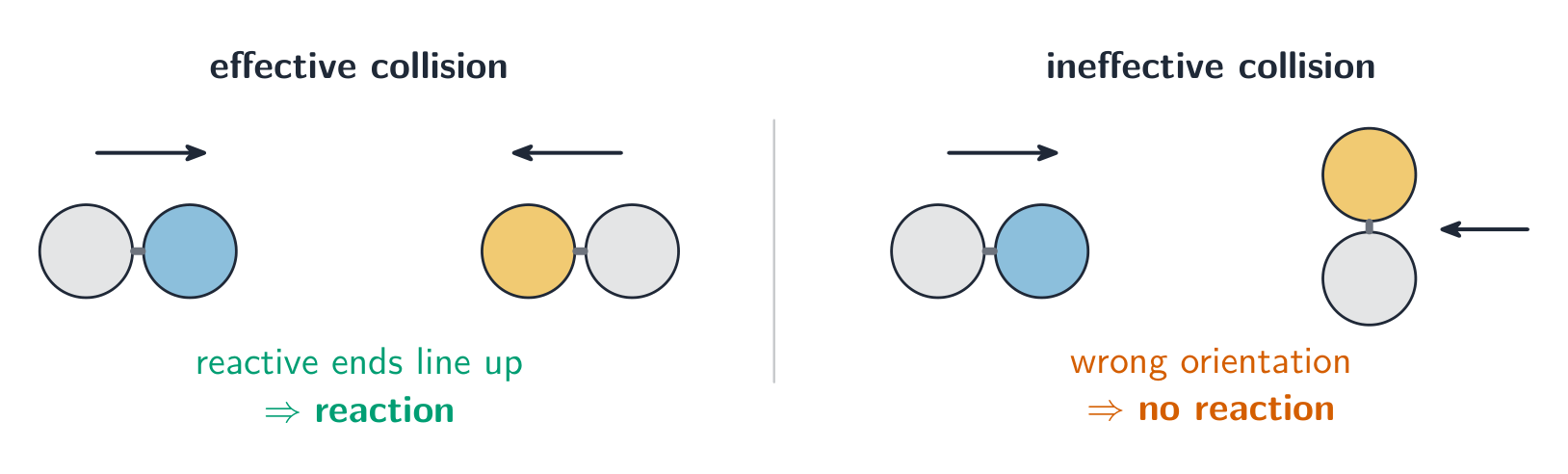
Select كلاهما conditions a collision needs to cause a reaction.
الصعوبة 2/5 · 140 عملة + مكافأة صغيرة عند الإنجاز الأول اليوم
A successful collision needs both sufficient energy and the right orientation.
The energy barrier
- A reaction needs a minimum collision energy, the activation energy 活化能 $E_a$. Collisions below it just bounce apart.
- At any temperature, particles have a spread of energies. Only the fraction in the tail, beyond $E_a$, can react.
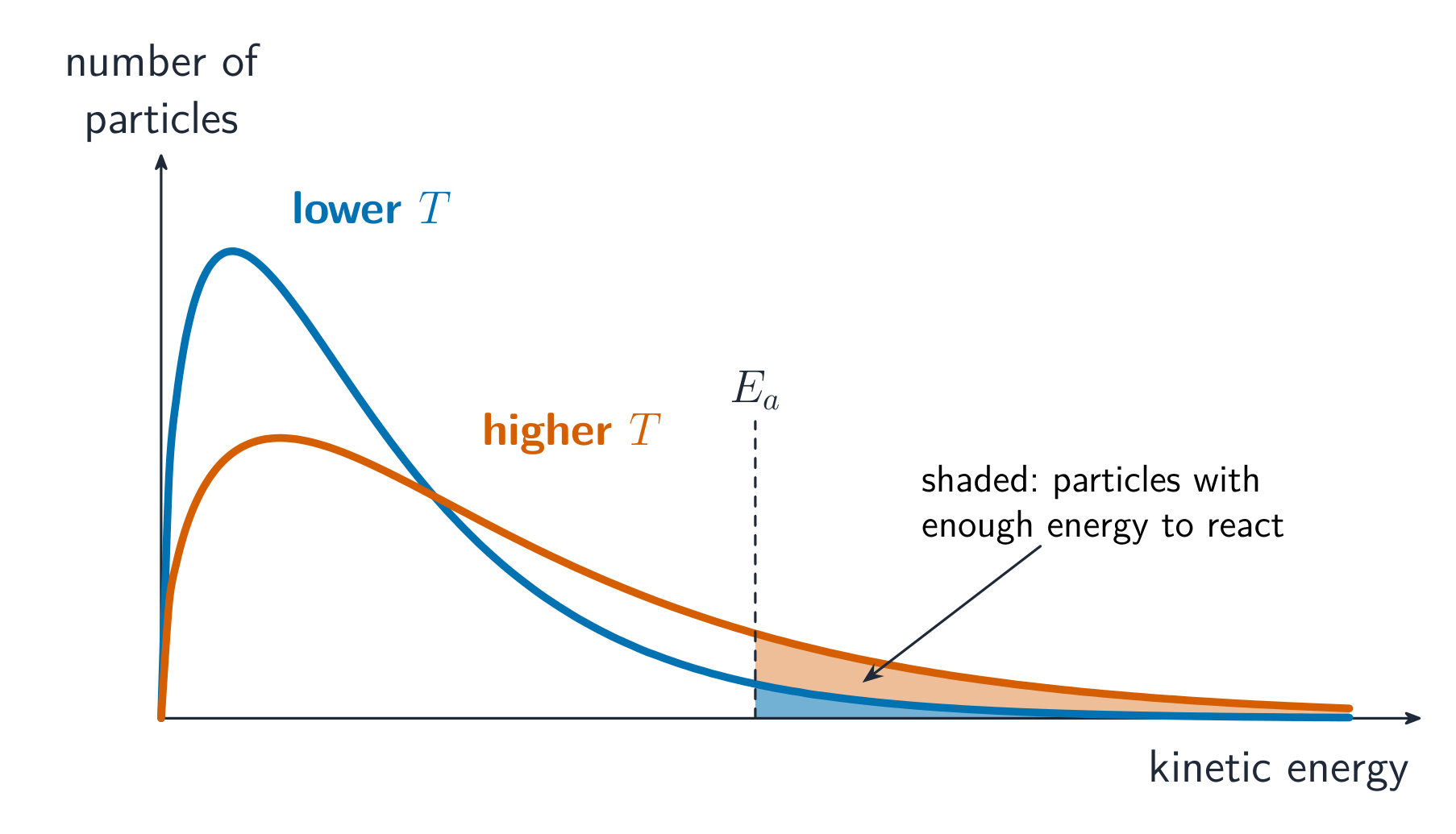
The minimum energy a collision needs to react is the...
الصعوبة 1/5 · 100 عملة + مكافأة صغيرة عند الإنجاز الأول اليوم
The activation energy is the barrier every reaction must clear.
Collisions with energy below the activation energy simply ____ apart.
الصعوبة 1/5 · 100 عملة + مكافأة صغيرة عند الإنجاز الأول اليوم
Too little energy means the particles just bounce off.
At a higher temperature, the Maxwell–Boltzmann curve:
الصعوبة 1/5 · 100 عملة + مكافأة صغيرة عند الإنجاز الأول اليوم
The spread of energies widens. The peak moves right and drops, and the tail beyond $E_a$ grows. $E_a$ itself does not move.
The right orientation
- Even an energetic collision fails if the reacting parts are not lined up. In $\text{NO}+\text{O}_3\rightarrow\text{NO}_2+\text{O}_2$, the N must hit an O of the ozone; an O-end hit does nothing.
- Big molecules have a small reactive site, so a smaller fraction of their collisions is aimed correctly.
Enough energy to react?
Only collisions above the activation energy react. Heat the gas and watch more particles cross that threshold.
A collision with plenty of energy but the wrong orientation can still fail.
الصعوبة 1/5 · 100 عملة + مكافأة صغيرة عند الإنجاز الأول اليوم
Both energy and orientation must be right for success.
Temperature. Raising the temperature by 10 °C often roughly doubles the rate. Why so much?
- Particles collide a little more often, but the main effect is energy: the curve shifts right and flattens.
- The shaded tail beyond $E_a$ grows a lot, so many more collisions are effective.
Raising temperature speeds a reaction mainly by...
الصعوبة 1/5 · 100 عملة + مكافأة صغيرة عند الإنجاز الأول اليوم
At higher temperature, a larger fraction of collisions has enough relative kinetic energy to cross the activation barrier. The barrier itself is not lowered by heating; a suitable catalyst provides a different pathway.
Most collisions between particles actually lead to a reaction.
الصعوبة 1/5 · 100 عملة + مكافأة صغيرة عند الإنجاز الأول اليوم
Most collisions fail; only the effective ones react.
Concentration and catalysts. Explain each change with collision theory.
- Doubling a reactant's concentration: more particles per volume, so more collisions per second. The fraction that is effective stays the same.
- Adding a catalyst 催化剂: it gives a route with lower $E_a$, so the line on the graph moves left and a larger fraction of collisions has enough energy.
Increasing the concentration of a reactant increases the rate because:
الصعوبة 1/5 · 100 عملة + مكافأة صغيرة عند الإنجاز الأول اليوم
More particles per volume means more collisions per second. Energy and orientation are unchanged.
- Both conditions must hold. A hard collision at the wrong angle still fails.
- Temperature mainly raises the fraction of collisions with enough energy; concentration raises the number of collisions. Say which one when you explain.
- A catalyst does not give particles more energy. It lowers the barrier.
A catalyst speeds up a reaction by giving the particles more kinetic energy.
الصعوبة 1/5 · 100 عملة + مكافأة صغيرة عند الإنجاز الأول اليوم
A catalyst gives a different route with a lower activation energy. Particle energies stay the same.
Collision theory: a reaction needs collisions with enough energy to clear the activation energy and the correct orientation. Higher temperature puts more particles beyond $E_a$; higher concentration gives more collisions; a catalyst lowers $E_a$.