Deviation from the Ideal Gas Law
مُقدَّم| English | المعنى |
|---|---|
| real gas/rɪəl ɡæs/ | الغاز الحقيقي |
Where the perfect model breaks
- A scuba tank holds air at about 200 atm. At that pressure, $PV=nRT$ gives the wrong amount of gas, so divers' tables use real-gas corrections.
- The ideal model treats particles as points with no attractions. A real gas 真实气体 breaks both rules when it is crowded or cold.
Two broken assumptions
- The ideal model assumes zero particle volume and no attractions.
- At high pressure, the particles' own volume starts to matter.
- At low temperature, their attractions pull them together.
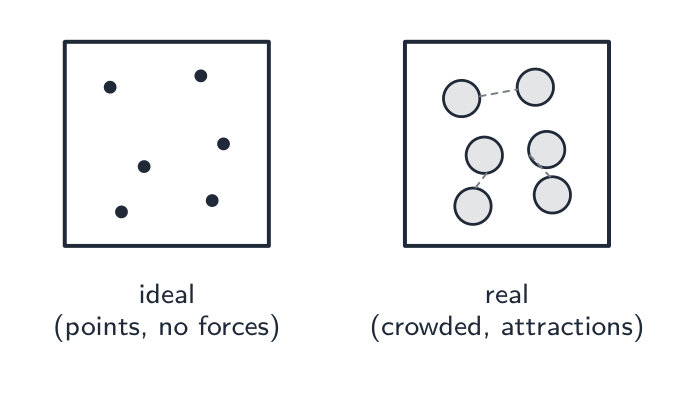
An ideal gas has point particles and no attractions; real particles take up space and attract each other
Select كلاهما reasons real gases deviate from the ideal law.
الصعوبة 2/5 · 140 عملة + مكافأة صغيرة عند الإنجاز الأول اليوم
Finite molecular volume and intermolecular attractions cause the deviations.
High pressure, low temperature
- A real gas 真实气体 deviates most at high pressure and low temperature.
- There the particles are crowded and slow.
- At low pressure and high temperature, gases act nearly ideal.
Real gases deviate most from ideal behaviour at...
الصعوبة 1/5 · 100 عملة + مكافأة صغيرة عند الإنجاز الأول اليوم
Crowded (high P) and slow (low T) is where volume and attractions matter.
Gases behave most ideally at high pressure and low temperature.
الصعوبة 1/5 · 100 عملة + مكافأة صغيرة عند الإنجاز الأول اليوم
False. At high pressure and low temperature molecules are close and slow, so their volume and attractions matter. Gases are most ideal at low pressure and high temperature.
Which gases stray most
- Big molecules, with more volume, deviate more.
- Polarity can increase attractions, but compare size, polarizability, temperature and density together; polarity alone cannot rank all gases.
- Small, nonpolar gases like helium stay closest to ideal.
At the same moderately low pressure and room temperature, which gas is expected to behave most ideally?
الصعوبة 1/5 · 100 عملة + مكافأة صغيرة عند الإنجاز الأول اليوم
Small, nonpolar helium has tiny volume and weak attractions.
For molecules of comparable size and polarizability under the same conditions, polarity can increase deviations through stronger attractions.
الصعوبة 1/5 · 100 عملة + مكافأة صغيرة عند الإنجاز الأول اليوم
Additional dipole attractions can increase deviations for otherwise comparable molecules. A large nonpolar molecule can still deviate more than a small polar one.
At fixed amount, volume and temperature, why can attractions make a real gas pressure lower than $PV=nRT$ predicts?
- Attractions pull the molecules inward, softening their wall collisions.
- When attractions dominate, measured pressure is lower than ideal. At very high density, finite molecular size and repulsion can dominate instead, raising pressure above ideal.
When gases stop being ideal
Sort each condition by whether a real gas behaves nearly ideally or deviates.
Attractions between real molecules make the measured pressure...
الصعوبة 1/5 · 100 عملة + مكافأة صغيرة عند الإنجاز الأول اليوم
Inward pulls soften wall collisions, lowering the pressure.
Real molar volumes at 0 °C and 1 atm
| Gas | Molar volume / L | Boiling point / °C | Main attraction |
|---|---|---|---|
| ideal | 22.41 | — | none |
| He | 22.43 | −269 | very weak dispersion |
| N₂ | 22.40 | −196 | dispersion |
| CO₂ | 22.26 | −78 (sublimes) | dispersion (larger e⁻ cloud) |
| NH₃ | 22.08 | −33 | hydrogen bonding |
- The stronger the attractions (higher boiling point), the more the volume falls below ideal.
At the same conditions, which gas deviates most from ideal behaviour?
الصعوبة 1/5 · 100 عملة + مكافأة صغيرة عند الإنجاز الأول اليوم
Water molecules form hydrogen bonds, the strongest attractions here, so they deviate most.
Rank and explain. Which deviates more from ideal at 1 atm and 0 °C: He or NH₃?
- NH₃ has hydrogen bonds; He has only very weak dispersion forces. Attractions pull NH₃ molecules together, so its molar volume (22.08 L) is below ideal.
- He is closest to ideal: tiny atoms, almost no attraction. Raising the temperature or lowering the pressure would make NH₃ behave more ideally too.
Under which conditions does CO₂ behave most like an ideal gas?
الصعوبة 1/5 · 100 عملة + مكافأة صغيرة عند الإنجاز الأول اليوم
High temperature (fast particles, attractions matter less) and low pressure (particles far apart, their volume negligible).
- Deviation is largest at high P and low T, the opposite of ideal conditions.
- Attractions make P (or V) lower than ideal; molecular volume makes it higher, which wins at very high pressure.
- In an explanation, name the intermolecular force and say whether it lowers or raises P.
A real gas deviates from $PV = nRT$ because its molecules take up space and attract each other. Deviations are largest at high pressure and low temperature, and worst for big or polar molecules. At low pressure and high temperature, or for small nonpolar gases, the ideal law works well.