Determining Intervals on Which a Function Is Increasing or Decreasing
مُقدَّم| English | المعنى |
|---|---|
| sign of the first derivative/saɪn ɒvðə fɜːst dɪˈrɪvətɪv/ | إشارة المشتقة الأولى |
| sign chart/saɪn tʃɑːt/ | جدول الإشارات |
The sign of $f'$ tells the story
- A hiker's GPS shows the slope of the path: positive means climbing, negative means going down. The sign of the first derivative 一阶导数的符号 does the same for a graph.
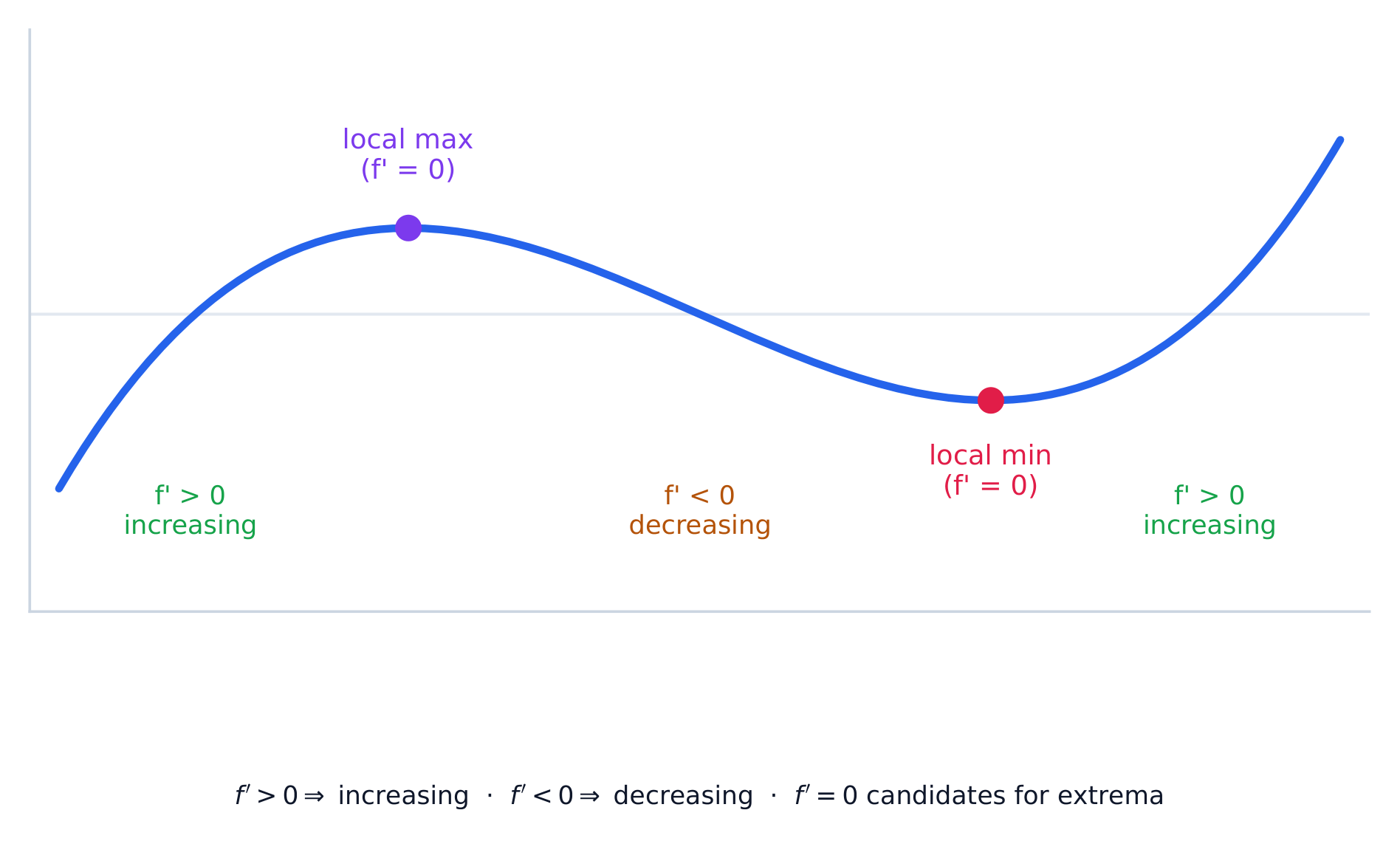
- $f'(x)>0$ on an interval: $f$ is increasing there. $f'(x)<0$: $f$ is decreasing.
Uphill where f′ > 0
y = ax³ + cx
The curve climbs where its slope is positive and falls where negative — the sign of $f'$ maps every stretch.
A function is increasing on an interval exactly when...
الصعوبة 1/5 · 100 عملة + مكافأة صغيرة عند الإنجاز الأول اليوم
Positive first derivative means increasing.
Build a sign chart
- Split the domain at critical points and at gaps in the domain. Between them $f'$ keeps one sign, so one test point per interval is enough.
- Record the signs in a sign chart 符号表, then read off the intervals of increase ($+$) and decrease ($-$).
The critical points split the number line into intervals for a ____ chart of $f'$.
الصعوبة 1/5 · 100 عملة + مكافأة صغيرة عند الإنجاز الأول اليوم
A sign chart tracks where $f'$ is positive or negative.
One test point settles a whole interval because $f'$ cannot change sign without...
الصعوبة 1/5 · 100 عملة + مكافأة صغيرة عند الإنجاز الأول اليوم
A sign change requires a zero or an undefined point of $f'$.
Where is $f(x)=x^3-3x$ increasing?
- $f'(x)=3(x-1)(x+1)$, critical points $x=\pm1$. Test: $f'(-2)=9>0$, $f'(0)=-3<0$, $f'(2)=9>0$.
- Increasing on $(-\infty,-1)$ and $(1,\infty)$; decreasing on $(-1,1)$.
للدفاع $f'(x)=3(x-1)(x+1)$, evaluate $f'(0)$ to test the middle interval.
الصعوبة 2/5 · 140 عملة + مكافأة صغيرة عند الإنجاز الأول اليوم
$3(-1)(1)=-3<0$, so $f$ is decreasing on $(-1,1)$.
للدفاع $f(x)=x^3-3x$ (critical points $\pm1$), select جميعها intervals of increase.
الصعوبة 2/5 · 140 عملة + مكافأة صغيرة عند الإنجاز الأول اليوم
$f'>0$ خارجية $[-1,1]$; decreasing in between.
A gap in the domain. Find where $f(x)=x+\dfrac4x$ is decreasing.
- $f'(x)=1-\dfrac{4}{x^2}=\dfrac{x^2-4}{x^2}$: zero at $x=\pm2$; $x=0$ is not in the domain but still splits the line.
| interval | $(-\infty,-2)$ | $(-2,0)$ | $(0,2)$ | $(2,\infty)$ |
|---|---|---|---|---|
| sign of $f'$ | $+$ | $-$ | $-$ | $+$ |
- Decreasing on $(-2,0)$ and $(0,2)$. Not "$(-2,2)$": $f$ is not even defined at 0.
On which intervals is $f(x)=x+\dfrac9x$ decreasing?
الصعوبة 1/5 · 100 عملة + مكافأة صغيرة عند الإنجاز الأول اليوم
$f'(x)=1-\dfrac{9}{x^2}=\dfrac{x^2-9}{x^2}$ is negative for $0<|x|<3$. $x=0$ is not in the domain, so the answer is two intervals, not $(-3,3)$.
Find where $f(x)=xe^{-x^2}$ is increasing.
- $f'(x)=e^{-x^2}-2x^2e^{-x^2}=e^{-x^2}(1-2x^2)$. Since $e^{-x^2}>0$, the sign is the sign of $1-2x^2$.
- $1-2x^2>0$ when $x^2<\tfrac12$: increasing on $\left(-\tfrac{1}{\sqrt2},\tfrac{1}{\sqrt2}\right)$, decreasing outside it.
Justify it
- AP answer: "$f$ is increasing on $(1,\infty)$ because $f'(x)>0$ there." Name $f'$ and its sign.
- If you only have a graph of $f'$: $f$ increases where the $f'$ graph is above the $x$-axis, whatever $f'$ itself is doing.
On an interval where the graph of $f'$ is above the $x$-axis but going down, $f$ is decreasing.
الصعوبة 1/5 · 100 عملة + مكافأة صغيرة عند الإنجاز الأول اليوم
$f'>0$ there, so $f$ is increasing. $f'$ going down only means $f$ is concave down.
- Track the sign of $f'$, not of $f$. A function can be negative and increasing (rising from $-5$ to $-1$).
- A positive factor such as $e^{-x^2}$ or $x^2$ never changes the sign. Drop it and study what is left.
- On a graph of $f'$, "$f'$ is decreasing" does not mean "$f$ is decreasing". Look at the sign, not the direction.
A function that is negative (below the $x$-axis) can still be increasing.
الصعوبة 1/5 · 100 عملة + مكافأة صغيرة عند الإنجاز الأول اليوم
Increasing depends on $f'>0$, not the sign of $f$.
The sign of $f'$ decides: $f'>0$ → increasing, $f'<0$ → decreasing. Split the domain at critical points and gaps, use one test point per interval in a sign chart, and justify with the sign of $f'$.