Using the First Derivative Test to Determine Relative (Local) Extrema
مُقدَّم 9:32
باستخدام نظرية القيمة المتوسطة
تقود مسافة مئتي كيلومتر في ساعتين. كان متوسط سرعتك مئة كيلومتر في الساعة. إليك الآن ادعاءً: في لحظة ما خلال تلك الرحلة…
سرد باللغة الإنجليزية · ترجمة نصية بالإنجليزية و中文 يمكنك التبديل بينهما
In this lesson
| English | المعنى |
|---|---|
| First Derivative Test/fɜːst dɪˈrɪvətɪv test/ | اختبار المشتقة الأولى |
| relative (local) maximum/ˈrelətɪv ˈmæksɪməm/ | القيمة العظمى النسبية (المحلية) |
| relative (local) minimum/ˈrelətɪv ˈmɪnɪməm/ | القيمة الصغرى النسبية (المحلية) |
Classify a critical point by how $f'$ turns
- A critical point is only a candidate for a maximum or minimum. Walking over a hill, you go up, level off, then go down: the slope changes from $+$ to $-$.
- The First Derivative Test 一阶导数判别法 reads that sign change of $f'$ across the point. It reuses your sign chart from 5.3.
Positive → negative means a max
- If $f'$ changes from $+$ to $-$ at a critical point $c$, then $f$ has a relative (local) maximum 局部最大值 at $x=c$. The maximum value is $f(c)$.
- On the sign chart: $+$ to the left of $c$, $-$ to the right.
A max then a min
y = ax³ + cx
The left hump is a local max ($f'$ goes $+$ إلى $-$) and the right dip a local min ($-$ إلى $+$).
If $f'$ changes from positive to negative at $c$, then $f$ has a...
الصعوبة 1/5 · 100 عملة + مكافأة صغيرة عند الإنجاز الأول اليوم
Up then down = the top of a hill = local max.
Negative → positive means a min
- If $f'$ changes from $-$ to $+$ at $c$, then $f$ has a relative (local) minimum 局部最小值 at $x=c$.
- If $f'$ does not change sign at $c$, there is no extremum there, even though $c$ is a critical point.
If $f'$ changes from negative to positive at $c$, then $f$ has a local ____ there.
الصعوبة 1/5 · 100 عملة + مكافأة صغيرة عند الإنجاز الأول اليوم
Down then up = bottom of a valley = local min.
If $f'$ has the same sign on both sides of a critical point, there is no extremum there.
الصعوبة 1/5 · 100 عملة + مكافأة صغيرة عند الإنجاز الأول اليوم
No sign change (like $y=x^3$ at $0$) means no max or min.
Classify the critical points of $f(x)=x^3-3x$, where $f'(x)=3(x-1)(x+1)$.
- At $x=-1$: $f'(-2)>0$ and $f'(0)<0$, so $f'$ goes $+\to-$: local max, $f(-1)=2$.
- At $x=1$: $f'(0)<0$ and $f'(2)>0$, so $f'$ goes $-\to+$: local min, $f(1)=-2$.
للدفاع $f(x)=x^3-3x$, the critical point $x=1$ is a...
الصعوبة 1/5 · 100 عملة + مكافأة صغيرة عند الإنجاز الأول اليوم
$f'$ goes $-\to+$ at $x=1$ → local min.
للدفاع $f(x)=x^3-3x$, the local max is at $x=-1$. Find the max value $f(-1)$.
الصعوبة 2/5 · 140 عملة + مكافأة صغيرة عند الإنجاز الأول اليوم
$f(-1)=(-1)^3-3(-1)=-1+3=2$.
Write the justification
- On the AP exam a correct answer with no reason scores 0 for that point. Name the derivative, the sign change and the point.
- Model: "$f$ has a relative minimum at $x=1$ because $f'$ changes from negative to positive at $x=1$."
Select جميعها true statements about the First Derivative Test.
الصعوبة 2/5 · 140 عملة + مكافأة صغيرة عند الإنجاز الأول اليوم
It is the change of sign that matters, not the value at $c$.
$f'(4)=0$. Which sentence fully justifies that $f$ has a relative maximum at $x=4$?
الصعوبة 1/5 · 100 عملة + مكافأة صغيرة عند الإنجاز الأول اليوم
The reason must name $f'$ and its sign change at the point. $f'(4)=0$ only makes $x=4$ a candidate.
A squared factor. $f'(x)=(x-2)^2(x+1)$. Find and classify every relative extremum of $f$.
- Critical points: $x=-1$ and $x=2$. Test values: $f'(-2)=16\cdot(-1)<0$, $f'(0)=4>0$, $f'(3)=1\cdot4>0$.
- At $x=-1$, $f'$ changes from negative to positive: relative minimum. At $x=2$, $f'$ is positive on both sides: neither. A squared factor never changes sign.
$f'(x)=x^2(x-3)$. At which $x$ يفعل $f$ have a relative extremum, and what kind?
الصعوبة 1/5 · 100 عملة + مكافأة صغيرة عند الإنجاز الأول اليوم
$x^2\ge0$ never changes sign, so $f'$ is negative on both sides of 0: no extremum there. Across $x=3$, $f'$ goes from $-$ إلى $+$: a relative minimum.
Where $f'$ is undefined. Classify the critical point of $f(x)=x^{2/3}$.
- $f'(x)=\dfrac{2}{3x^{1/3}}$ is undefined at $x=0$, and $0$ is in the domain, so $x=0$ is a critical point.
- $f'(-1)=-\tfrac23<0$ and $f'(1)=\tfrac23>0$: $-\to+$, so a relative minimum at $x=0$ (a sharp point, a cusp).
- Use the sign change, not the value at $c$: $f'(c)$ is $0$ or undefined either way. $y=x^3$ has $f'(0)=0$ but no extremum.
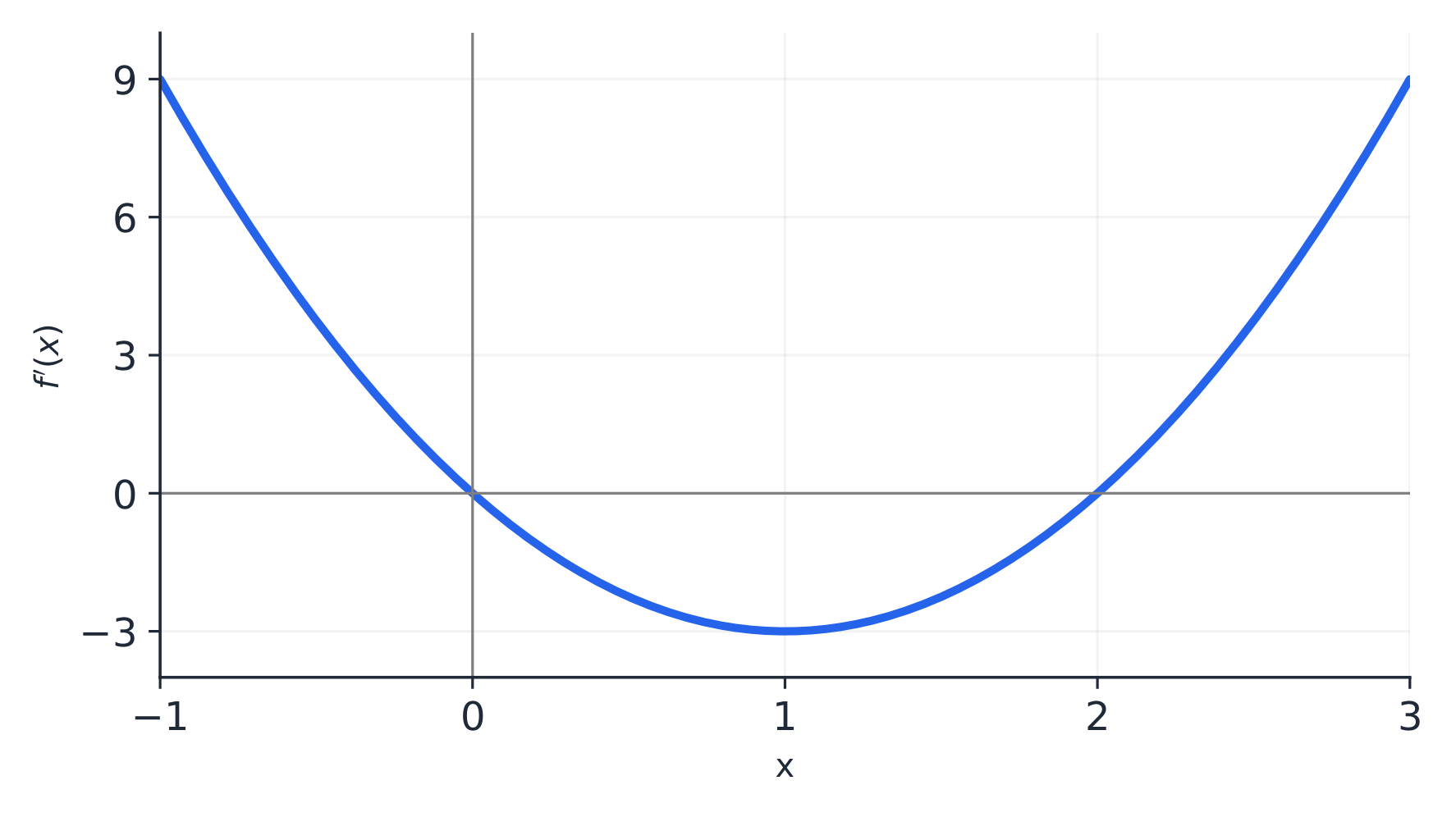
- Read signs from $f'$, not from $f$. On a graph of $f'$, a max of $f$ is where the $f'$ graph crosses the axis from above to below, not where $f'$ has its own peak.
- "$f'(c)=0$" alone is never a justification.
On a graph of $f'$, a relative maximum of $f$ is where the graph of $f'$ reaches its highest point.
الصعوبة 1/5 · 100 عملة + مكافأة صغيرة عند الإنجاز الأول اليوم
A relative max of $f$ is where $f'$ crosses the $x$-axis from above to below. The highest point of $f'$ is where $f$ is steepest (an inflection point of $f$).
The First Derivative Test classifies a critical point by the sign change of $f'$: $+\to-$ is a relative maximum, $-\to+$ is a relative minimum, and no sign change means no extremum. Always justify in a sentence that names $f'$ and its sign change.