القوة الجاذبة للمركز
| English | العربية |
|---|---|
| tangent/ˈtændʒənt/ | القطري |
| centripetal acceleration/senˈtrɪpɪtl əkˌseləˈreɪʃn/ | التسارع المركزي |
| centripetal force/senˈtrɪpɪtl fɔːs/ | قوة مركزية |
| perpendicular/ˌpɜːpənˈdɪkjʊlə/ | عمودية |
| tension/ˈtenʃn/ | قوة الشد |
| banked/bæŋkt/ | مائل / مدرج |
Let go and it flies off
- Swing a ball on a string in a circle, then let go.
- It shoots off in a straight line — not outwards, but along the tangent 切线.
- So while it circled, something must have pulled it inward.
Centripetal acceleration 向心加速度
- Constant speed, but ever-changing direction, means the velocity changes — an acceleration.
- It points to the centre: $a = \dfrac{v^{2}}{r} = r\omega^{2}$ (and, since $v = r\omega$, also $a = v\omega$).
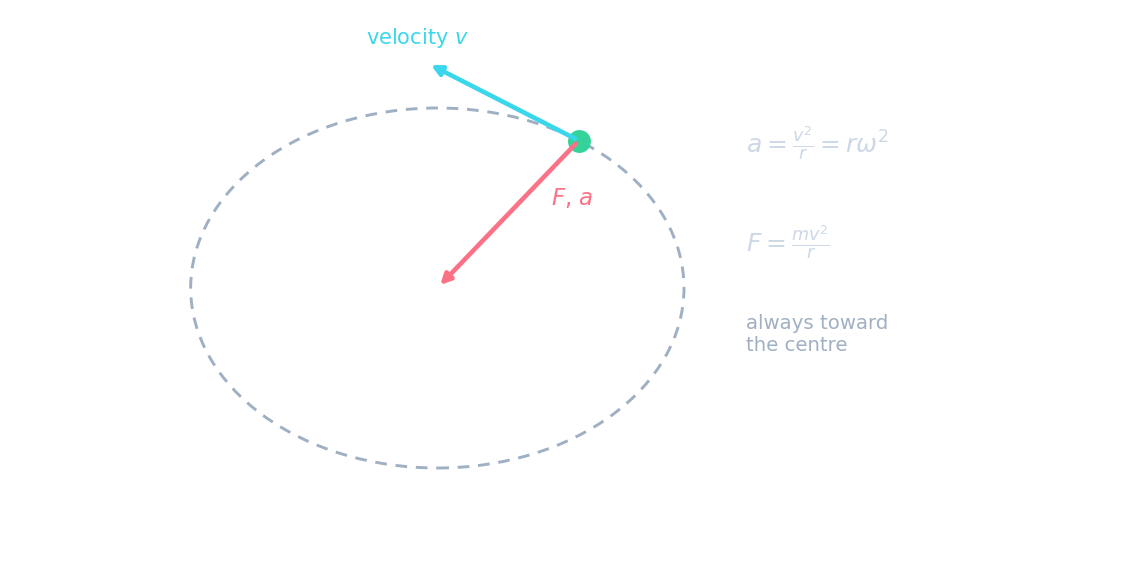
القوة الجاذبة للمركز والسرعة
F = mv²/r
للمotion الدائري، القوة اللازمة تنمو مع مربع السرعة — ضعف v، أربعة أضعاف القوة.
جسم يتحرك حول دائرة بسرعة ثابتة لا يزال يتسارع لأنه:
السرعة المتجهة كمية متجهة. حتى مع ثبات السرعة، فإن تغير الاتجاه يعني تغير السرعة المتجهة — وهو تسارع نحو المركز.
جسم يتحرك بسرعة $4.0\ \dfrac{\text{m}}{\text{s}}$ حول دائرة نصف قطرها $2.0\ \text{m}$. أوجد تسارعه الجاذب للمركز.
$a = \dfrac{v^{2}}{r} = \dfrac{4.0^{2}}{2.0} = 8.0\ \dfrac{\text{m}}{\text{s}^2}$.
Centripetal force 向心力
- By $F = ma$: $F = \dfrac{mv^{2}}{r} = mr\omega^{2}$, pointing to the centre.
- It is always perpendicular 垂直 to the velocity, so it does no work and the speed stays constant.

A spinning fairground ride needs a centripetal force toward the centre
القوة الجاذبة للمركز تتجه نحو مركز الدائرة.
نعم — دائماً نحو المركز، عمودية على السرعة المتجهة.
كرة كتلتها $2.0\ \text{kg}$ تتحرك بسرعة $4.0\ \dfrac{\text{m}}{\text{s}}$ حول دائرة نصف قطرها $2.0\ \text{m}$. ما مقدار القوة الجاذبة للمركز المطلوبة؟
$F = \dfrac{mv^{2}}{r} = \dfrac{2.0 \times 4.0^{2}}{2.0} = 16\ \text{N}$.
Not a new force
- "Centripetal force" is not a new kind of force.
- It is the net result of the real forces — tension 张力, gravity, friction, a normal force.

The velocity points along the tangent; the force and acceleration point to the centre
القوة الجاذبة للمركز هي:
هي whatever القوى الحقيقية التي تميل إلى التوجه نحو المركز — وليست قوة مستقلة بذاتها.
Where it comes from
- Ball on a string → tension. Car on a flat corner → friction.
- Planet or satellite → gravity. Banked 倾斜 track → the inward part of the normal force.

On a banked track the horizontal part of the road's force provides the centripetal force
طابق كل حركة دائرية مع القوة التي توفر القوة الجاذبة للمركز.
مواقف مختلفة، قوى حقيقية مختلفة — لكن كل منها يتجه نحو المركز ويوفر $\dfrac{mv^{2}}{r}$.
Worked example: how fast round the corner?
A $1200\ \text{kg}$ car takes a flat bend of radius $50\ \text{m}$. The largest friction force the tyres can provide is $8200\ \text{N}$.
- Friction is the centripetal force: $F = \dfrac{mv^{2}}{r}$, so the fastest safe speed has $\dfrac{1200\,v^{2}}{50} = 8200$.
- Solve: $v^{2} = \dfrac{8200 \times 50}{1200} = 342$, so $v = 18\ \dfrac{\text{m}}{\text{s}}$ (about $65\ \dfrac{\text{km}}{\text{h}}$).
- Tighter bend: halve $r$ and $v_{\text{max}}$ falls by $\sqrt{2}$ — the required force grows as $\dfrac{1}{r}$.
- Check: on a wet road the available friction drops, so the safe speed drops too, which is what the physics says and what road signs assume.
سيارة كتلتها $800\ \text{kg}$ تمر بمنعطف مسطح نصف قطره $40\ \text{m}$. أقصى قوة احتكاك متاحة هي $6400\ \text{N}$. ما هي أقصى سرعة آمنة، بوحدة م/ث؟
$\dfrac{mv^{2}}{r} = F$، لذا $v^{2} = \dfrac{6400 \times 40}{800} = 320$ و $v = 17.9\ \dfrac{\text{m}}{\text{s}}$.
Vertical circles
- Going round an upright loop, the speed changes (gravity does work).
- At the top, weight and tension both point to the centre: $T + mg = \dfrac{mv^{2}}{r}$. At the bottom they oppose: $T - mg = \dfrac{mv^{2}}{r}$.
- The slowest speed at the top with the string just tight is $v_{\text{min}} = \sqrt{gr}$ (set tension $= 0$).

Going round a vertical circle, gravity helps at the top and opposes at the bottom — so the string tension is largest at the bottom
في أعلى حلقة رأسية، أقل سرعة (يكون الخيط مشدوداً فقط) هي:
مع شد $= 0$، الجاذبية وحدها هي القوة الجاذبة للمركز: $mg = \dfrac{mv^{2}}{r}$، لذا $v_{\text{min}} = \sqrt{gr}$.
Worked example: tension top and bottom
A $0.50\ \text{kg}$ ball on a $1.0\ \text{m}$ string is whirled in a vertical circle. At the bottom its speed is $8.0\ \dfrac{\text{m}}{\text{s}}$.
- Bottom: $T - mg = \dfrac{mv^{2}}{r}$, so $T = 0.50 \times 9.81 + \dfrac{0.50 \times 8.0^{2}}{1.0} = 4.9 + 32 = 37\ \text{N}$.
- Speed at the top: energy conservation over a rise of $2r$: $v_{\text{top}}^{2} = 8.0^{2} - 2g(2.0) = 64 - 39 = 25$, so $v_{\text{top}} = 5.0\ \dfrac{\text{m}}{\text{s}}$.
- Top: $T + mg = \dfrac{mv^{2}}{r}$, so $T = \dfrac{0.50 \times 25}{1.0} - 4.9 = 12.5 - 4.9 = 7.6\ \text{N}$.
- Check: the tension is far larger at the bottom, which is where a string breaks. At the top $v_{\text{top}} > \sqrt{gr} = 3.1\ \dfrac{\text{m}}{\text{s}}$, so the string stays taut.
Never draw "centripetal force" as an extra arrow on a force diagram — it is the resultant of the real forces, and there is no outward "centrifugal" force in this course. At the top of a loop the weight helps ($T + mg$); at the bottom it opposes ($T - mg$). And in a vertical circle the speed is not constant, so use energy conservation to move between top and bottom.
في أعلى دائرة رأسية يكون شد الخيط هو الأصغر، لأنه هناك ____ الكرة يؤثر أيضاً نحو المركز.
في الأعلى $T + mg = \dfrac{mv^{2}}{r}$: الوزن يوفر جزءاً من القوة الجاذبة للمركز، لذا يحتاج الخيط لتوفير القليل منه.
You've got it
- circular motion needs an inward (centripetal) acceleration $a = \dfrac{v^{2}}{r} = r\omega^{2} = v\omega$
- centripetal force $F = \dfrac{mv^{2}}{r}$ — the net of real forces, toward the centre; it does no work
- vertical loop: $T + mg = \dfrac{mv^{2}}{r}$ at the top, $T - mg = \dfrac{mv^{2}}{r}$ at the bottom; $v_{\text{min}} = \sqrt{gr}$ at the top