Carbon-13 NMR
مُقدَّم| English | المعنى |
|---|---|
| NMR/ˌen em ˈɑː/ | الرنين المغناطيسي النووي |
| carbon environment/ˈkɑːbən enˈvaɪrənmənt/ | بيئة الكربون |
| chemical shift/ˈkemɪkl ʃɪft/ | الإزاحة الكيميائية |
| superconducting/ˈsuːpəkəndʌktɪŋ/ | فائق التوصيل |
Mapping the carbons
- The MRI scanner in a hospital uses the same physics as NMR: nuclei in a strong magnetic field absorb radio waves. Chemists use it to map the carbon skeleton of a molecule.
- In carbon-13 NMR 核磁共振, each different carbon environment 碳环境 gives one peak, and the peak position shows what the carbon is bonded to.
Carbon-13 NMR lab
Match carbon environments to C-13 NMR evidence.
The number of peaks in a carbon-13 NMR spectrum shows the number of different carbon ______.
الصعوبة 1/5 · 100 عملة + مكافأة صغيرة عند الإنجاز الأول اليوم
Equivalent carbons give one peak.
Carbon-13 NMR gives information about the carbon skeleton of a molecule.
الصعوبة 1/5 · 100 عملة + مكافأة صغيرة عند الإنجاز الأول اليوم
Each chemically different carbon gives a peak.
Reading a carbon-13 spectrum
- the number of peaks = the number of different carbon environments (equivalent carbons share a peak).
- the position of each peak (its chemical shift 化学位移) suggests the type of carbon.
- Together these help you deduce possible structures.
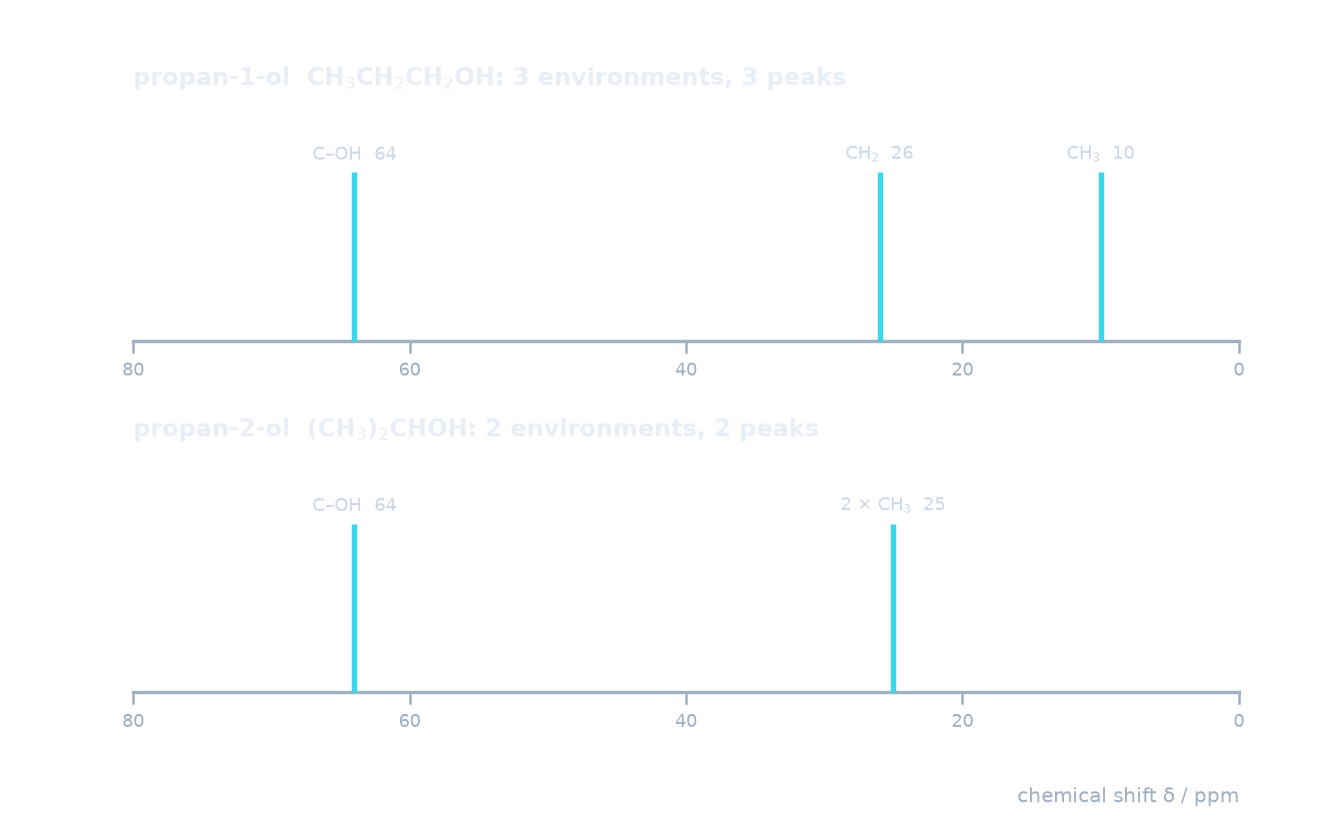
Same formula, different symmetry: the two CH₃ carbons of propan-2-ol are equivalent, so they share one peak.
In carbon-13 NMR, the number of peaks tells you:
الصعوبة 1/5 · 100 عملة + مكافأة صغيرة عند الإنجاز الأول اليوم
Each distinct carbon environment gives one peak; equivalent carbons share a peak.
The chemical shift (position) of a carbon-13 peak suggests:
الصعوبة 1/5 · 100 عملة + مكافأة صغيرة عند الإنجاز الأول اليوم
The shift indicates the kind of carbon, helping to deduce the structure.
Equivalent carbons (in the same environment) give a single shared peak.
الصعوبة 1/5 · 100 عملة + مكافأة صغيرة عند الإنجاز الأول اليوم
Carbons in identical environments are not distinguished, so they appear as one peak.
The number of peaks in a carbon-13 spectrum equals the number of carbon atoms in the molecule.
الصعوبة 1/5 · 100 عملة + مكافأة صغيرة عند الإنجاز الأول اليوم
It equals the number of different carbon environments; equivalent carbons share a peak, as in propan-2-ol.
Chemical shifts to know
| Carbon type | Example | Shift δ / ppm |
|---|---|---|
| C–C (alkyl) | CH₃, CH₂ | 5–55 |
| C–O or C–N | C–OH, C–O in esters, C–NH₂ | 35–90 |
| C=C, aromatic | alkene, benzene ring | 100–160 |
| C=O in acid, ester, amide | –COOH, –COO– | 160–185 |
| C=O in aldehyde, ketone | –CHO, C=O | 190–220 |
- The data booklet gives these ranges. Electronegative atoms (O, N) nearby push the shift higher.
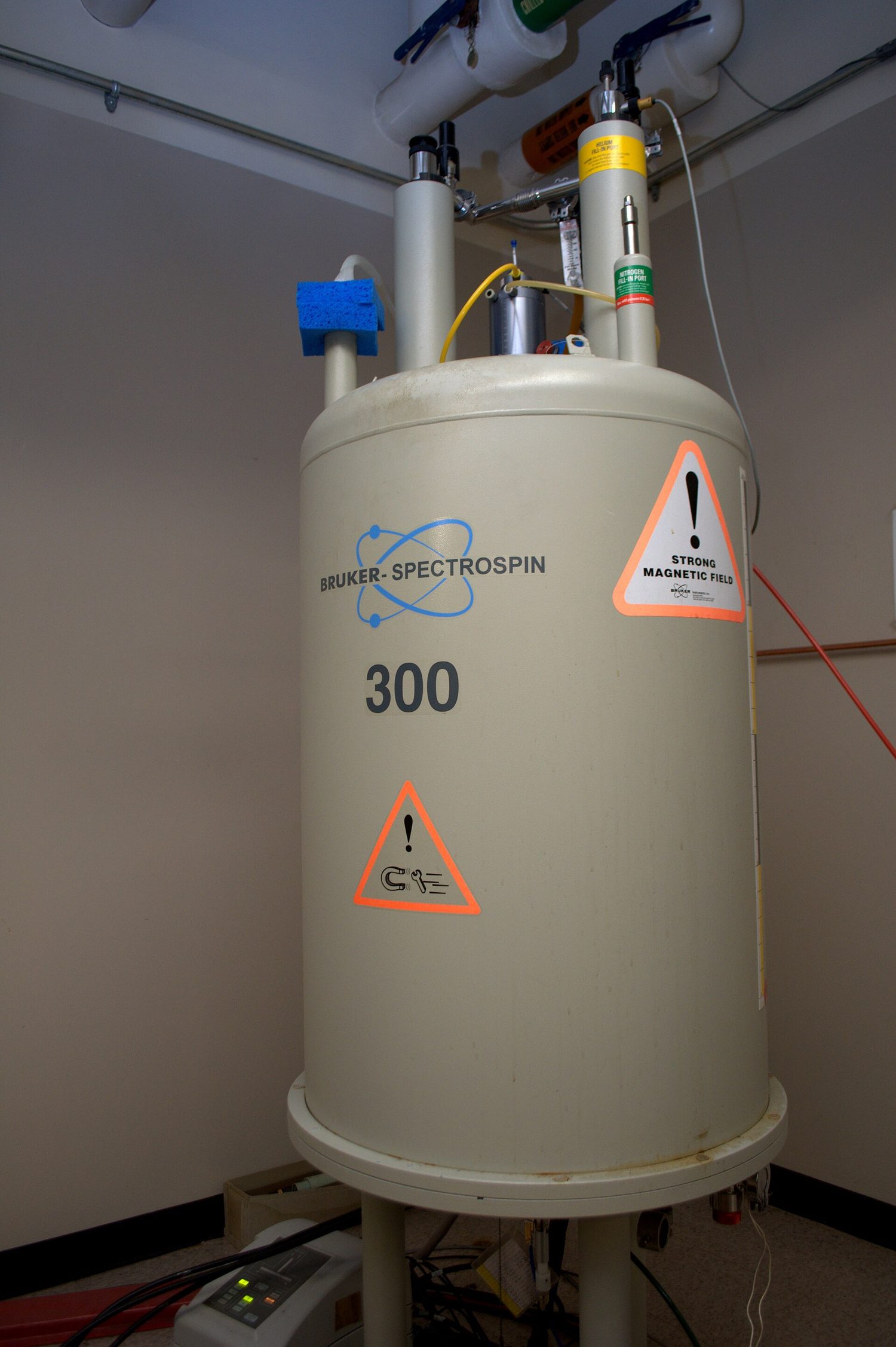
An NMR spectrometer: the large cylinder is a superconducting 超导 magnet that makes the very strong magnetic field the technique needs
A carbon-13 spectrum has a peak at 208 ppm. What does it show?
الصعوبة 1/5 · 100 عملة + مكافأة صغيرة عند الإنجاز الأول اليوم
190–220 ppm is the range for aldehyde and ketone C=O carbons.
Worked example: identify an isomer by peak count
An alcohol $\text{C}_4\text{H}_{10}\text{O}$ gives two peaks in its carbon-13 spectrum. Which isomer is it?
- Count environments in each isomer: butan-1-ol, $\text{CH}_3\text{CH}_2\text{CH}_2\text{CH}_2\text{OH}$, has 4; butan-2-ol has 4; 2-methylpropan-1-ol, $(\text{CH}_3)_2\text{CHCH}_2\text{OH}$, has 3 (its two $\text{CH}_3$ match).
- 2-Methylpropan-2-ol, $(\text{CH}_3)_3\text{COH}$, has three identical $\text{CH}_3$ carbons and one C–OH carbon: 2 environments. So it is 2-methylpropan-2-ol; the C–O peak sits near 70 ppm, the $\text{CH}_3$ peak near 30 ppm.
How many peaks are there in the carbon-13 spectrum of pentan-3-one, $\text{CH}_3\text{CH}_2\text{COCH}_2\text{CH}_3$?
الصعوبة 2/5 · 140 عملة + مكافأة صغيرة عند الإنجاز الأول اليوم
The molecule is symmetrical about the C=O: one C=O carbon, two equivalent $\text{CH}_2$ and two equivalent $\text{CH}_3$, so 3 peaks.
How many peaks are in the carbon-13 spectrum of 1,4-dimethylbenzene, CH₃C₆H₄CH₃?
الصعوبة 2/5 · 140 عملة + مكافأة صغيرة عند الإنجاز الأول اليوم
By symmetry: the two CH₃ carbons (1), the two ring carbons holding CH₃ (1), and the four ring C–H carbons (1): 3 peaks.
- Look for symmetry first: equivalent carbons give one peak, so count environments, not carbons.
- Carbon-13 peaks are not split and their height does not show the number of carbons.
- A peak above 160 ppm means a C=O; check whether it is above 190 (aldehyde/ketone).
You've got it
- carbon-13 NMR: each different carbon environment gives one peak
- the number of peaks = the number of carbon environments
- the chemical shift suggests the type of carbon, helping deduce the structure