Proton NMR
مُقدَّم| English | المعنى |
|---|---|
| chemical shift/ˈkemɪkl ʃɪft/ | الإزاحة الكيميائية |
| splitting/ˈsplɪtɪŋ/ | التشظي |
| deuterated/ˈdjuːtəreɪtɪd/ | معادلة بالديوتيريوم |
Proton (¹H) NMR
- Proton NMR looks at the hydrogen atoms in a molecule.
- The spectrum gives three kinds of information.
- A few practical tricks make it readable.
Proton NMR lab
Match proton evidence to chemical environment and neighbours.
In proton NMR, the area under each peak is proportional to the number of ______ in that environment.
الصعوبة 1/5 · 100 عملة + مكافأة صغيرة عند الإنجاز الأول اليوم
Integration gives the ratio of protons.
What you read off
- chemical environments: protons in different environments appear at different chemical shifts 化学位移 (number of peak groups = number of environments).
- relative numbers: the peak areas give the ratio of each type of proton.
- splitting 裂分: a peak is split by the protons on the neighbouring carbon — the $n+1$ rule.
| Neighbours ($n$) | Pattern |
|---|---|
| 0 | singlet |
| 1 | doublet |
| 2 | triplet |
| 3 | quartet |
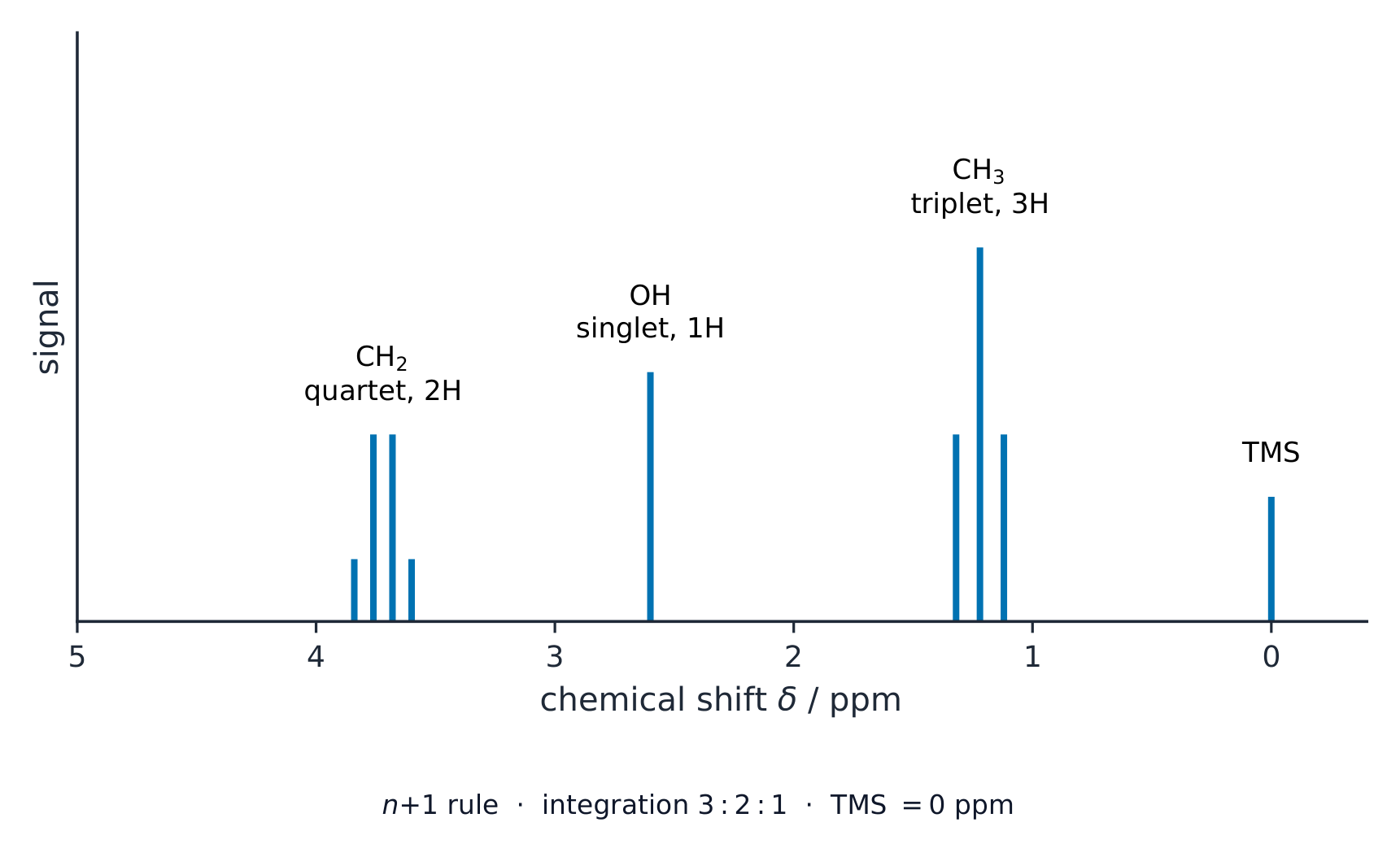
A proton NMR spectrum of ethanol
In proton NMR, the number of groups of peaks tells you:
الصعوبة 1/5 · 100 عملة + مكافأة صغيرة عند الإنجاز الأول اليوم
Protons in different environments give peaks at different chemical shifts.
The relative areas of the peaks give:
الصعوبة 1/5 · 100 عملة + مكافأة صغيرة عند الإنجاز الأول اليوم
Peak area is proportional to how many protons of that type there are (e.g. 3:2:1 for ethanol).
By the n+1 rule, a CH₃ group next to a CH₂ group appears as a:
الصعوبة 1/5 · 100 عملة + مكافأة صغيرة عند الإنجاز الأول اليوم
The CH₃ has 2 neighbouring protons (on the CH₂), so n+1 = 3 lines — a triplet.
Match each term to its meaning.
الصعوبة 2/5 · 140 عملة + مكافأة صغيرة عند الإنجاز الأول اليوم
Each item links the term to its correct meaning.
Practical points
- TMS (tetramethylsilane) is the standard, set at chemical shift 0.
- a deuterated 氘代 solvent (e.g. $\text{CDCl}_3$) gives no proton signal of its own.
- shaking with D₂O makes O–H and N–H peaks disappear (their H is swapped for D), identifying those protons.
Shaking a sample with D₂O makes which peaks disappear?
الصعوبة 1/5 · 100 عملة + مكافأة صغيرة عند الإنجاز الأول اليوم
The exchangeable O–H and N–H hydrogens swap for deuterium, so their peaks vanish — identifying them.
Worked example: predict the spectrum of propan-2-ol
Predict the proton NMR spectrum of propan-2-ol, $(\text{CH}_3)_2\text{CHOH}$.
- Three environments: the six equivalent $\text{CH}_3$ protons, the one C–H proton and the one O–H proton, with areas 6 : 1 : 1.
- Splitting: each $\text{CH}_3$ has 1 neighbouring H, so a doublet; the C–H has 6 neighbours, so $6 + 1 = 7$ lines (a heptet). The O–H shows as a singlet and disappears when the sample is shaken with $\text{D}_2\text{O}$.
In the proton NMR spectrum of chloroethane, $\text{CH}_3\text{CH}_2\text{Cl}$, how is the $\text{CH}_3$ peak split?
الصعوبة 1/5 · 100 عملة + مكافأة صغيرة عند الإنجاز الأول اليوم
العنصر $\text{CH}_3$ protons have two neighbouring H on the $\text{CH}_2$, so $2 + 1 = 3$ lines. The $\text{CH}_2$ is a quartet, and the areas are 3 : 2.
Where the peaks appear
- A proton's chemical shift $\delta$ (in ppm) rises when it is close to electronegative atoms or a C=O group. Use the ranges in the data booklet; typical values:
| Type of proton | $\delta$ / ppm |
|---|---|
| alkyl, $\text{R–CH}_3$ | 0.9–1.7 |
| next to C=O, $\text{H–C–C=O}$ | 2.0–2.7 |
| next to O, $\text{H–C–O}$ | 3.3–4.8 |
| on a benzene ring | 6.0–9.0 |
| aldehyde, $\text{–CHO}$ | 9.3–10.5 |
| carboxylic acid, $\text{–COOH}$ | 9.0–13.0 |
A singlet at δ 9.8 (1H) most likely comes from which kind of proton?
الصعوبة 1/5 · 100 عملة + مكافأة صغيرة عند الإنجاز الأول اليوم
Aldehyde protons appear at δ 9.3–10.5.
Deduce the structure. A compound $\text{C}_4\text{H}_8\text{O}_2$ has peaks at $\delta$ 1.3 (3H, triplet), 2.0 (3H, singlet) and 4.1 (2H, quartet).
- 2.0, 3H, singlet: a $\text{CH}_3$ next to C=O with no neighbouring H: $\text{CH}_3\text{–C(=O)–}$.
- 4.1, 2H, quartet: a $\text{CH}_2$ next to O, with 3 neighbouring H. 1.3, 3H, triplet: a $\text{CH}_3$ next to that $\text{CH}_2$.
- So the compound is ethyl ethanoate, $\text{CH}_3\text{COOCH}_2\text{CH}_3$. The total area $3+3+2=8$ matches the 8 H.
C₃H₆O₂ gives peaks at δ 1.1 (3H, triplet), 2.4 (2H, quartet) and 11.8 (1H, singlet). What is it?
الصعوبة 1/5 · 100 عملة + مكافأة صغيرة عند الإنجاز الأول اليوم
δ 11.8 is –COOH; the quartet at 2.4 is CH₂ next to C=O with a CH₃ neighbour (the triplet at 1.1).
- Splitting comes from H on the next carbon, not on the same carbon. Equivalent protons do not split each other.
- O–H protons usually appear as a singlet: they exchange quickly, so they neither split nor are split.
- Peak area gives the ratio of protons, not the actual number. Scale it to the molecular formula.
In CH₃CH₂Cl, how is the CH₂ peak split?
الصعوبة 1/5 · 100 عملة + مكافأة صغيرة عند الإنجاز الأول اليوم
n = 3 neighbouring H, so n + 1 = 4 lines.
You've got it
- ¹H NMR: number of peak groups = proton environments; areas = ratio of protons
- splitting: the $n+1$ rule ($n$ neighbours → $n+1$ lines): 0→singlet, 1→doublet, 2→triplet, 3→quartet
- TMS = reference (shift 0); a deuterated solvent is silent; D₂O removes O–H/N–H peaks