Skip to content · ⁨الانتقال إلى المحتوى⁩
Subjects · ⁨المواد⁩

English Grammar · A1 · ⁨قواعد اللغة الإنجليزية · A1⁩

  • 1 The verb to be · ⁨الفعل to be⁩
    1.1

    am / is / are

    English

    The verb "to be" means "is / am / are." It changes according to the subject and has three forms:

    • I → am
    • he / she / it → is
    • you / we / they → are

    我I 是am 一名a 学生student.

    I am a student.

    她She 是is 开心happy.

    She is happy.

    他们They (是)are 来自from 中国China.

    They are from China.

    Note: Common spoken contractions: I'm, you're, he's, she's, it's, we're, they're.

    العربية
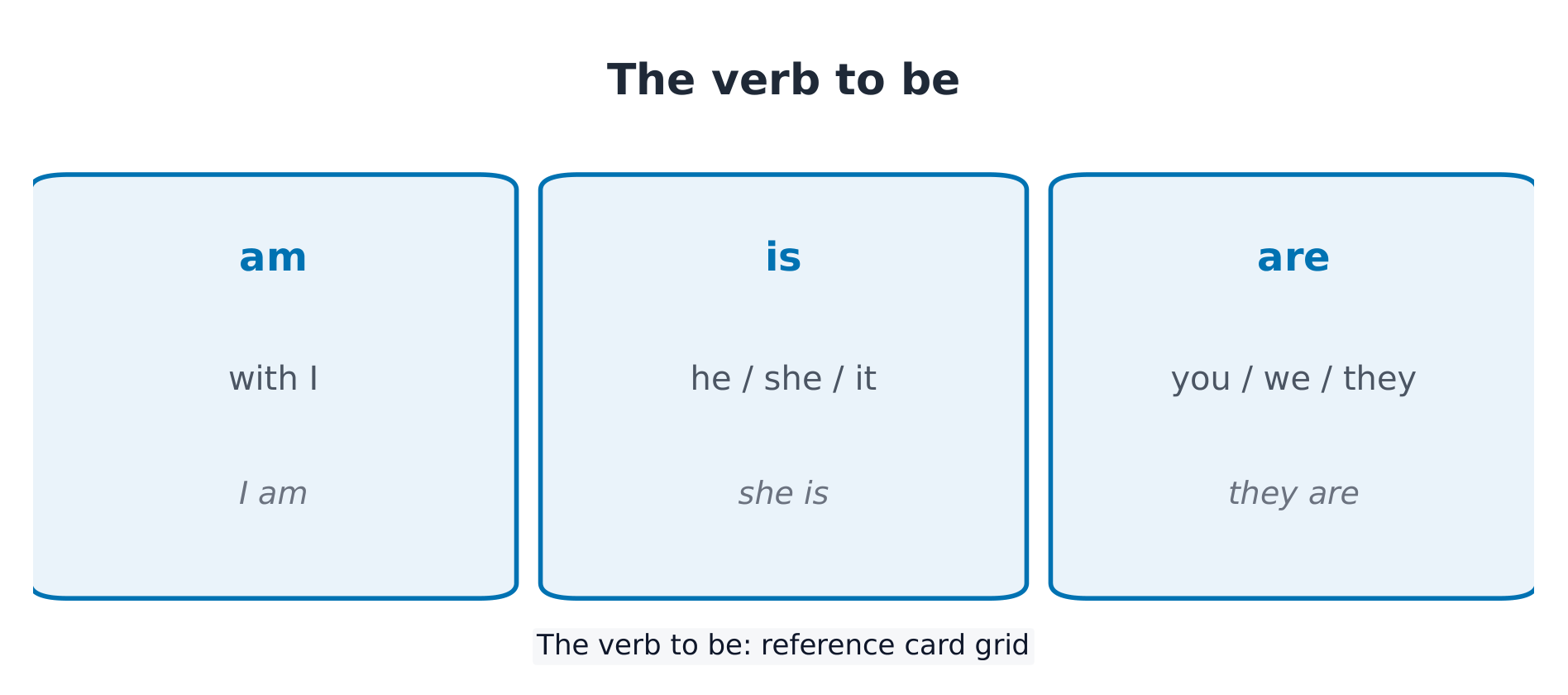
    be verbs: am / is / are change with the subject

    The verb "to be" means "is / am / are." It changes according to the subject and has three forms:

    • I → am
    • he / she / it → is
    • you / we / they → are

    我I 是am 一名a 学生student.

    I am a student.

    她She 是is 开心happy.

    She is happy.

    他们They (是)are 来自from 中国China.

    They are from China.

    Note: Common spoken contractions: I'm, you're, he's, she's, it's, we're, they're.
    1.2

    Negation and Interrogative

    English

    Negation: Add not after the be verb (often contracted).

    他He 不是is not 一名a 老师teacher.

    He is not a teacher. (= He isn't a teacher.)

    Interrogative: Place the be verb before the subject.

    (是吗)Are 你you 准备好ready?

    Are you ready?

    Short answers: Yes, I am. / No, I'm not.

    Note: Negative contractions: is not → isn't, are not → aren't; but am not is only contracted to I'm not (there is no ~~amn't~~).

    Common Errors

    • ❌ ~~He busy.~~ → ✓ He is busy. — In Chinese, "He is very busy" can exist without a verb, but an English sentence must have a verb. Use be to link when the predicative is an adjective or noun and there are no other verbs in the sentence (He is busy); do not add be if the sentence already contains an ordinary verb (I go to school).
    • ❌ ~~I am go to school.~~ → ✓ I go to school. — Do not use be and ordinary verbs together; "go" alone suffices for "to go."
    • ❌ ~~They is my friends.~~ → ✓ They are my friends. — Plural subjects (you / we / they) take are.
    • ❌ ~~I am agree.~~ → ✓ I agree. — agree is itself a verb; do not add am before it.
    • ❌ ~~Are you ready? — Yes, I'm.~~ → ✓ Yes, I am. — Contractions cannot be used at the end of affirmative short answers (say Yes, I am); however, negative short answers typically end with a negative contraction (No, he isn't / No, I can't; first person is No, I'm not, as there is no amn't).
    العربية

    Negation: Add not after the be verb (often contracted).

    他He 不是is not 一名a 老师teacher.

    He is not a teacher. (= He isn't a teacher.)

    Interrogative: Place the be verb before the subject.

    (是吗)Are 你you 准备好ready?

    Are you ready?

    Short answers: Yes, I am. / No, I'm not.

    Note: Negative contractions: is not → isn't, are not → aren't; but am not is only contracted to I'm not (there is no ~~amn't~~).

    Common Errors

    • ❌ ~~He busy.~~ → ✓ He is busy. — In Chinese, "He is very busy" can exist without a verb, but an English sentence must have a verb. Use be to link when the predicative is an adjective or noun and there are no other verbs in the sentence (He is busy); do not add be if the sentence already contains an ordinary verb (I go to school).
    • ❌ ~~I am go to school.~~ → ✓ I go to school. — Do not use be and ordinary verbs together; "go" alone suffices for "to go."
    • ❌ ~~They is my friends.~~ → ✓ They are my friends. — Plural subjects (you / we / they) take are.
    • ❌ ~~I am agree.~~ → ✓ I agree. — agree is itself a verb; do not add am before it.
    • ❌ ~~Are you ready? — Yes, I'm.~~ → ✓ Yes, I am. — Contractions cannot be used at the end of affirmative short answers (say Yes, I am); however, negative short answers typically end with a negative contraction (No, he isn't / No, I can't; first person is No, I'm not, as there is no amn't).
  • 2 Subject pronouns · ⁨ضمائر الفاعل⁩
    2.1

    I, you, he, she, it, we, they

    English

    Subject pronouns replace the subject and are placed before the verb:

    • I(I), you(you), he(he), she(she)
    • it(it), we(we), they(they)

    他He 是is 我的my 哥哥brother.

    He is my brother.

    我们We 喜欢like 音乐music.

    We like music.

    Key Usage Points:

    • I is always capitalized, regardless of its position in the sentence.
    • Things and animals commonly use it: This is my bag. It is new.(This is my bag. It is new.)*
    • Plural people or things both use they: The books are here. They are mine.(The books are here. They are mine.)*

    Note: Subject pronouns are followed by verbs; do not confuse them with object pronouns (me, him, her...) which will be learned later.

    Common Errors

    • ❌ ~~My mother is a doctor. He is very kind.~~ → ✓ She is very kind. — In colloquial Chinese, "he/she" sounds identical, but in English, he and she must be clearly distinguished.
    • ❌ ~~Me am a student.~~ → ✓ I am a student. — Use I for the subject, not me.
    • ❌ ~~My friend he is tall.~~ → ✓ My friend is tall. — The subject needs to be mentioned only once; avoid repeating "noun + pronoun" (the Chinese habit of saying "my friend he..." does not apply in English).
    • ❌ ~~Is raining.~~ → ✓ It is raining. — English sentences must have a subject; weather, time, and dates begin with it.
    العربية
    Subject pronouns and possessive adjectives

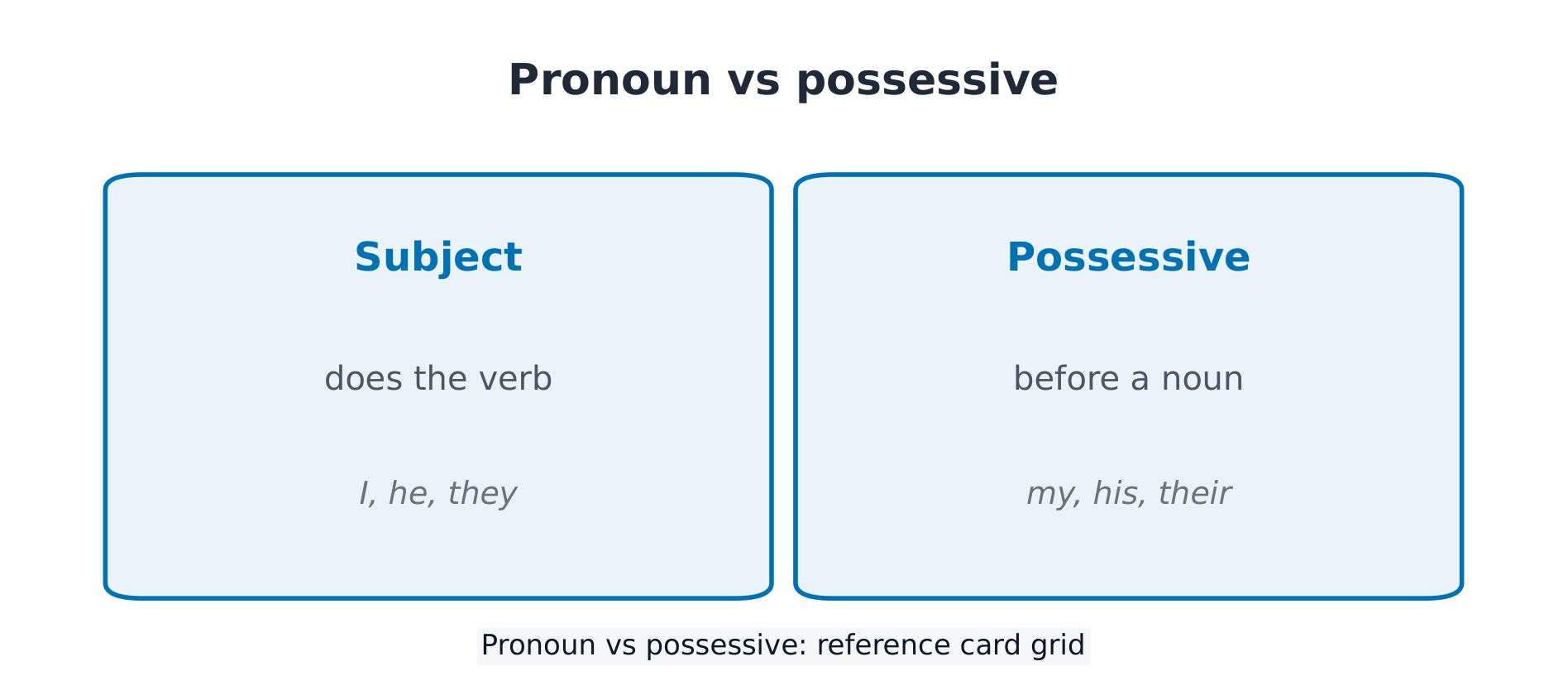
    Subject pronouns replace the subject and are placed before the verb:

    • I(I), you(you), he(he), she(she)
    • it(it), we(we), they(they)

    他He 是is 我的my 哥哥brother.

    He is my brother.

    我们We 喜欢like 音乐music.

    We like music.

    Key Usage Points:

    • I is always capitalized, regardless of its position in the sentence.
    • Things and animals commonly use it: This is my bag. It is new.(This is my bag. It is new.)*
    • Plural people or things both use they: The books are here. They are mine.(The books are here. They are mine.)*

    Note: Subject pronouns are followed by verbs; do not confuse them with object pronouns (me, him, her...) which will be learned later.

    Common Errors

    • ❌ ~~My mother is a doctor. He is very kind.~~ → ✓ She is very kind. — In colloquial Chinese, "he/she" sounds identical, but in English, he and she must be clearly distinguished.
    • ❌ ~~Me am a student.~~ → ✓ I am a student. — Use I for the subject, not me.
    • ❌ ~~My friend he is tall.~~ → ✓ My friend is tall. — The subject needs to be mentioned only once; avoid repeating "noun + pronoun" (the Chinese habit of saying "my friend he..." does not apply in English).
    • ❌ ~~Is raining.~~ → ✓ It is raining. — English sentences must have a subject; weather, time, and dates begin with it.
  • 3 Possessive adjectives · ⁨صفات الملكية⁩
    3.1

    my, your, his, her, our, their

    English

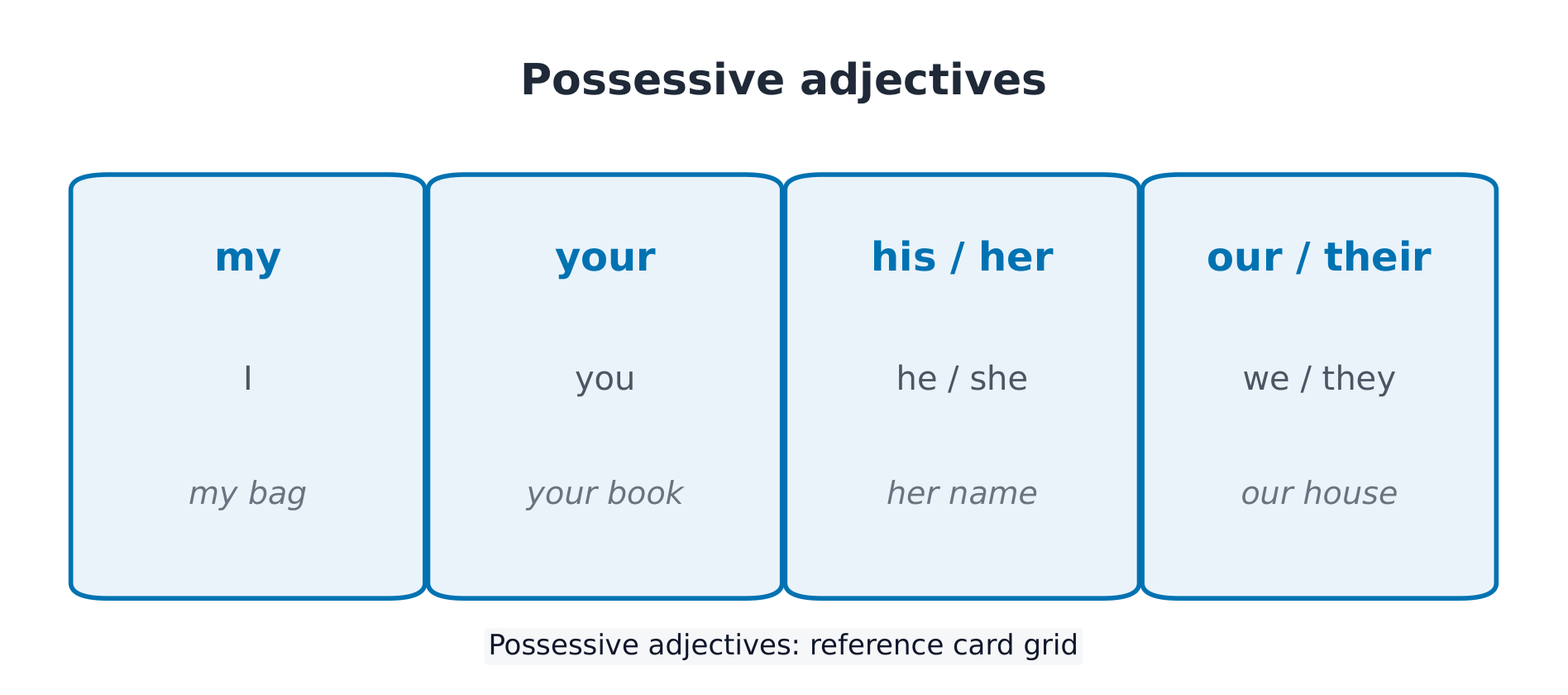
    Possessive adjectives indicate "whose" and are placed before the noun:

    • I → my(my), you → your(your), he → his(his)
    • she → her(her), it → its(its), we → our(our), they → their(their)

    这This 是is 我的my 包bag.

    This is my bag.

    她的Her 名字name 是is 露西Lucy.

    Her name is Lucy.

    Key Usage Points:

    • Possessive adjectives are always followed by a noun: my book, their house.
    • They do not change with noun number: my book, my books(my remains unchanged).

    Note: Be careful to distinguish its (its, no apostrophe) and it's (= it is). For example: The dog wags its tail.(The dog wags its tail.)*

    Common Errors

    • ❌ ~~This is she book.~~ → ✓ This is her book. — A possessive form must precede a noun: he → his, she → her.
    • ❌ ~~He is me friend.~~ → ✓ He is my friend. — The possessive form of I is my.
    • ❌ ~~The dog wags it's tail.~~ → ✓ …wags its tail. — it's = it is; "its" (possessive) has no apostrophe.
    • ❌ ~~Their is a park near here.~~ → ✓ There is a park near here. — their (their) and there (there/here) sound identical; do not mix them up in writing.
    العربية
    Possessive adjectives: my / your / his / her

    Possessive adjectives indicate "whose" and are placed before the noun:

    • I → my(my), you → your(your), he → his(his)
    • she → her(her), it → its(its), we → our(our), they → their(their)

    这This 是is 我的my 包bag.

    This is my bag.

    她的Her 名字name 是is 露西Lucy.

    Her name is Lucy.

    Key Usage Points:

    • Possessive adjectives are always followed by a noun: my book, their house.
    • They do not change with noun number: my book, my books(my remains unchanged).

    Note: Be careful to distinguish its (its, no apostrophe) and it's (= it is). For example: The dog wags its tail.(The dog wags its tail.)*

    Common Errors

    • ❌ ~~This is she book.~~ → ✓ This is her book. — A possessive form must precede a noun: he → his, she → her.
    • ❌ ~~He is me friend.~~ → ✓ He is my friend. — The possessive form of I is my.
    • ❌ ~~The dog wags it's tail.~~ → ✓ …wags its tail. — it's = it is; "its" (possessive) has no apostrophe.
    • ❌ ~~Their is a park near here.~~ → ✓ There is a park near here. — their (their) and there (there/here) sound identical; do not mix them up in writing.
  • 4 this, that, these, those
    4.1

    this and that

    English

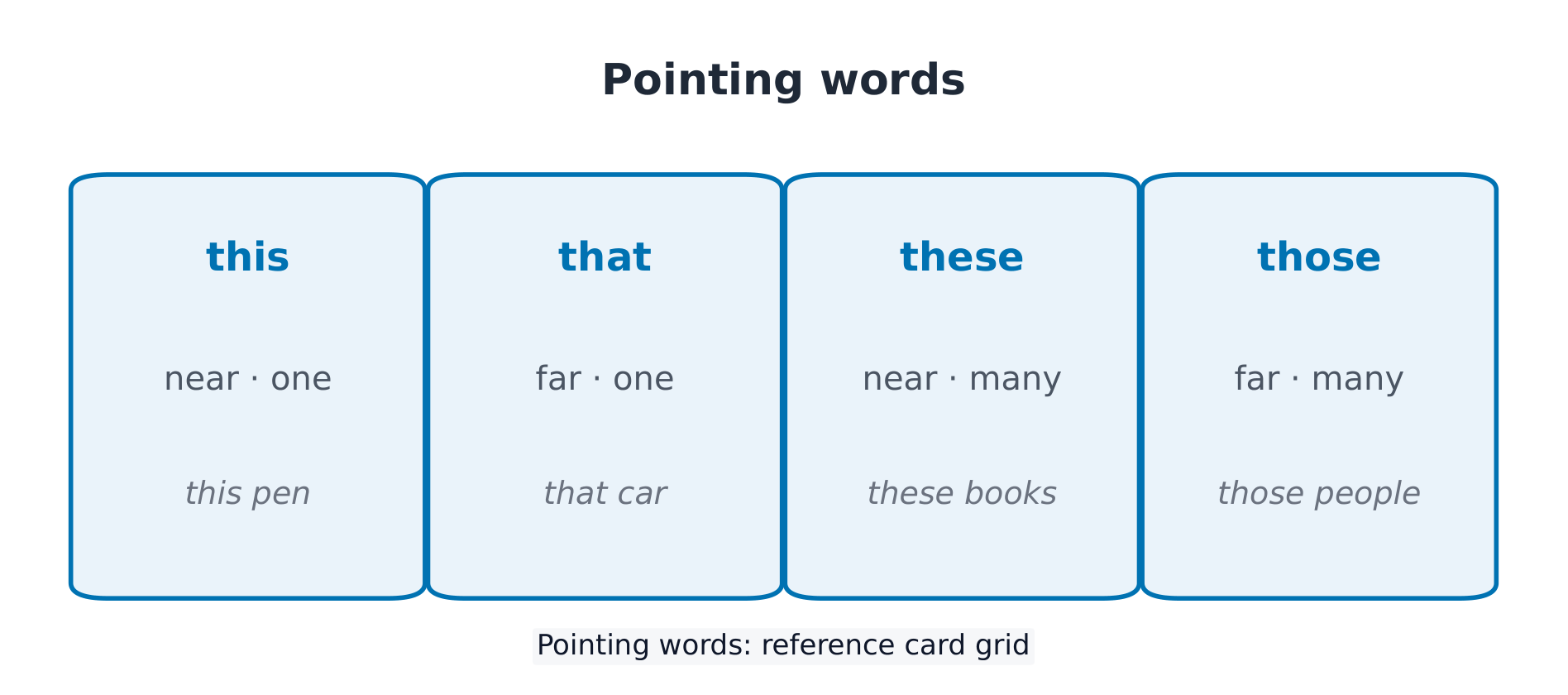
    Demonstratives point out "which one." Use this and that for singular:

    • this(this): Close to the speaker.
    • that(that): Far from the speaker.

    这This 是is 我的my 手机phone.

    This is my phone. (Close)

    那That 是is 你的your 车car.

    That is your car. (Far)

    العربية
    Near/Far × Singular/Plural: this / that / these / those

    Demonstratives point out "which one." Use this and that for singular:

    • this(this): Close to the speaker.
    • that(that): Far from the speaker.

    这This 是is 我的my 手机phone.

    This is my phone. (Close)

    那That 是is 你的your 车car.

    That is your car. (Far)

    4.2

    these and those

    English

    Use these and those for plural:

    • these(these): Close. those(those): Far.

    这些These 是are 我的my 书books.

    These are my books.

    那些Those 是are 她的her 朋友friends.

    Those are her friends.

    Contrastive Memory:

    • Near → this (singular) / these (plural).
    • Far → that (singular) / those (plural).

    Note: These / those are followed by plural nouns: these books, not ~~these book~~.

    Common Errors

    • ❌ ~~these book~~ → ✓ these books — Plural nouns must follow these / those.
    • ❌ ~~This books are mine.~~ → ✓ These books are mine. — If the noun is plural, the demonstrative must also be plural.
    • ❌ When introducing yourself on the phone, say ~~I am Tom.~~ → ✓ This is Tom. — In English, introduce yourself on the phone using this is.
    • Remember pairs: Near this / these are often used with here; far that / those are often used with there.
    العربية

    Use these and those for plural:

    • these(these): Close. those(those): Far.

    这些These 是are 我的my 书books.

    These are my books.

    那些Those 是are 她的her 朋友friends.

    Those are her friends.

    Contrastive Memory:

    • Near → this (singular) / these (plural).
    • Far → that (singular) / those (plural).

    Note: These / those are followed by plural nouns: these books, not ~~these book~~.

    Common Errors

    • ❌ ~~these book~~ → ✓ these books — Plural nouns must follow these / those.
    • ❌ ~~This books are mine.~~ → ✓ These books are mine. — If the noun is plural, the demonstrative must also be plural.
    • ❌ When introducing yourself on the phone, say ~~I am Tom.~~ → ✓ This is Tom. — In English, introduce yourself on the phone using this is.
    • Remember pairs: Near this / these are often used with here; far that / those are often used with there.
  • 5 a, an and plurals · ⁨a, an والجمع⁩
    5.1

    a and an

    English

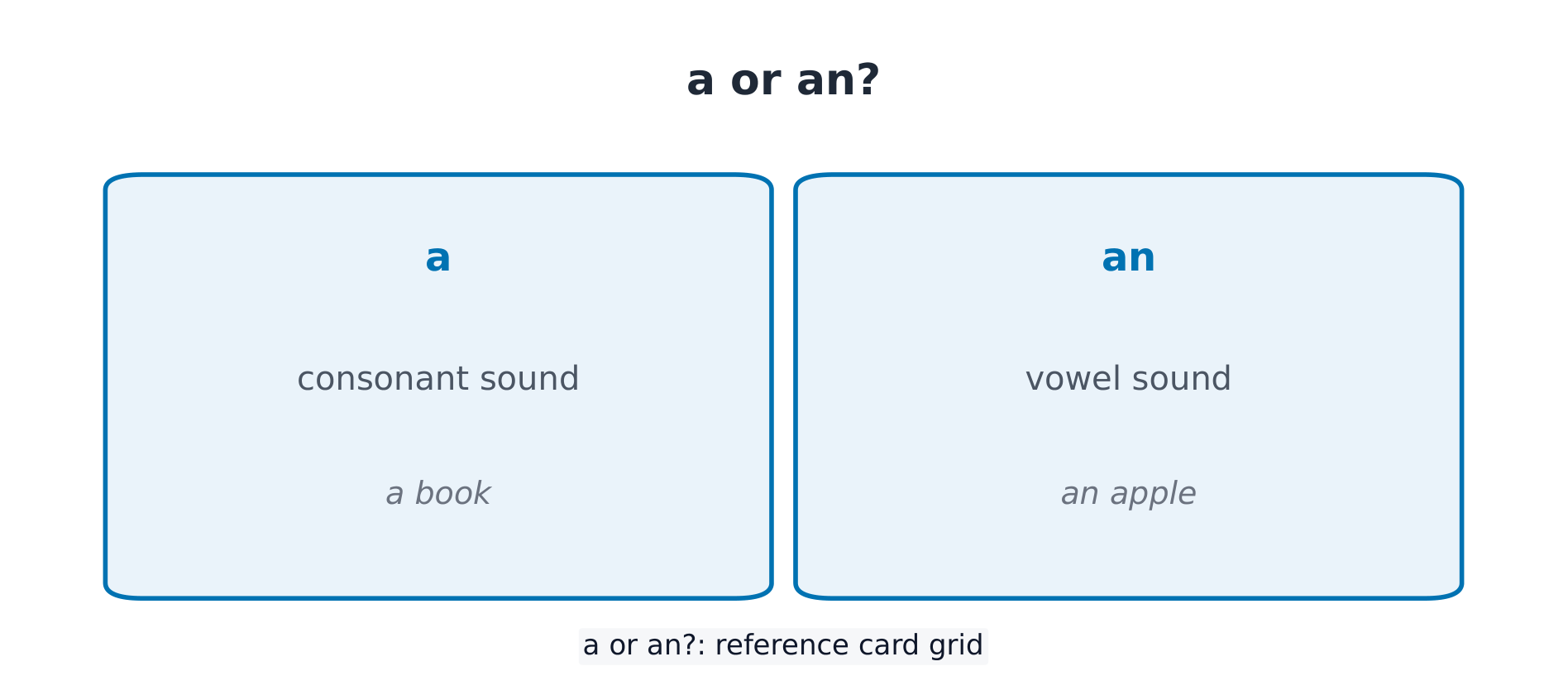
    a and an mean "one" and are used before singular countable nouns. How to choose depends on pronunciation:

    • a + consonant sound: a book, a dog, a cat.
    • an + vowel sound: an apple, an egg, an orange.

    我I 有have 一个a 笔pen.

    I have a pen.

    她She 吃eats 一个an 苹果apple.

    She eats an apple.

    Note: Look at the sound, not the letter: an hour (h is silent), a university (pronounced "yu-").

    العربية
    a / an: Look at pronunciation (consonant vs. vowel)

    a and an mean "one" and are used before singular countable nouns. How to choose depends on pronunciation:

    • a + consonant sound: a book, a dog, a cat.
    • an + vowel sound: an apple, an egg, an orange.

    我I 有have 一个a 笔pen.

    I have a pen.

    她She 吃eats 一个an 苹果apple.

    She eats an apple.

    Note: Look at the sound, not the letter: an hour (h is silent), a university (pronounced "yu-").

    5.2

    Plural Nouns

    English

    To indicate "more than one," use the plural form of the noun, usually adding -s:

    • Generally add -s: book → books, car → cars.
    • Words ending in -s / -sh / -ch / -x add -es: bus → buses, box → boxes.
    • Consonant + y ending: change y to i and add -es: baby → babies, city → cities.

    我I 有have 两two 猫cats.

    I have two cats.

    Irregular plurals (must memorize):

    • man → men, woman → women, child → children.
    • foot → feet, tooth → teeth, person → people.

    Note: Do not use a / an before plural nouns: ~~a books~~ ✗ → books / two books ✓.

    Common Errors

    • ❌ ~~I have dog.~~ → ✓ I have a dog. — In Chinese you can say "I have dogs," but singular countable nouns in English must have a / an (or my, the, etc.) before them.
    • ❌ ~~an university~~ → ✓ a university; ❌ ~~a hour~~ → ✓ an hour — Look at pronunciation, not spelling: university starts with a consonant sound /j/, and h is silent in hour.
    • ❌ ~~two book~~ → ✓ two books — Chinese nouns do not change for plurality, but nouns after numbers in English require -s; this is easily forgotten.
    • ❌ ~~three childs~~ → ✓ three children — Irregular plurals must be memorized separately: men, women, children, feet, teeth, people.
    • ❌ ~~a people~~ → ✓ a person (one person) / people (many people) — people is inherently plural.
    العربية

    To indicate "more than one," use the plural form of the noun, usually adding -s:

    • Generally add -s: book → books, car → cars.
    • Words ending in -s / -sh / -ch / -x add -es: bus → buses, box → boxes.
    • Consonant + y ending: change y to i and add -es: baby → babies, city → cities.

    我I 有have 两two 猫cats.

    I have two cats.

    Irregular plurals (must memorize):

    • man → men, woman → women, child → children.
    • foot → feet, tooth → teeth, person → people.

    Note: Do not use a / an before plural nouns: ~~a books~~ ✗ → books / two books ✓.

    Common Errors

    • ❌ ~~I have dog.~~ → ✓ I have a dog. — In Chinese you can say "I have dogs," but singular countable nouns in English must have a / an (or my, the, etc.) before them.
    • ❌ ~~an university~~ → ✓ a university; ❌ ~~a hour~~ → ✓ an hour — Look at pronunciation, not spelling: university starts with a consonant sound /j/, and h is silent in hour.
    • ❌ ~~two book~~ → ✓ two books — Chinese nouns do not change for plurality, but nouns after numbers in English require -s; this is easily forgotten.
    • ❌ ~~three childs~~ → ✓ three children — Irregular plurals must be memorized separately: men, women, children, feet, teeth, people.
    • ❌ ~~a people~~ → ✓ a person (one person) / people (many people) — people is inherently plural.
  • 6 there is and there are · ⁨there is و there are⁩
    6.1

    المفرد والجمع

    English

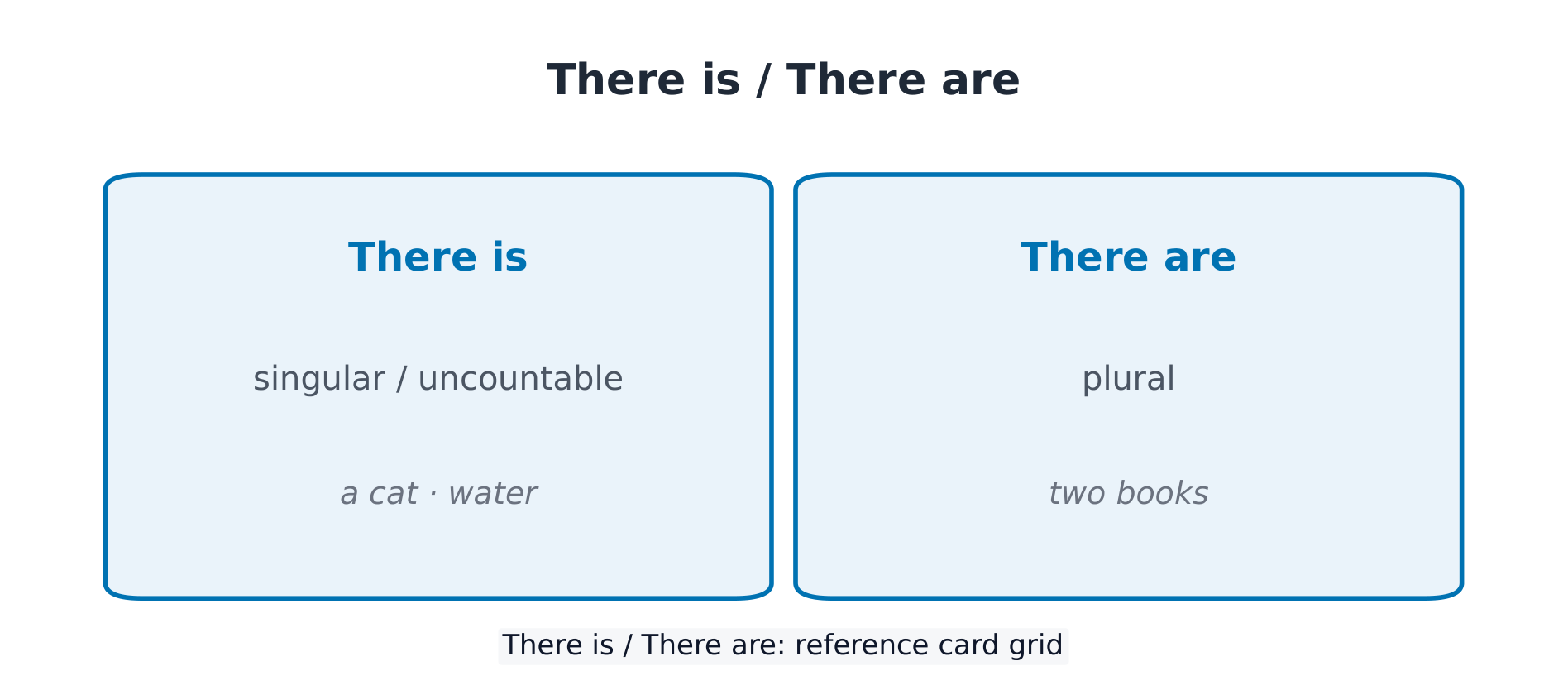
    there is / there are means "there exists" (something exists somewhere).

    • There is + singular / uncountable noun: There is a book.
    • There are + plural noun: There are two books.

    (有)There 有is 一只a 猫cat 在on (冠词)the 沙发上sofa.

    There is a cat on the sofa.

    (有)There 有are 三three 书books 在on (冠词)the 桌上desk.

    There are three books on the table.

    Note: In spoken English, there is is often contracted to there's: There's a problem.

    العربية
    There is (مفرد) / There are (جمع)

    there is / there are تُستخدم للتعبير عن "يوجد" (وجود شيء في مكان ما).

    • There is + اسم مفرد / غير معدود: There is a book.
    • There are + اسم جمع: There are two books.

    (有)There 有is 一只a 猫cat 在on (冠词)the 沙发上sofa.

    يوجد قطة على الأريكة.

    (有)There 有are 三three 书books 在on (冠词)the 桌上desk.

    هناك ثلاث كتب على الطاولة.

    ملاحظة: في المحادثة، غالبًا ما يُختصر there is إلى there's: There's a problem.

    6.2

    النفي والاستفهام

    English

    Negative: there is not / there are not (contracted as there isn't / there aren't).

    (有)There 没有isn't 任何any 牛奶milk.

    There is no milk left.

    Question: Move is / are to the front of there.

    (有吗)Is (有)there 一家a 银行bank 附近near 这里here?

    Is there a bank nearby?

    Short answer: Yes, there is. / No, there isn't.

    Note: Use any frequently in negative / question sentences: Is there any water? (Is there any water?)

    Common Errors

    • ❌ ~~Here has many people.~~ → ✓ There are many people here. — The "have" in the Chinese "There are many people here" indicates existence; use there is / there are in English, do not translate literally as have.
    • ❌ ~~There have a book on the desk.~~ → ✓ There is a book on the desk. — Use is / are after there; there have does not exist.
    • ❌ ~~There is two cats.~~ → ✓ There are two cats. — If the following noun is plural, use are.
    • ❌ ~~There are a milk.~~ → ✓ There is some milk. — milk is uncountable: use there is + some, do not use a.
    العربية

    النفي: there is not / there are not (يُختصر إلى there isn't / there aren't).

    (有)There 没有isn't 任何any 牛奶milk.

    لم يعد هناك حليب.

    السؤال: نضع is / are قبل there.

    (有吗)Is (有)there 一家a 银行bank 附近near 这里here?

    هل يوجد بنك في هذه المنطقة؟

    الإجابة المختصرة: Yes, there is. / No, there isn't.

    ملاحظة: في الجمل المنفية والسؤالية، نستخدم عادةً any: Is there any water? (هل يوجد ماء؟)

    ** الأخطاء الشائعة **

    • ❌ ~~Here has many people.~~ → ✓ There are many people here. — كلمة "يوجد" في الجملة الصينية "هنا الكثير من الناس" تعني الوجود، وفي الإنجليزية نستخدم there is / there are، ولا يمكن ترجمتها حرفيًا باستخدام have.
    • ❌ ~~There have a book on the desk.~~ → ✓ There is a book on the desk. — بعد there نستخدم is / are، ولا توجد صيغة "there have".
    • ❌ ~~There is two cats.~~ → ✓ There are two cats. — لأن الاسم الذي يليها جمع، نستخدم are.
    • ❌ ~~There are a milk.~~ → ✓ There is some milk. — الحليب اسم غير معدود: نستخدم there is + some، ولا نستخدم a.
  • 7 have got
    7.1

    have got / has got

    English

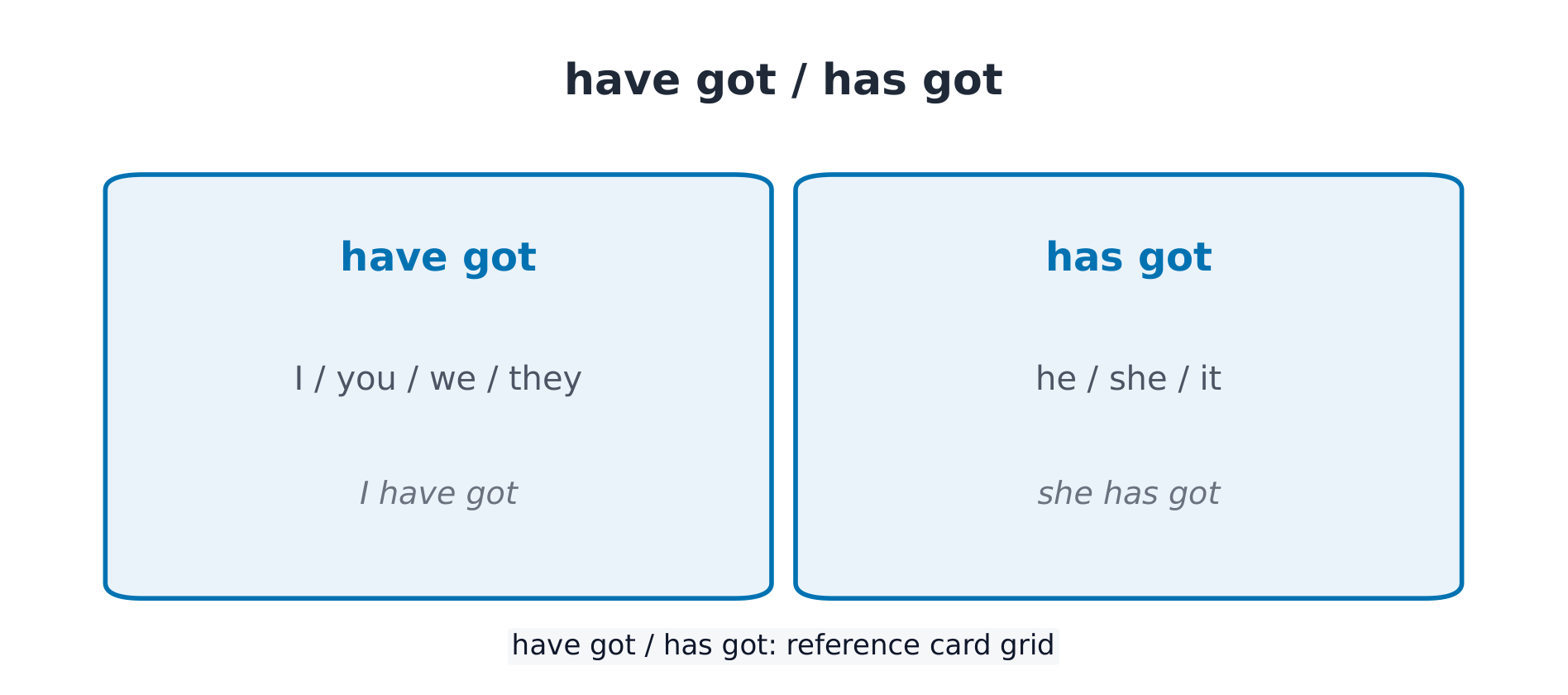
    have got means "to possess" (= have), common in British English.

    • I / you / we / they → have got
    • he / she / it → has got

    我I 有have got 一个a 兄弟brother.

    I have a brother. (= I have a brother.)

    她She 有has got 蓝色blue 眼睛eyes.

    She has blue eyes.

    Note: Often contracted in spoken language: I've got, she's got, they've got. Same meaning as have / has.

    العربية
    have got / has got

    have got تُعبر عن "امتلاك" (= have)، وشائعة جدًا في اللغة الإنجليزية البريطانية.

    • I / you / we / they → have got
    • he / she / it → has got

    我I 有have got 一个a 兄弟brother.

    لدي أخ. (= I have a brother.)

    她She 有has got 蓝色blue 眼睛eyes.

    لها عيون زرقاء.

    ملاحظة: في المحادثة يُختصر غالبًا: I've got, she's got, they've got. لها نفس معنى have / has.

    7.2

    النفي والاستفهام

    English

    Negative: haven't got / hasn't got.

    他He 没有hasn't got 一辆a 车car.

    He doesn't have a car.

    Question: Move Have / Has to the front of the subject.

    (有吗)Have 你you 有got 一支a 笔pen?

    Do you have a pen?

    Short answer: Yes, I have. / No, I haven't.

    Note: have got is mostly used for current possession; for past or habits, use regular have / had.

    Common Errors

    • ❌ ~~She have got long hair.~~ → ✓ She has got long hair. — Use has got for he / she / it.
    • ❌ ~~I have got not a car.~~ → ✓ I haven't got a car. — Place not after have / has, then contract.
    • ❌ ~~Do you have got a pen?~~ → ✓ Have you got a pen? / Do you have a pen? — Both question forms are correct, but never mix them.
    • ❌ ~~Yes, I have got.~~ → ✓ Yes, I have. — Short answers end at have / has, without got.
    العربية

    النفي: haven't got / hasn't got.

    他He 没有hasn't got 一辆a 车car.

    ليس لديه سيارة.

    السؤال: نضع Have / Has قبل الفاعل.

    (有吗)Have 你you 有got 一支a 笔pen?

    هل لديك قلم؟

    الإجابة المختصرة: Yes, I have. / No, I haven't.

    ملاحظة: تُستخدم have got بشكل رئيسي للتعبير عن حالة "الامتلاك" الحالية؛ أما عند التحدث عن الماضي أو العادة، فنستخدم still have / had العادية.

    ** الأخطاء الشائعة **

    • ❌ ~~She have got long hair.~~ → ✓ She has got long hair. — مع he / she / it نستخدم has got.
    • ❌ ~~I have got not a car.~~ → ✓ I haven't got a car. — نضع not بعد have / has، ثم نختصر.
    • ❌ ~~Do you have got a pen?~~ → ✓ Have you got a pen? / Do you have a pen? — كلا الصيغتين صحيحتان، لكن لا يمكن دمجهم في جملة واحدة.
    • ❌ ~~Yes, I have got.~~ → ✓ Yes, I have. — الإجابة المختصرة تقتصر على have / has فقط، دون إضافة got.
  • 8 Present simple · ⁨المضارع البسيط⁩
    8.1

    العادات والثالث شخص -s

    English

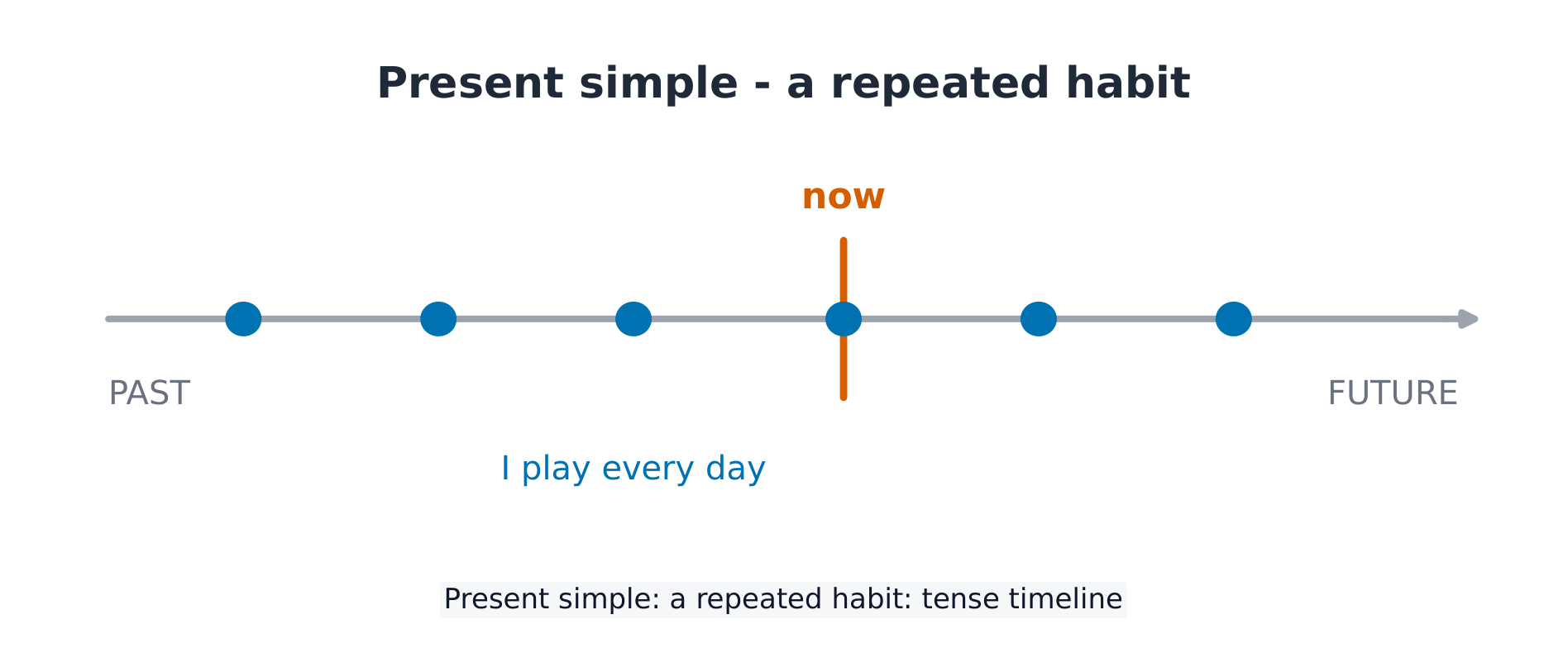
    Present simple (present simple) describes habits and facts. The base form is the infinitive (base verb).

    我I 喜欢like 茶tea.

    I like tea.

    When the subject is he / she / it, add -s to the verb:

    他He 踢plays 足球football.

    He plays football.

    Spelling rules:

    • Generally add -s: like → likes.
    • Words ending in -s / -sh / -ch / -x / -o add -es: go → goes, watch → watches.
    • Consonant + y ending: change y to i and add -es: study → studies.

    Note: Only he / she / it take -s; I / you / we / they use the base form: They like tea.

    العربية
    المضارع البسيط: العادات المتكررة

    زمن المضارع البسيط (present simple) يُستخدم للحديث عن العادات والحقائق. الشكل الأساسي هو فعل المصدر.

    我I 喜欢like 茶tea.

    أنا أحب الشاي.

    إذا كان الفاعل he / she / it، نضيف للفعل -s:

    他He 踢plays 足球football.

    هو يلعب كرة القدم.

    ** الإملاء:**

    • نضيف -s بشكل عام: like → likes.
    • إذا انتهى الفعل بـ -s / -sh / -ch / -x / -o، نضيف -es: go → goes, watch → watches.
    • حرف ساكن + y، نحول y إلى i ونضيف -es: study → studies.

    ملاحظة: نضيف -s فقط مع he / she / it؛ أما مع I / you / we / then نستخدم الفعل في المصدر: They like tea.

    8.2

    النفي والاستفهام

    English

    For negatives and questions, use auxiliary verbs do / does (does for he / she / it).

    Negative: Subject + don't / doesn't + base verb.

    我I 不don't 喜欢like 咖啡coffee.

    I don't like coffee.

    Question: Do / Does + Subject + base verb ?

    (助动词)Does 她she 住live 这里here?

    Does she live here?

    Note: When using do / does, the verb returns to its base form (no -s): ~~Does she lives~~ ✗ → Does she live ✓.

    Common Errors

    • ❌ ~~He go to school by bus.~~ → ✓ He goes to school by bus. — Forgetting to add -s in third person singular is the most frequent error; check your work afterwards.
    • ❌ ~~She doesn't likes coffee.~~ → ✓ She doesn't like coffee. — When using does / doesn't, the verb returns to its base form.
    • ❌ ~~I very like English.~~ → ✓ I like English very much. — "Very much" in Chinese cannot be translated literally; very cannot directly modify a verb.
    • ❌ ~~You like tea?~~ → ✓ Do you like tea? — Questions must start with do / does; rising intonation alone is insufficient.
    العربية
    عادات يومية: I have breakfast every morning.

    للنفي والسؤال نستخدم الفعل المساعد do / does (نستخدم does مع he / she / it).

    النفي: الفاعل + don't / doesn't + فعل المصدر.

    我I 不don't 喜欢like 咖啡coffee.

    لا أحب القهوة.

    السؤال: Do / Does + الفاعل + فعل المصدر ؟

    (助动词)Does 她she 住live 这里here?

    هل تعيش هنا؟

    ملاحظة: عند استخدام do / does، يعود الفعل إلى المصدر (بدون إضافة -s): ~~Does she lives~~ ✗ → Does she live ✓.

    ** الأخطاء الشائعة **

    • ❌ ~~He go to school by bus.~~ → ✓ He goes to school by bus. — نسيان إضافة -s للضمير الغائب المفرد هو الخطأ الأكثر شيوعًا، تأكد من مراجعته بعد الكتابة.
    • ❌ ~~She doesn't likes coffee.~~ → ✓ She doesn't like coffee. — عند استخدام does / doesn't، يعود الفعل إلى المصدر.
    • ❌ ~~I very like English.~~ → ✓ I like English very much. — لا يمكن ترجمة "يحب كثيرًا" حرفيًا؛ لا يمكن استخدام very لوصف الفعل مباشرة.
    • ❌ ~~You like tea?~~ → ✓ Do you like tea? — يجب أن تبدأ الجمل الاستفهامية بـ do / does، ولا يمكن الاعتماد فقط على ارتفاع النبرة.
  • 9 can
    9.1

    القدرة والطلب

    English

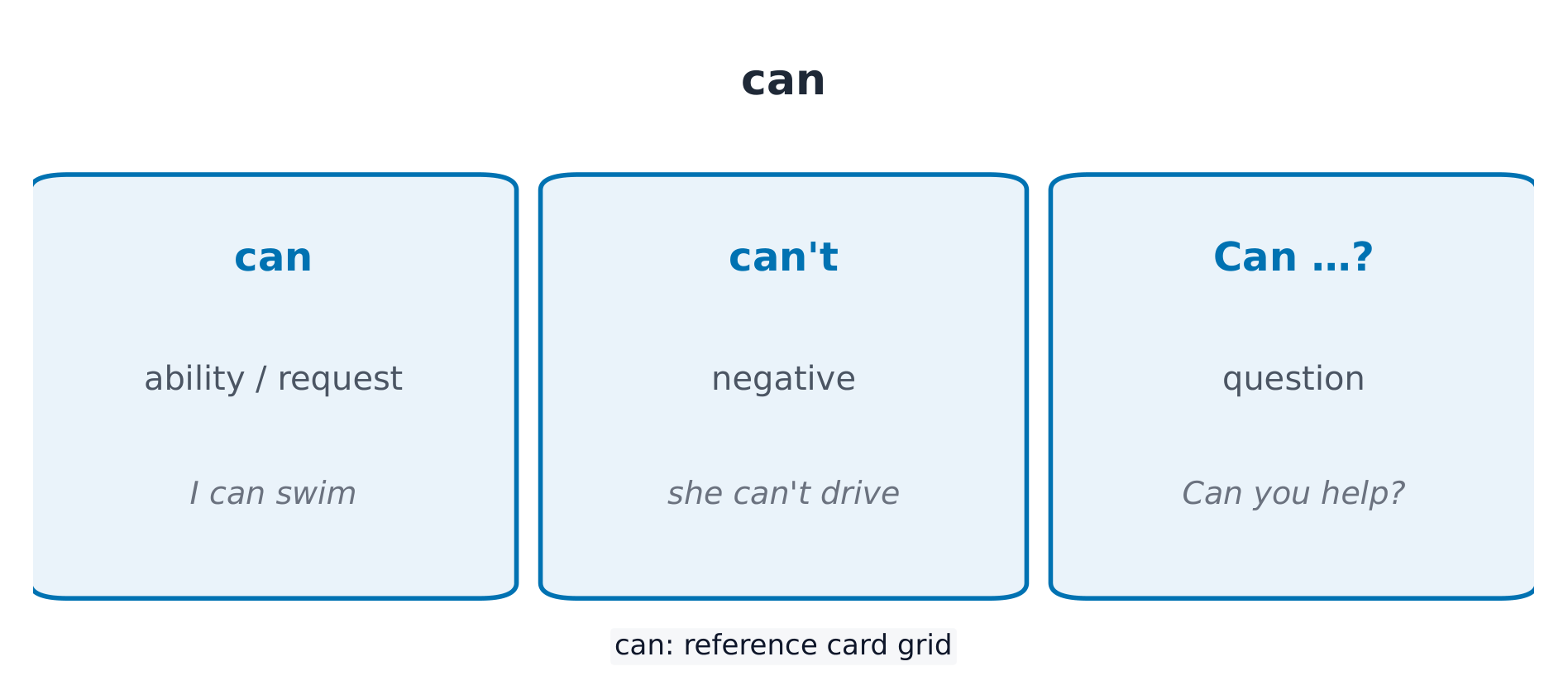
    can expresses ability ("know how to / be able to") or is used for requests. It is followed by the base form of the verb, and remains the same for all persons.

    我I 会can 游泳swim.

    I can swim.

    能Can 你you 帮help 我me?

    Can you help me?

    Note: Use the base form after can: ~~can to swim~~ ✗, ~~can swims~~ ✗ → can swim ✓.

    العربية
    can: القدرة، النفي، السؤال

    can تُعبر عن القدرة ("يعرف كيف / يستطيع") أو تُستخدم لـ الطلب. يأتي بعدها فعل المصدر، وتبقى كما هي لجميع الضمائر.

    我I 会can 游泳swim.

    أنا أعرف السباحة.

    能Can 你you 帮help 我me?

    هل يمكنك مساعدتي؟

    ملاحظة: بعد can نستخدم المصدر: ~~can to swim~~ ✗، ~~can swims~~ ✗ → can swim ✓.

    9.2

    النفي والاستفهام

    English

    Negative: cannot (abbreviation can't) + base form of the verb.

    她She 不会can't 开车drive.

    She cannot drive.

    Question: Place Can before the subject.

    能Can 他he 做饭cook?

    Can he cook?

    Short answer: Yes, I can. / No, I can't.

    Note: can has no -s and does not use do/does: ask directly with Can he…?, not ~~Does he can…?~~

    Common Errors

    • ❌ ~~She cans drive.~~ → ✓ She can drive. — can has no third-person singular -s; it is the same for all persons.
    • ❌ ~~I don't can swim.~~ → ✓ I can't swim. — The negative of can is formed directly with not (can't), without using don't.
    • ❌ ~~He can sings very good.~~ → ✓ He can sing very well. — Use the base form of the verb after can; use the adverb well to modify a verb, not good.
    • ❌ ~~You can help me?~~ → ✓ Can you help me? — When making a request, place can before the subject.
    العربية

    النفي: cannot (يُختصر إلى can't) + فعل المصدر.

    她She 不会can't 开车drive.

    لا تستطيع القيادة.

    السؤال: نضع Can قبل الفاعل.

    能Can 他he 做饭cook?

    هل يطبخ؟

    الإجابة المختصرة: Yes, I can. / No, I can't.

    ملاحظة: can لا تأخذ -s ولا تستخدم do / does: نستخدم السؤال مباشرة Can he…?، وليس ~~Does he can…?~~

    ** الأخطاء الشائعة **

    • ❌ ~~She cans drive.~~ → ✓ She can drive. — can لا تأخذ -s للضمير الغائب، وتبقى متطابقة لجميع الضمائر.
    • ❌ ~~I don't can swim.~~ → ✓ I can't swim. — نفي can يكون بإضافة not مباشرة (can't)، ولا نستخدم don't.
    • ❌ ~~He can sings very good.~~ → ✓ He can sing very well. — بعد can نستخدم فعل المصدر؛ ولوصف الفعل نستخدم الظرف well، لا الصفة good.
    • ❌ ~~You can help me?~~ → ✓ Can you help me? — عند طلب المساعدة من شخص آخر، نرفع Can قبل الفاعل.
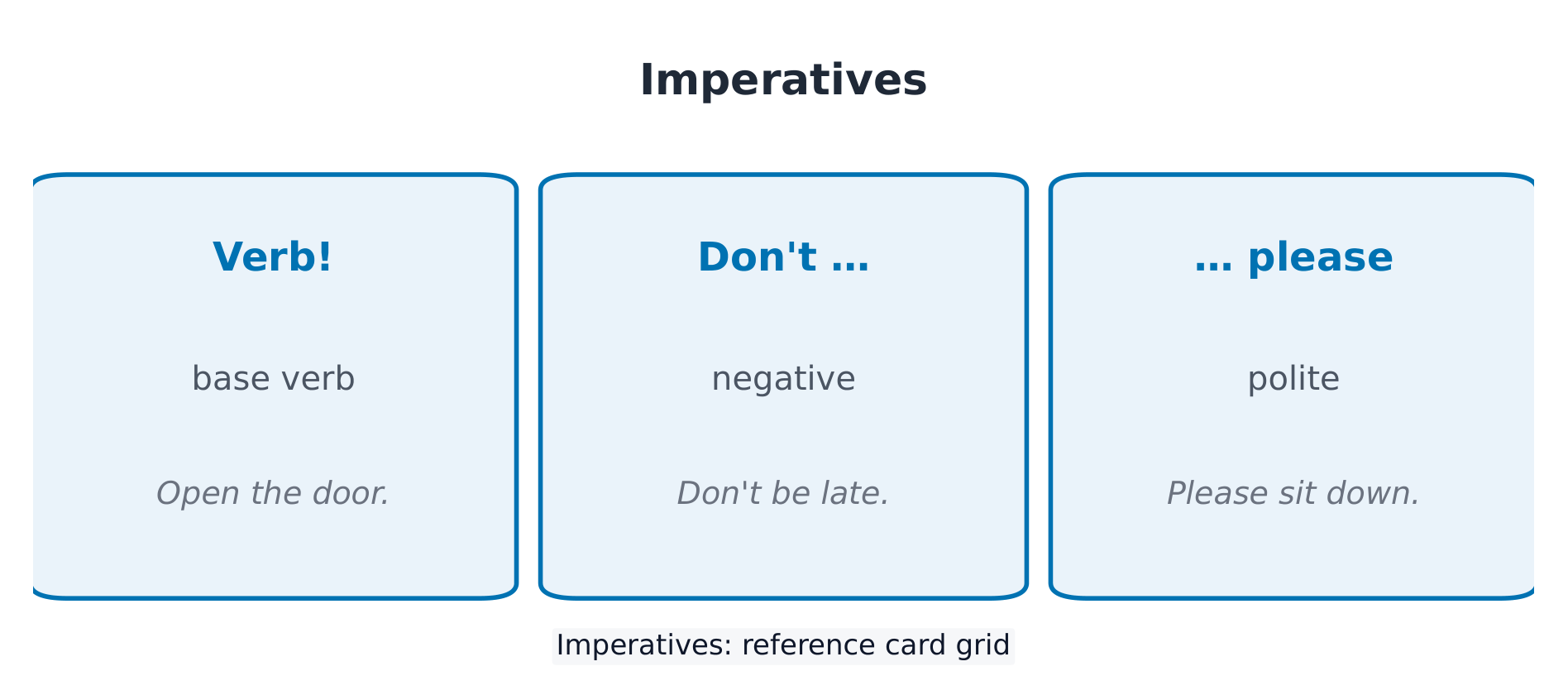
  • 10 Imperatives · ⁨الصيغة الأمرية⁩
    10.1

    الأمر والتوجيه

    English

    Imperatives are used to give commands, provide instructions, or make requests. Start directly with the base form of the verb, without a subject.

    打开Open (冠词)the 门door 请, please.

    Please open the door.

    坐Sit 下down.

    Sit down.

    Negative: Add Don't at the beginning.

    不要Don't (是)be 迟到late.

    Don't be late.

    Key Usage Points:

    • Add please to be more polite: Please come in.
    • Also used for directions and instructions: Turn left. Mix the eggs.

    Note: Do not write a subject in imperatives: ~~You open the door~~ (for a command) → Open the door.

    Common Errors

    • ❌ ~~Please open door.~~ → ✓ Please open the door. — Articles must still be included in imperatives.
    • ❌ ~~Don't to touch it.~~ → ✓ Don't touch it. — Follow don't directly with the base form of the verb; do not add to.
    • ❌ ~~No talk in class!~~ → ✓ Don't talk in class! / No talking! — To prohibit an action, use don't + base form; after no, use -ing or a noun.
    • ❌ ~~You sit down!~~ → ✓ Sit down, please. — Adding you to a command sounds angry; add please for politeness, or change to Can you…?
    العربية
    جملة الأمر: الأمر، النفي، الطلب

    جمل الأمر (imperatives) تُستخدم لإصدار الأوامر أو تقديم التعليمات أو طرح الطلبات. تبدأ مباشرة بـ فعل المصدر، بدون فاعل.

    打开Open (冠词)the 门door 请, please.

    يرجى فتح الباب.

    坐Sit 下down.

    اجلس.

    النفي: نضع Don't قبل الفعل.

    不要Don't (是)be 迟到late.

    لا تتأخر.

    ** نقاط الاستخدام:**

    • إضافة please تجعلها أكثر أدبًا: Please come in. (تفضل بالدخول.)
    • تُستخدم أيضًا في المسارات والتعليمات: Turn left. (انعطف يسارًا.) Mix the eggs. (اخفق البيض.)

    ملاحظة: جمل الأمر لا تكتب فيها الفاعل: ~~You open the door~~ (عند إصدار أمر) → Open the door.

    ** الأخطاء الشائعة **

    • ❌ ~~Please open door.~~ → ✓ Please open the door. — أداة التعريف لا يمكن حذفها حتى في جمل الأمر.
    • ❌ ~~Don't to touch it.~~ → ✓ Don't touch it. — بعد don't نضع فعل المصدر مباشرة، دون to.
    • ❌ ~~No talk in class!~~ → ✓ Don't talk in class! / No talking! — لمنع فعل ما نستخدم don't + المصدر؛ أما بعد no فنستخدم -ing أو اسماً.
    • ❌ ~~You sit down!~~ → ✓ Sit down, please. — إضافة you للأمر تجعله يبدو غاضبًا؛ لتكون مؤدبًا أضف please، أو حوّل السؤال إلى Can you…?
  • 11 Question words · ⁨كلمات الاستفهام⁩
    11.1

    what, where, who

    English

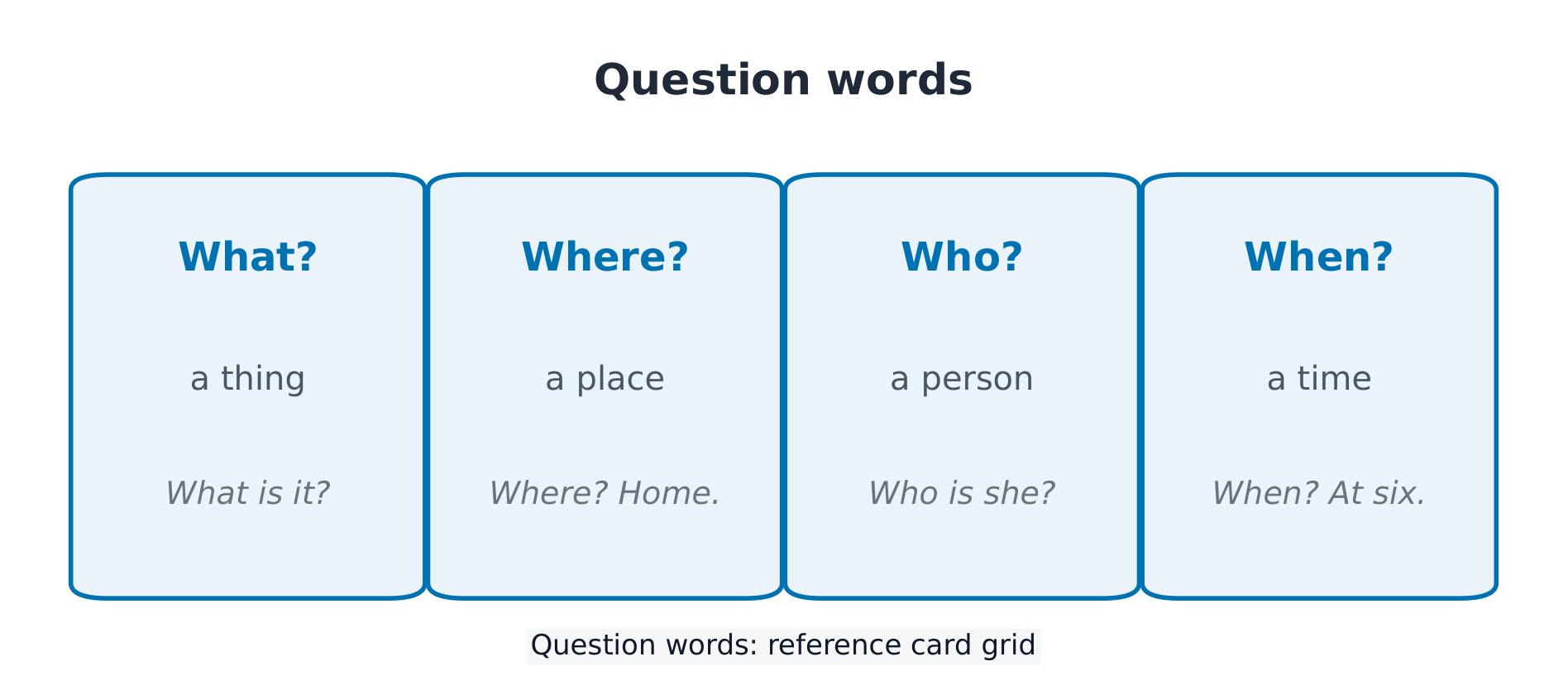
    Question words are placed at the beginning of a question to ask for specific information.

    • what (what), where (where), who (who)

    什么What 是is 你的your 名字name?

    What's your name?

    哪里Where (助动词)do 你you 住live?

    Where do you live?

    谁Who 是is 那个that 男人man?

    Who is that man?

    Note: A be verb or auxiliary do/does often follows the question word: Where do you work?

    العربية
    أدوات الاستفهام: سؤال عن الأشياء/المكان/الشخص/الوقت

    كلمات الاستفهام (question words) تأتي في بداية السؤال لتسأل عن معلومات محددة.

    • what(ماذا/أي شيء)، where(أين)، who(من)

    什么What 是is 你的your 名字name?

    ما اسمك؟

    哪里Where (助动词)do 你you 住live?

    أين تسكن؟

    谁Who 是is 那个that 男人man?

    من ذلك الرجل؟

    تنبيه: غالبًا ما يأتي بعد كلمات الاستفهام فعل كينونة be أو الفعل المساعد do / does: Where do you work?

    11.2

    متى، لماذا، كيف

    English
    • when (when), why (why), how (how / in what way)

    什么时候When 是is (冠词)the 派对party?

    When is the party?

    为什么Why (是)are 你you 难过sad?

    Why are you sad?

    怎么How (助动词)do 你you 拼写spell 它it?

    How do you spell this?

    Note: how can also combine with adjectives to ask about degree: How old are you? How much is it?

    Common Errors

    • ❌ ~~Where you live?~~ → ✓ Where do you live? — After the question word, you still need do/does or be; you cannot follow directly with the subject.
    • ❌ ~~What means this word?~~ → ✓ What does this word mean? — mean is an ordinary verb: question word + does + subject + base form.
    • ❌ ~~Why you are late?~~ → ✓ Why are you late? — When there is a be verb in the sentence, move be before the subject.
    • ❌ ~~How to spell it?~~ → ✓ How do you spell it? — A literal translation of "How to spell?" loses the subject and auxiliary verb; these must be added.
    العربية
    • when(متى)، why(لماذا)، how(كيف / بماذا)

    什么时候When 是is (冠词)the 派对party?

    متى الحفل؟

    为什么Why (是)are 你you 难过sad?

    لماذا أنت حزين؟

    怎么How (助动词)do 你you 拼写spell 它it?

    كيف تُكتب هذه الكلمة؟

    تنبيه: يمكن أن يأتي how أيضًا مع الصفة للسؤال عن الدرجة: How old are you?(كم عمرك؟) How much is it?(كم سعره؟)

    ** الأخطاء الشائعة **

    • ❌ ~~Where you live?~~ → ✓ Where do you live? — بعد كلمة الاستفهام يجب وجود do / does أو be، ولا يمكن أن يتبعها الفاعل مباشرةً.
    • ❌ ~~What means this word?~~ → ✓ What does this word mean? — mean فعل عادي: كلمة الاستفهام + does + الفاعل + المصدر.
    • ❌ ~~Why you are late?~~ → ✓ Why are you late? — عندما يحتوي الجملة على فعل be، يتم وضع be قبل الفاعل.
    • ❌ ~~How to spell it?~~ → ✓ How do you spell it? — الترجمة الحرفية للعبارة الصينية "كيف تكتبها؟" تفقد الفاعل والفعل المساعد، لذا يجب إكمالهما.
  • 12 Prepositions of place · ⁨حروف الجر المكانية⁩
    12.1

    في، على، تحت

    English

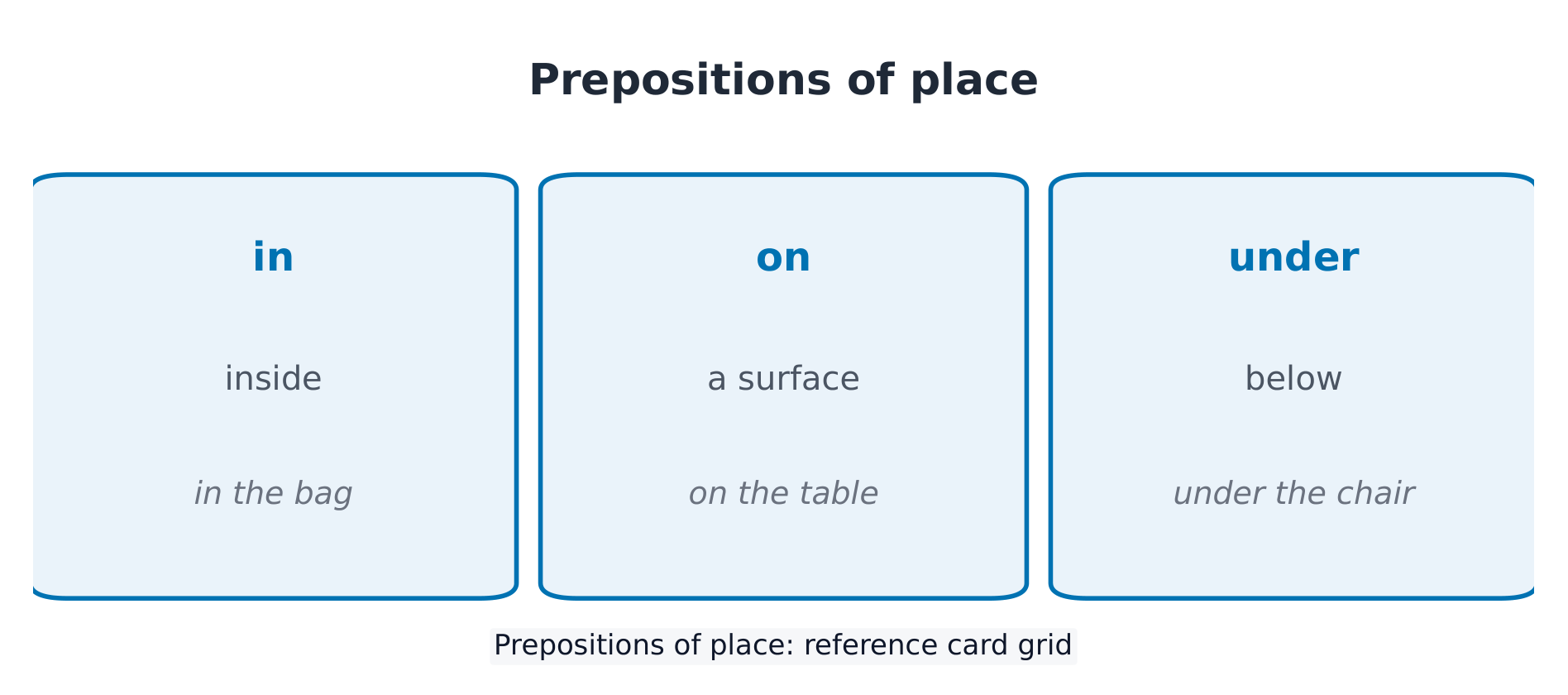
    Prepositions of place indicate where something is located.

    • in (inside...), on (on top of... / surface), under (below...)

    (冠词)The 钥匙keys 在are 在...里in (冠词)the 包里bag.

    The key is in the bag.

    (冠词)The 书book 在is 在...上on (冠词)the 桌上table.

    The book is on the table.

    (冠词)The 猫cat 在is 在...下under (冠词)the 椅子下chair.

    The cat is under the chair.

    العربية
    حروف الجر للمكان: in / on / under

    حروف جر المكان (prepositions of place) توضح أين يكون الشيء.

    • in(في داخل...)، on(على... / السطح)، under(تحت...)

    (冠词)The 钥匙keys 在are 在...里in (冠词)the 包里bag.

    المفتاح في الحقيبة.

    (冠词)The 书book 在is 在...上on (冠词)the 桌上table.

    الكتاب على الطاولة.

    (冠词)The 猫cat 在is 在...下under (冠词)the 椅子下chair.

    القطة تحت الكرسي.

    12.2

    بجانب، بين، خلف

    English
    • next to (beside...), between (between...), behind (behind...), in front of (in front of...)

    (冠词)The 商店shop 在is 旁边next to (冠词)the 银行bank.

    The shop is next to the bank.

    她She 坐sits 之间between 汤姆Tom 和and 萨姆Sam.

    She sits between Tom and Sam.

    Note: between means "between two," and is usually followed by A and B: between the door and the window.

    Common Errors

    • ❌ ~~The picture is in the wall.~~ → ✓ The picture is on the wall. — Hanging "on" the wall involves surface contact, so use on.
    • ❌ ~~I read it on the book.~~ → ✓ ...in the book. — Content "inside" a book uses in; people in photos also use in the photo.
    • ❌ ~~The shop is next the bank.~~ → ✓ next to the bank — next to is two words; to cannot be omitted.
    • ❌ ~~between the door with the window~~ → ✓ between the door and the window — between takes the fixed collocation A and B.
    العربية
    • next to(بجانب...)، between(بين...)، behind(خلف...)، in front of(أمام...)

    (冠词)The 商店shop 在is 旁边next to (冠词)the 银行bank.

    المتجر بجانب البنك.

    她She 坐sits 之间between 汤姆Tom 和and 萨姆Sam.

    هي جالس بين توم وسام.

    **تنبيه:**来表示 "بين شيئين"، يأتي عادةً بعدها A and B: between the door and the window.

    ** الأخطاء الشائعة **

    • ❌ ~~The picture is in the wall.~~ → ✓ The picture is on the wall. — عندما يُعلق الصورة "على" الجدار، يكون هناك تماس على السطح، نستخدم on.
    • ❌ ~~I read it on the book.~~ → ✓ ...in the book. — المحتوى الموجود "داخل" الكتاب يستخدم in؛ والأشخاص في الصور يستخدمون أيضًا in the photo.
    • ❌ ~~The shop is next the bank.~~ → ✓ next to the bank — next to تتكون من كلمتين، لا يمكن حذف to.
    • ❌ ~~between the door with the window~~ → ✓ between the door and the window — بين fixed collocation A and B.

Log in or create account · ⁨تسجيل الدخول أو إنشاء حساب⁩

IGCSE, A-Level & AP